
Belhaven in Beaufort County, North Carolina — The American South (South Atlantic)
Aquascogoc

Photographed by Steve Stoessel, May 13, 2026
1. Aquascogoc Marker
Erected 2013 by North Carolina Office of Archives and History. (Marker Number B 72.)
Topics. This historical marker is listed in these topic lists: Colonial Era • Indigenous Peoples and Communities. A significant historical date for this entry is July 18, 1585.
Location. 35° 32.811′ N, 76° 37.868′ W. Marker is in Belhaven, North Carolina, in Beaufort County. It is at the intersection of Main Street and Mill Street, on the right when traveling east on Main Street. Touch for map. Marker is in this post office area: Belhaven NC 27810, United States of America. Touch for directions.

Regionally, this marker is in North Carolina’s Coastal Plain. It is also in the American South, specifically in the Upper South, in the Tidewater, and on the Eastern Seaboard. Globally, it is in the North Atlantic Region, North America, the Western Hemisphere, the Western World, and the Anglosphere. Historically, it finds itself in what was once the territory of the Mississippian Culture, one of the original
this page online
Other nearby markers. At least 8 other markers are within 12 miles of this marker, measured as the crow flies: Belhaven is the Town that the Lumber Industry and the Railroad Built (approx. 0.6 miles away); Christopher Gale (approx. 11.1 miles away); Colonial Bath (approx. 11.3 miles away); Historic Bath (approx. 11.3 miles away); a different marker also named Colonial Bath (approx. 11.4 miles away); Matthew Rowan (approx. 11.4 miles away); Palmer-Marsh House (approx. 11.4 miles away); First Public Library (approx. 11.4 miles away).
Also see . . . Aquascogoc (Wikipedia).
The Aquascogoc is the name given to a Native American tribe of Secotan people and also the name of a village encountered by English colonists during their late 16th century attempts to settle and establish permanent colonies in what is now North Carolina, known at the time as Virginia. Together with the rest of Secotan people they formed a part of the Native American group known as the Carolina Algonquian Indians, and spoke the now extinct Carolina Algonquian language.

Photographed by Steve Stoessel, May 13, 2026
2. Aquascogoc Marker
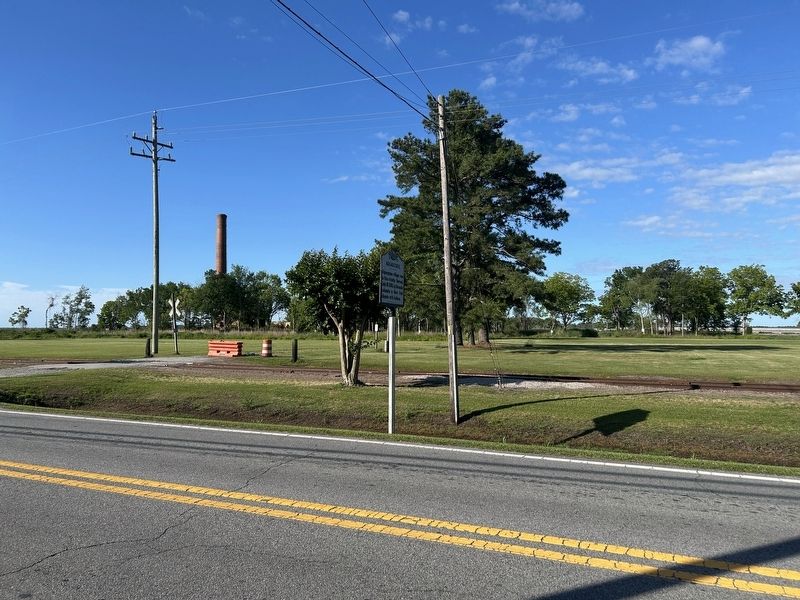
Photographed by Steve Stoessel, May 13, 2026
3. Aquascogoc Marker
Credits. This page was last revised on May 13, 2026. It was originally submitted on May 13, 2026, by Steve Stoessel of Niskayuna, New York. This page has been viewed 13 times since then. Photos: 1, 2, 3. submitted on May 13, 2026, by Steve Stoessel of Niskayuna, New York.
