
Old Town in Alexandria, Virginia — The American South (Mid-Atlantic)
The Civil War and Battery Rodgers
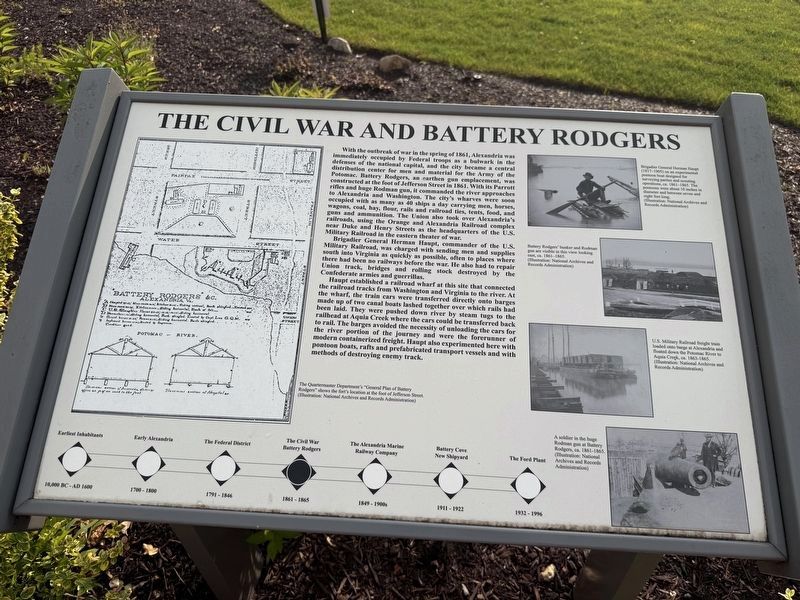
With the outbreak of war in the spring in 1861, Alexandria was immediately occupied by Federal troops as a bulwark in the defenses of the national capital, and the city became a central distribution center for men and material for the Army of the Potomac. Battery Rodgers, an earthen gun emplacement, was constructed at the foot of Jefferson Street in 1861. With its parrott rifles and huge Rodman gun, it commanded the river approaches to Alexandria and Washington. The city's wharves were soon occupied with as many as 40 ships a day carrying men, horses, wagons, coal, hay, flour, rails and railroad ties, tents, food and guns and ammunition. The Union also took over Alexandria's railroads, using the Orange and Alexandria Railroad complex near Duke and Henry Streets as the headquarters of the U.S. Military Railroad in the eastern theater of war.
Brigadier General Herman Haupt, commander of the U.S. Military Railroad, was charged with sending men and supplies south into Virginia as quickly as possible, often to places where there had been no railways before the war. He also had to repair the Union track, bridges and rolling
this page online
Haupt established a railroad wharf at this site that connected the railroad tracks from Washington and Virginia to the river. At the wharf the train cars were transferred directly onto barges made up of two canal boats lashed together over which rials had been laid. They were pushed down river by steam tugs to the railhead at Aquia Creek where the cars could be transferred back to rail. The bargest avoided the necessity of unloading the cars for the river portion of the journey and were the forerunner of modern containerized freight. Haupt also experimented here with pontoon boats, rafts and prefabricated transport vessels and with methods of destroying enemy track.
[Captions:]
The Quartermaster Department's "General Plan of Battery Rodgers" shows the fort's location at the foot of Jefferson Street.
(Illustration: National Archives and Records Administration)
Brigadier General Herman Haupt (1817-1905) on an experimental pontoon boat designed for surveying parties and scouting operations, ca. 1861-1856. The pontoons were about 10 inches in diameter and between seven and eight feet long.
(Illustration: National Archives and Records Administration)
Battery Rodgers' bunker and Rodman gun are visible in this view looking east, ca. 1861-1865.
(Illustration: National Archives and Records Administration)
U.S. Military Railroad freight train loaded onto barge at Alexandria and floated down the Potomac River to Aquia Creek, ca. 1863-1865.
(Illustration: National Archives and Records Administration)
A soldier in the huge Rodman gun at Battery Rodgers, ca. 1861-1865.
(Illustration: National Archives and Records Administration)
Erected by Fords
Topics and series. This historical marker is listed in these topic lists: Forts and Castles • Railroads & Streetcars • War, US Civil • Waterways & Vessels. In addition, it is included in the Defenses of Washington, the Orange and Alexandria Railroad, and the Virginia, The City of Alexandria series lists. A significant historical year for this entry is 1861.
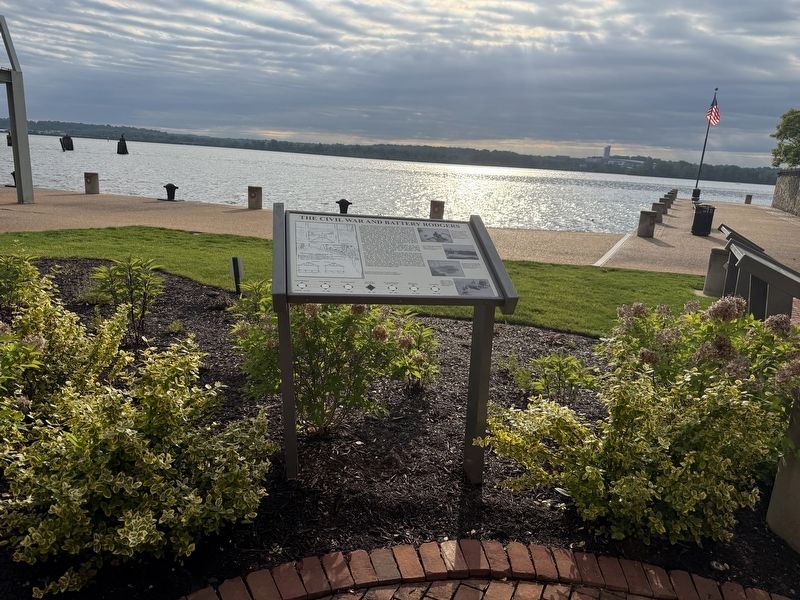
Location. 38° 47.813′ N, 77° 2.413′ W. Marker is in Alexandria, Virginia. It is in Old Town. It can be reached from Fords Landing Way north of Wharf Street, on the right when traveling north. Touch for map. Marker is at or near this postal address: 704 Fords Landing Way, Alexandria VA 22314, United States of America. Touch for directions.

Regionally, this marker is in the Washington Metropolitan Area and in Northern Virginia. It is also in the American South, specifically in the Upper South, in the Mid-Atlantic, and on the Eastern Seaboard. Globally, it is in the North Atlantic Region, North America, the Western Hemisphere, the Western World, and the Anglosphere. Historically, it finds itself in what was once the territory of the Mississippian Culture, one of the original Thirteen Colonies, one of the Confederate States of America, and the Antebellum South.
Other nearby markers. At least 8 other markers are within walking distance of this marker: Battery Cove Filled: A New Shipyard (here, next to this marker); The Alexandria Marine Railway (here, next to this marker); a different marker also named The Federal District and Alexandria (here, next to this marker); a different marker also named Early Alexandria and Keith's Wharf (here, next to this marker); The Earliest Inhabitants (a few steps from this marker); a different marker also named The Alexandria Ford Plant (within shouting distance of this marker); Guarding the Potomac (about 600 feet away, measured in a direct line); Zion Baptist Church (approx. 0.2 miles away). Touch for a list and map of all markers in Alexandria.
Other markers no longer nearby. The Federal District and Alexandria (was here, next to this marker but has been replaced with another marker now near it); a different marker also named The Civil War and Battery Rodgers (has been replaced with this marker); Early Alexandria and Keith's Wharf (was here, next to this marker but has been replaced with another marker now near it); a different marker also named Battery Cove Filled: A New Shipyard (was a few steps from this marker but has been replaced with another marker now near it); a different marker also named The Earliest Inhabitants (was a few steps from this marker but has been replaced with another marker now near it); The Alexandria Ford Plant (was within shouting distance of this marker but has been replaced with another marker now near it).
Credits. This page was last revised on May 14, 2026. It was originally submitted on May 14, 2026, by Devry Becker Jones of Washington, District of Columbia. This page has been viewed 16 times since then. Photos: 1, 2. submitted on May 14, 2026, by Devry Becker Jones of Washington, District of Columbia.
