
Old Town in Alexandria, Virginia — The American South (Mid-Atlantic)
Early Alexandria and Keith's Wharf
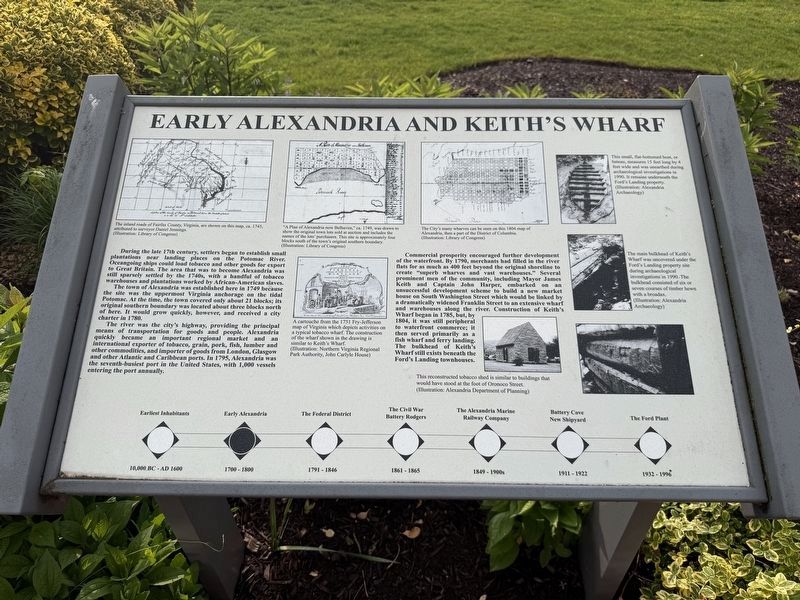
During the late 17th century, settlers began to establish small plantations near landing places on the Potomac River. Oceangoing ships could load tobacco and other goods for export to Great Britain. The area that was to become Alexandria was still sparsely settled by the 1740s, with a handful of tobacco warehouses and plantations worked by African-American slaves.
The town of Alexandria was established here in 1749 because the site was the uppermost Virginia anchorage on the tidal Potomac. At the time, the town covered only about 21 blocks; its original southern boundary was located about three blocks north of here. It would grow quickly, however, and received a city charter in 1780.
The river was the city's highway, providing the principal means of transport for goods and people. Alexandria quickly became an important regional market and an international exporter of tobacco, grain, pork, fish, lumber and other commodities, and importer of goods from London, Glasgow and other Atlantic and Caribbean ports. In 1795, Alexandria was the seventh-busiest port in the United States, with 1,000 vessels entering the port
this page online
Commercial prosperity encouraged further development of the waterfront. By 1790, merchants had filled in the river flats for as much as 400 feet beyond the original shoreline to create "superb wharves and vast warehouses." Several prominent men of the community, including Mayor James Keith and Captain John Harper, embarked on an unsuccessful development scheme to build a new market house on South Washington Street which would be linked by a dramatically widened Franklin Street to an extensive wharf and warehouses along the river. Construction of Keith's Wharf began in 1785, but, by 1804, it was still peripheral to waterfront commerce; it then served primarily as a fish wharf and ferry landing. The bulkhead of Keith's Wharf still exists beneath the Ford's Landing townhouses.
The inland roads of Fairfax County, Virginia are shown on this map, ca. 1745, attributed to surveyor Daniel Jennings.
(Illustration: Library of Congress)
"A Plan of Alexandria now Belhaven," ca. 1749, was drawn to show the original town lots sold at auction and includes the names of the lots' purchasers. This site is approximately four blocks south of the town's original southern boundary.
(Illustration: Library of Congress)
The City's many wharves can be seen on this 1804 map of Alexandria, then a part of the District of Columbia.
(Illustration: Library of Congress)
This small, flat-bottomed boat, or bateau, measures 15 feet long by 4 feet wide and was unearthed during archaeological investigations in 1990. It remains underneath the Ford's Landing property.
(Illustration: Alexandria Archaeology)
A cartouche from the 1751 Fry-Jefferson map of Virginia which depicts activities on a typical tobacco wharf. The construction of the wharf shown in the drawing is similar to Keith's Wharf.
(Illustration: Northern Virginia Regional Park Authority, John Carlyle House)
The main bulkhead of Keith's Wharf was uncovered under the Ford's Landing property site during archaeological investigations in 1990. The bulkhead consisted of six or seven courses of timber hewn with a broadax.
(Illustration: Alexandria Archaeology)
This reconstructed tobacco shed is similar to buildings that would have stood at the foot of Oronoco Street.
(Illustration: Alexandria Department of Planning)
Erected by Fords
Topics and series. This historical marker is listed in these topic lists: Colonial Era • Industry & Commerce • Settlements & Settlers • Waterways & Vessels. In addition, it is included in the Virginia, The City of Alexandria series list. A significant historical year for this entry is 1749.
Location. 38° 47.817′ N, 77° 2.414′ W. Marker is in Alexandria, Virginia. It is in Old Town. It can be reached from Fords Landing Way north of Wharf Street, on the right when traveling north. Touch for map. Marker is at or near this postal address: 702 Fords Landing Way, Alexandria VA 22314, United States of America. Touch for directions.

Regionally, this marker is in the Washington Metropolitan Area and in Northern Virginia. It is also in the American South, specifically in the Upper South, in the Mid-Atlantic, and on the Eastern Seaboard. Globally, it is in the North Atlantic Region, North America, the Western Hemisphere, the Western World, and the Anglosphere. Historically, it finds itself in what was once the territory of the Mississippian Culture, one of the original Thirteen Colonies, one of the Confederate States of America, and the Antebellum South.
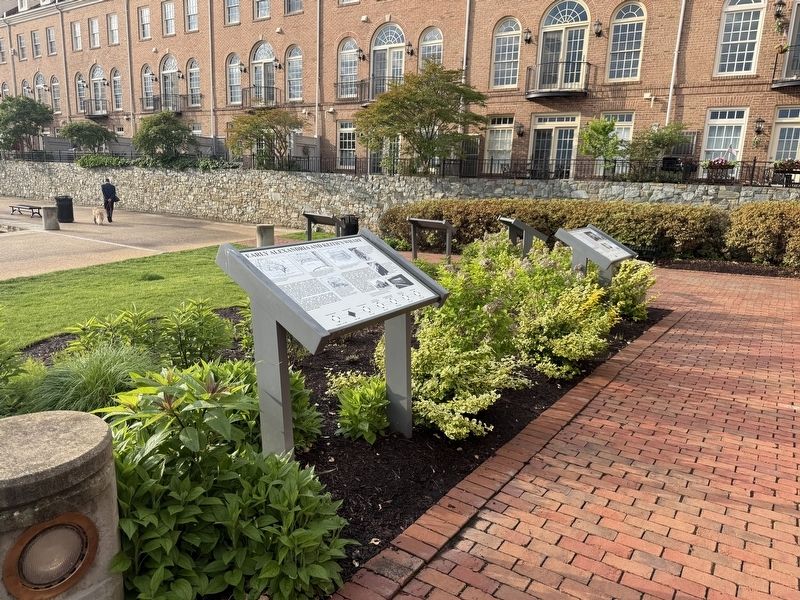
Other nearby markers. At least 8 other markers are within walking distance of this marker: A different marker also named The Federal District and Alexandria (here, next to this marker); Battery Cove Filled: A New Shipyard (here, next to this marker); The Alexandria Marine Railway (here, next to this marker); a different marker also named The Civil War and Battery Rodgers (here, next to this marker); The Earliest Inhabitants (here, next to this marker); a different marker also named The Alexandria Ford Plant (a few steps from this marker); Guarding the Potomac (about 600 feet away, measured in a direct line); Zion Baptist Church (about 800 feet away). Touch for a list and map of all markers in Alexandria.
Other markers no longer nearby. Early Alexandria and Keith's Wharf (has been replaced with this marker); The Federal District and Alexandria (was here, next to this marker but has been replaced with another marker now near it); The Civil War and Battery Rodgers (was here, next to this marker but has been replaced with another marker now near it); a different marker also named Battery Cove Filled: A New Shipyard (was here, next to this marker but has been replaced with another marker now near it); a different marker also named The Earliest Inhabitants (was here, next to this marker but has been replaced with another marker now near it); The Alexandria Ford Plant (was a few steps from this marker but has been replaced with another marker now near it).
Credits. This page was last revised on May 14, 2026. It was originally submitted on May 14, 2026, by Devry Becker Jones of Washington, District of Columbia. This page has been viewed 14 times since then. Photos: 1, 2. submitted on May 14, 2026, by Devry Becker Jones of Washington, District of Columbia.
