Near Thurmont in Frederick County, Maryland — The American Northeast (Mid-Atlantic)
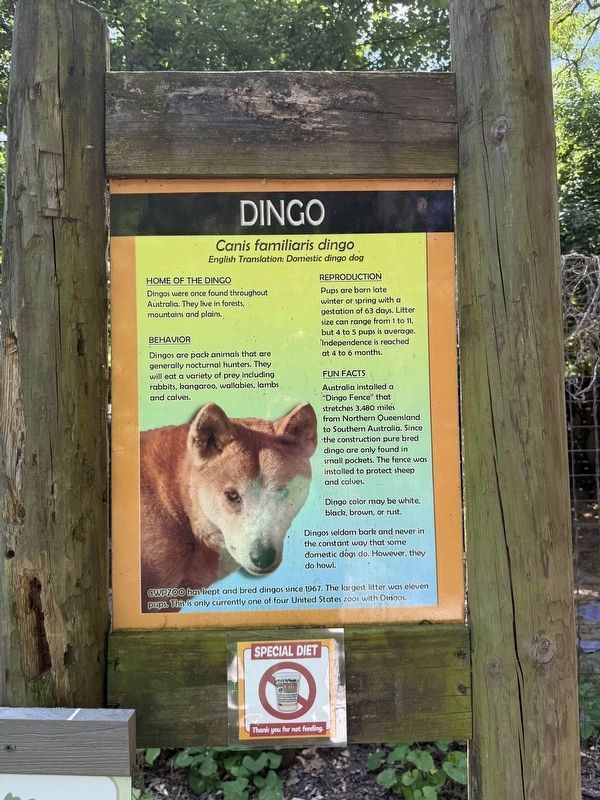
Dingo
Canis familiaris dingo
| — | English Translation: Domestic dingo dog | — |
Home of the Dingo
Dingos were once found throughout Australia. They live in forests, mountains and plains.
Behavior
Dingos are pack animals that are generally nocturnal hunters. They will eat a variety of prey including rabbits, kangaroos, wallabies, lambs and calves.
Reproduction
Pups are born late winter or spring with a gestation of 63 days. Litter size can range from 1 to 11, but 4 to 5 pups is average. Independence is reached at 4 to 6 months.
Fun Facts
Australia installed a "Dingo Fence" that stretches 3,480 miles from Northern Queensland to Southern Australia. Since the construction pure bred dingos are only found in small pockets. The fence was installed to protect sheep and calves.
Dingo color may be white, black, brown, or rust.
Dingos seldom bark and never in the constant way that some domestic dogs do. However, they do howl.
CWPZOO has kept and bred dingos since 1967. The largest litter was eleven pups. This is only one of four United States zoos with Dingos.
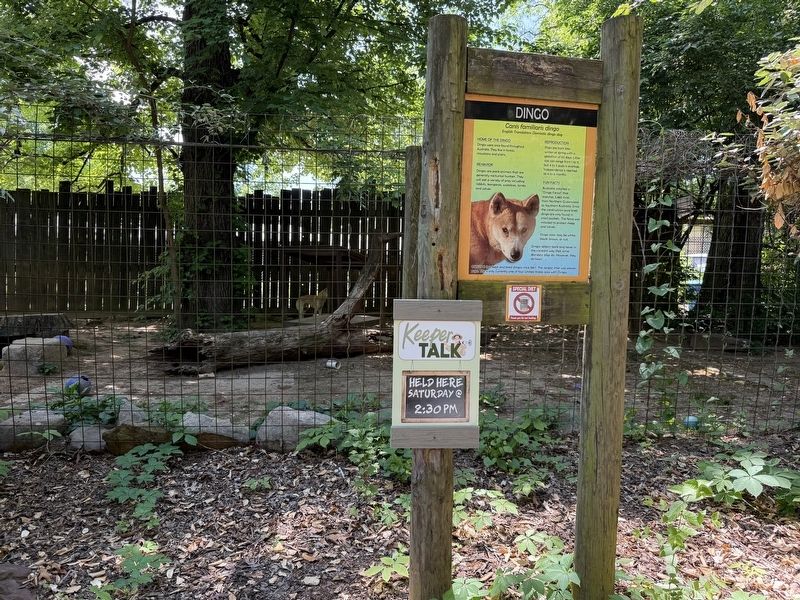
Erected by Catoctin Wildlife Preserve.
Topics. This historical marker is listed in these topic lists: Animals •
this page online
Location. 39° 35.423′ N, 77° 25.89′ W. Marker is near Thurmont, Maryland, in Frederick County. It can be reached from Catoctin Furnace Road north of Kellys Store Road, on the right when traveling north. Touch for map. Marker is at or near this postal address: 13019D Catoctin Furnace Rd, Thurmont MD 21788, United States of America. Touch for directions.

Regionally, this marker is in the Washington Metropolitan Area and in Central Maryland. It is also in the American Mid-Atlantic. Globally, it is in North America, the Western Hemisphere, the Western World, and the Anglosphere. Historically, it finds itself in what was once one of the original Thirteen Colonies and also the Antebellum South.
Other nearby markers. At least 8 other markers are within walking distance of this marker: Australian Wetland Birds (a few steps from this marker); Ruffed Lemur (within shouting distance of this marker); Lucky Bird's Aviary (within shouting distance of this marker); Macaws (within shouting distance of this marker); Sacred Ibis (within shouting
Credits. This page was last revised on May 17, 2026. It was originally submitted on May 17, 2026, by Devry Becker Jones of Washington, District of Columbia. This page has been viewed 9 times since then. Photos: 1, 2. submitted on May 17, 2026, by Devry Becker Jones of Washington, District of Columbia.
