East Melbourne in Melbourne, Victoria, Australia — Oceania
Fitzroy Gardens Welcome

Photographed by Dean Barton-Ancliffe, May 11, 2026
1. Fitzroy Gardens Marker
Set aside as a public reserve in 1848, the 26 hectare site officially became Fitzroy Gardens in 1862. It is the City of Melbourne's premier garden, where different eras of Melbourne's history are represented, both in the landscape and the built features.
In this immediate area is the Conservatory, with its colourful floral exhibitions, and the main pathway to Cooks Cottage. Further exploration of the Gardens will reveal magnificent tree avenues, fountains, a fern gully, garden beds and extensive lawns. The Fairies Tree, Model Tudor Village, and Scarred Tree may also be found here.
Fitzroy Gardens was included on the Victorian Heritage Register in 1998.
(Photo caption) The conservatory (1930) with the statue of Diana and the Hounds (1939) outside the main entrance (City of Melbourne)
Erected by City of Melbourne.
Topics. This historical marker is listed in these topic lists: Colonial Era • Parks & Recreational Areas. A significant historical year for this entry is 1848.
Location. 37° 48.856′ S, 144° 58.683′ E.
this page online

Regionally, it is in Oceania, in Australasia, in the Pacific Ocean, in South Pacific, on the Pacific Rim, in the Western World, and in the Anglosphere. Historically, it finds itself in what was once a British colony.
Other nearby markers. At least 8 other markers are within walking distance of this marker: Captain Cook's Pine (about 90 meters away, measured in a direct line); A Great Australian Tree (about 120 meters away); John F. Kennedy Memorial (about 150 meters away); Sinclair's Cottage (about 180 meters away); Fitzroy Gardens (about 210 meters away); Taken not Given (about 210 meters away); Scarred Tree (about 240 meters away); Model Tudor Village (approx. 0.3 kilometers away). Touch for a list and map of all markers in East Melbourne.
Also see . . . Fitzroy Gardens. City of Melbourne
Originally set aside(Submitted on May 17, 2026, by Dean Barton-Ancliffe of Rowville, Victoria.)as a reserve in 1848, the gardens were named after Sir Charles Augustus Fitzroy, Governor of NSW. The gardens were laid out in 1859 and were developed as a garden under the supervision of Deputy Surveyor-General Clement Hodgkinson, with the assistance of gardener James Sinclair.Photographed by Dean Barton-Ancliffe, May 11, 20262. Fitzroy Gardens MarkerConservatory is in the background
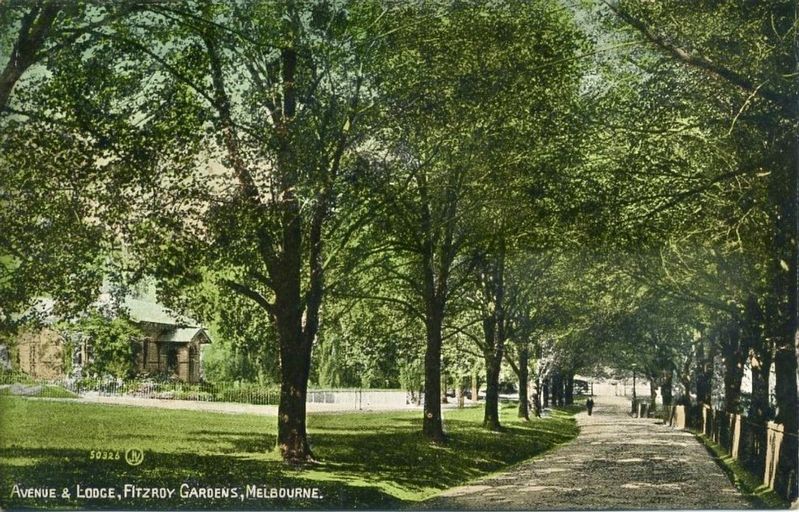
The layout follows a classic Victorian era design, featuring pathways lined with magnificent elm trees, known to be some of the best grown in Victoria. There are a variety of flowers and ornamental shrubs and trees, which together with extensive lawns creates a diverse and layered landscape.
The watercourse that runs through the centre of the gardens is an ephemeral tributary of the Yarra River, Birrarung. The Scarred Tree in the south-east section of the gardens is associated with the pre-colonial use of the area by Aboriginal peoples and it is registered on the Aboriginal Heritage Register. The tree was a redgum, one of a number of remnant redgum found in the gardens.
The gardens contain several buildings and structures which are of architectural significance in their own right, including the Band Pavilion (1864), Sinclair's Cottage (1866) and theRotunda (1873).Photographed by John Valentine and Son, circa 19103. Avenue and Lodge, Fitzroy Gardens
Significant twentieth century buildings include the plant manager’s cottage The Lodge (1927), the recently refurbished Spanish mission-style Conservatory (1930) and the Electricity Substation (1940).
The Fitzroy Gardens Visitor Centre opened in 2014 and provides tourism information and manages entry to Cooks' Cottage.

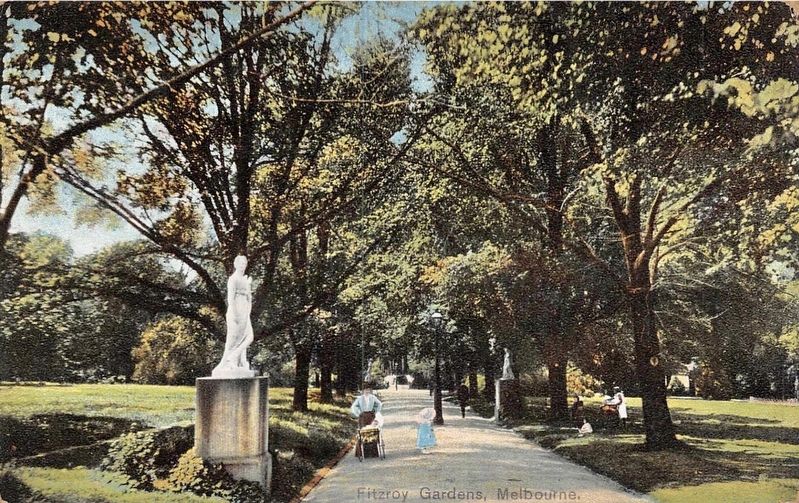
circa 1908
4. Fitzroy Gardens
Credits. This page was last revised on May 19, 2026. It was originally submitted on May 17, 2026, by Dean Barton-Ancliffe of Rowville, Victoria. This page has been viewed 26 times since then. Photos: 1, 2. submitted on May 17, 2026, by Dean Barton-Ancliffe of Rowville, Victoria. 3, 4. submitted on May 19, 2026. • Andrew Ruppenstein was the editor who published this page.
