Hoe Park in Plymouth in Devon, England, United Kingdom — Northwestern Europe (the British Isles)
The British Slave Ship Brookes
Photographed by Judith Elizabeth Pearson, May 15, 2026
1. The British Slave Ship Brookes Marker
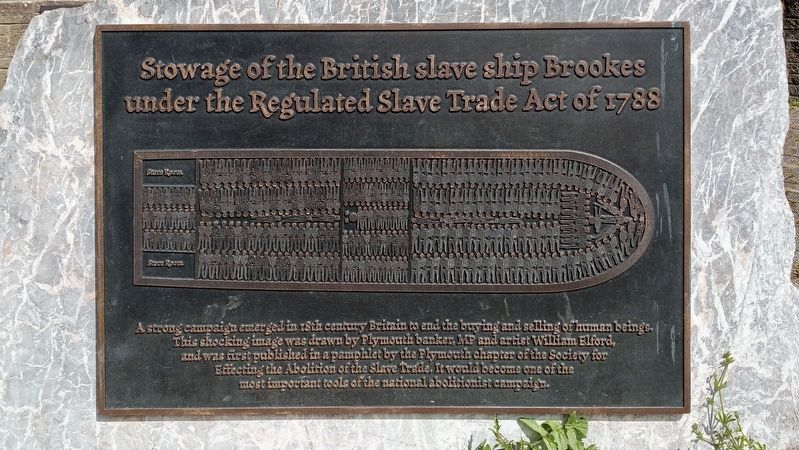
Stowage of the British slave ship Brookes under the Regulated Slave Trade Act of 1788
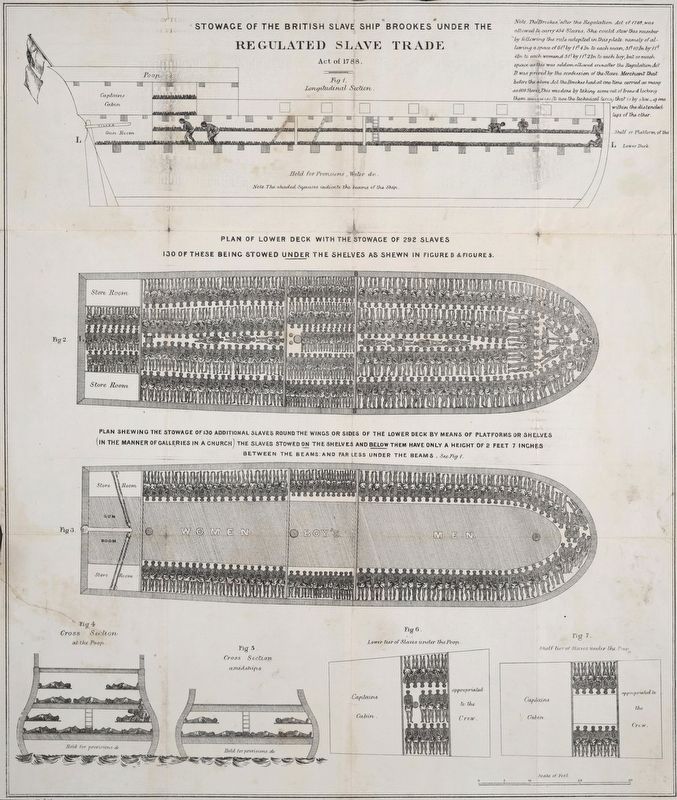
A strong campaign emerged in eighteenth century Britain to end the buying and selling of human beings. This shocking image was drawn by Plymouth banker, MP and artist William Elford, and was first published in a pamphlet by the Plymouth chapter of the Society for Effecting the Abolition of the Slave Trade. It would become one of the most important tools of the national abolitionist campaign.
Erected 2021 by Plymouth City Council.
Topics. This historical marker is listed in these topic lists: Abolition & Underground RR • Waterways & Vessels. A significant historical year for this entry is 1788.
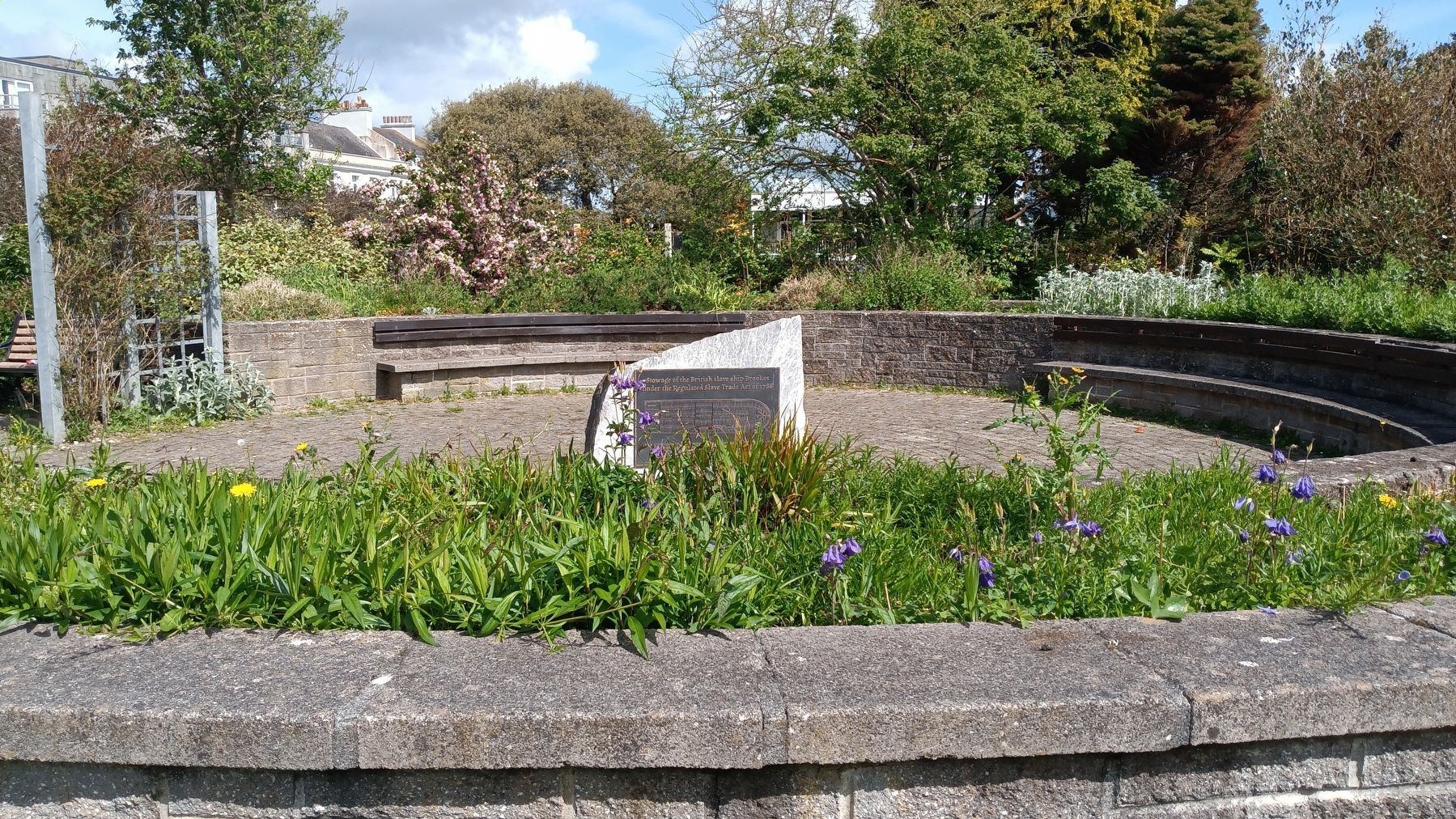
Location. 50° 21.944′ N, 4° 8.584′ W. Marker is in Plymouth, England, in Devon. It is in Hoe Park. It can be reached from Osborne Place south of Citadel Road. The metal marker is located in Hoe Park, and is mounted on the side of a limestone plinth in the Peace Garden, a circular enclosure just off the footpath. The enclosure is formed by a low brick wall of flower boxes. Touch for map. Marker is in this post office area: Plymouth, England
this page online

Regionally, this marker is in South West England. Globally, it is on the Atlantic Ocean, in the North Atlantic Region, in Europe, in Atlantic Europe, on one of the British Isles, in the Western World, and in the Anglosphere. Historically, it finds itself in what was once the Roman Empire.
Other nearby markers. At least 8 other markers are within walking distance of this marker: The Plymouth Naval Memorial (within shouting distance of this marker); a different marker also named The Plymouth Naval Memorial (within shouting distance of this marker); Drake Memorial (within shouting distance of this marker); a different marker also named Plymouth Naval Memorial (within shouting distance of this marker); Tribute of Plymouth (about 90 meters away, measured in a direct line); Frank Bickerton (about 90 meters away); Invicta Hotel (about 120 meters away); National Armada Memorial (about 120 meters away). Touch for a list and map of all markers in Plymouth.
More about this marker. The Peace Garden is intended as a place for contemplation and reflection.
Also see . . .
1. Memorial to victims of slavery unveiled (Plymouth.Gov.UK, 24 March 2021).
Photographed by Judith Elizabeth Pearson, May 15, 2026
2. Here is the marker in the Peace Garden
Plymouth will be marking the International Day of Remembrance of the Victims of Slavery and the Transatlantic Slave Trade with a new memorial.(Submitted on May 20, 2026, by Judith Elizabeth Pearson of Burke, Virginia.)
…It is mounted on a limestone plinth and features a plaque with an image of the British slave ship Brookes, designed by William Elford.
This image was first published in a pamphlet by the Plymouth chapter of the Society for Effecting the Abolition of the Slave Trade and became one of the most important symbols of the national abolitionist campaign.
2. Brooks (1781 ship) (Wikipedia). Overview:
Brooks (or Brook, Brookes) was a British slave ship launched at Liverpool in 1781. She became infamous after prints of her were published in 1788. Between 1782 and 1804, she made 11 voyages from Liverpool in the triangular slave trade in enslaved people (for the Brooks, England, to Africa, to the Caribbean, and back to England). During this period she spent some years as a West Indiaman. She also recaptured a British merchantman and captured a French merchantman. Brooks's last voyage shipping enslaved(Submitted on May 20, 2026.)people was to Montevideo in the South Atlantic where she was condemned as unseaworthy in November 1804.Photographed by Judith Elizabeth Pearson, May 15, 20263. Sign designating the Peace Garden
Additional keywords. Slavery
Plymouth Chapter of the Society for Effecting the Abolition of the Slave Trade, 1788
4. Stowage of the British slave ship Brookes under the regulated slave trade act of 1788
Image courtesy Library of Congress via Wikimedia Commons
Credits. This page was last revised on September 9, 2026. It was originally submitted on May 18, 2026, by Judith Elizabeth Pearson of Burke, Virginia. This page has been viewed 54 times since then. Photos: 1, 2, 3. submitted on May 18, 2026, by Judith Elizabeth Pearson of Burke, Virginia. 4. submitted on May 20, 2026. • Andrew Ruppenstein was the editor who published this page.
