Jean Vauquelin
(1728-1772)
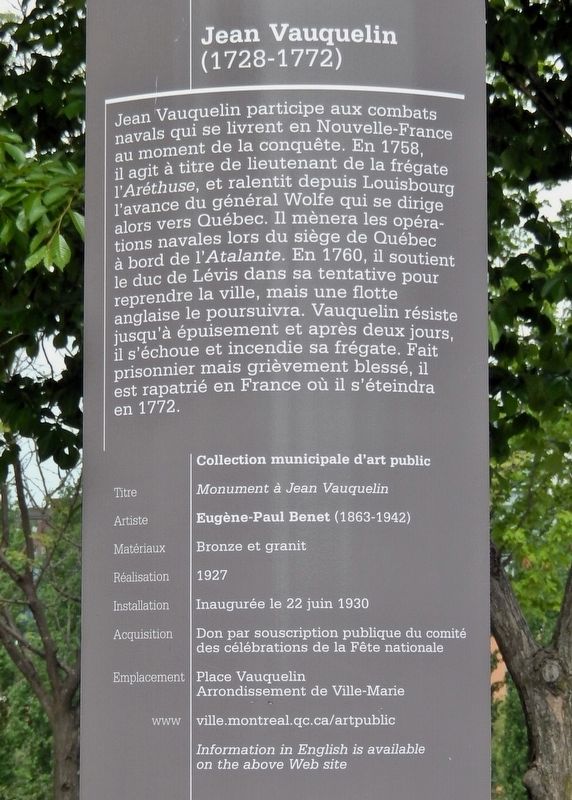

Jean Vauquelin participe aux combats navals qui se livrent en Nouvelle-France au moment de la conquête. En 1758 il agit à titre de lieutenant de la frégate l'Aréthuse, et ralentit depuis Louisbourg l'avance du général Wolfe qui se dirige alors vers Québec. Il mènera les opérations navales lors du siège de Québec abord de l'Atalante. En 1760, il soutient le duc de Lévis dans sa tentative pour reprendre la ville, mais une flotte anglaise le poursuivra. Vauquelin résiste jusqu'à épuisement et après deux jours, il s'échoue et incendie sa frégate. Fait prisonnier mais grièvement blessé, il est rapatrié en France où il s'éteindra en 1772.
Collection municipale d’art public
Titre : Monument à Jean Vauquelin
Artiste : Eugène-Paul Benet (1863-1942)
Matériaux : Bronze et granit
Réalisation : 1927
Installation : Inaugurée le 22 juin 1930
Acquisition : Don par souscription publique du comité des célébrations de la Fête nationale
Emplacement : Place Vauquelin, Arrondissement de Ville-Marie
www : ville.montreal.qc.ca/artpublic
Jean Vauquelin took part in the naval battles fought in New France at the
this page online
Municipal Public Art Collection
Title: Monument to Jean Vauquelin
Artist: Eugène-Paul Benet (1863-1942)
Materials: Bronze and granite
Created: 1927
Installation: Inaugurated on June 22, 1930
Acquisition: Gift through public subscription by the Committee of National Holiday Celebrations
Location: Place Vauquelin, Ville-Marie Borough
www: ville.montreal.qc.ca/artpublic
Topics. This historical marker is listed in these topic lists: Arts, Letters, Music • Colonial Era • Patriots & Patriotism • Waterways & Vessels. A significant historical year for this entry is 1758.
Location. 45° 30.51′ N, 73° 33.281′ W.
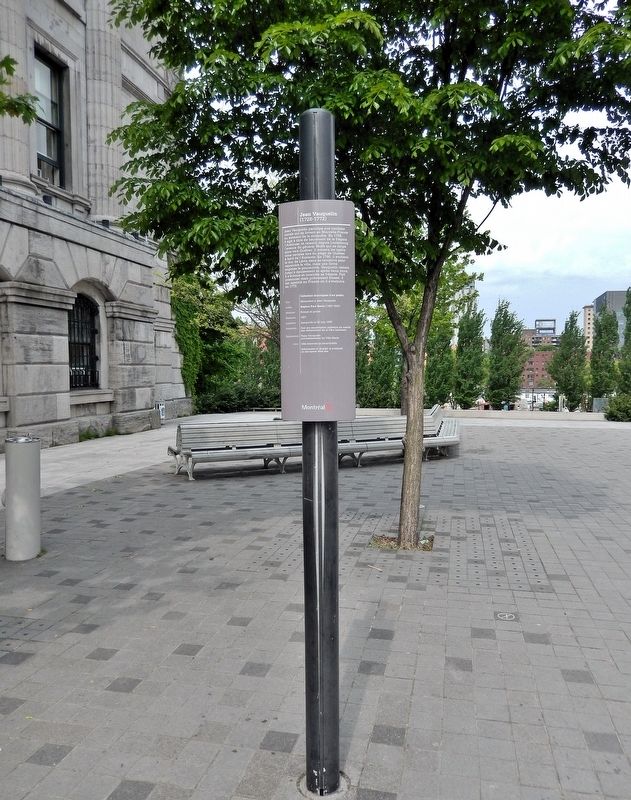

Regionally, this marker is in Central Canada. Globally, it is in North America, the Western Hemisphere, and the Western World. Historically, it finds itself in what was once a British colony, the Viceroyalty of New France, the Haudenosaunee (Iroquois) Confederacy, and Rupert’s Land.
Other nearby markers. At least 8 other markers are within walking distance of this marker: Place Vauquelin (within shouting distance of this marker); Jacques Viger (within shouting distance of this marker); Ancien Palais de Justice / The Old Courthouse (within shouting distance of this marker); Horatio Nelson (within shouting distance of this marker); Le Château Ramezay / Château Ramezay (within shouting distance of this marker); The Nelson Column, Montreal (within shouting
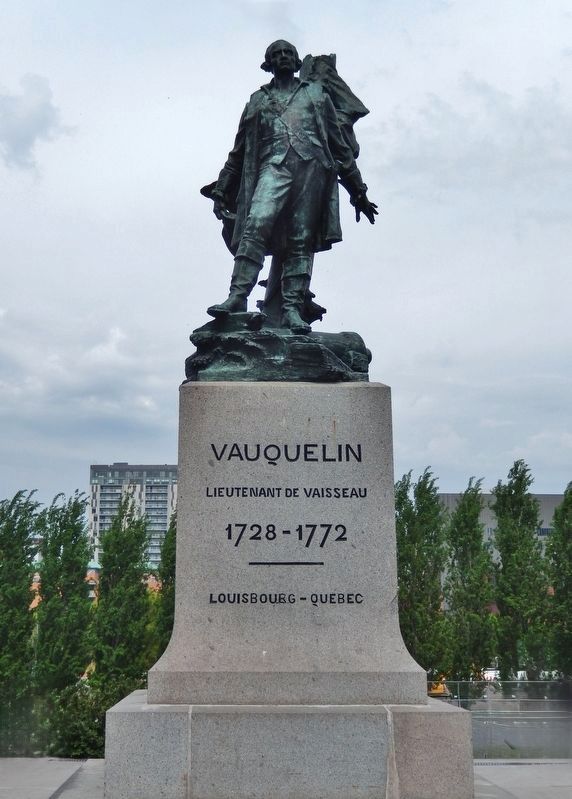
Lieutenant de Vaisseau
1728-1772
Louisbourg-Québec
Related markers. Click here for a list of markers that are related to this marker. Place Vauquelin / Vauquelin Square
Also see . . .
1. Jean Vauquelin (Wikipedia).
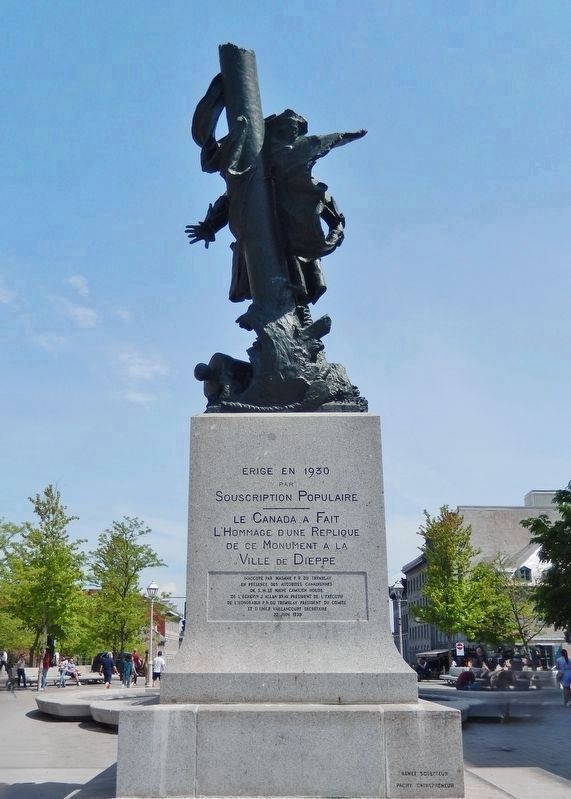
Excerpt: Vauquelin came to Canada as part of the naval force involved in the Seven Years' War. In February 1758, he became lieutenant and was given command of the Pèlerine, a 30 gun frigate bought by the king from a builder in Le Havre and renamed the Aréthuse. Sent to Île Royale, he entered the port of Louisbourg on 9 June, getting past the Royal Navy's blockade commanded by Admiral Edward Boscawen. After assisting the defense of Louisbourg, Vauquelin slipped away under cover of night, evading the blockade a second time and reaching France after a rapid crossing of the Atlantic. Returning to Canada the following year as captain of the frigate Atalante, Vauquelin participated in naval operations during the 1759 Siege of Quebec,(Submitted on May 24, 2026, by Cosmos Mariner of Cape Canaveral, Florida.)and then at the Battle of Sainte-Foy, a French victory.Photographed by Cosmos Mariner, May 20, 20244. Jean Vauquelin Monument (west side)Erigé en 1930 par Souscription Populaire le Canada a Fait L’Hommage d'une Réplique de ce monument a la Ville Dieppe.
Inaugure par Madame P.R. du Tremblay en présence des autorités canadiennes de S. H. Le Maire Camilien Houde de l'échevin J. Allan Bray, président de l'exécutif de l'honorable P. R. du Tremblay président du comité et d’Émile Vaillancourt secrétaire 22 juin 1930.• • • Erected in 1930 by Public Subscription, Canada paid tribute with a replica of this monument to the City of Dieppe.
Inaugurated by Madam P.R. du Tremblay in the presence of Canadian authorities, H. His Worship Mayor Camilien Houde, Councillor J. Allan Bray, President of the Executive, the Honourable P. R. du Tremblay, President of the Committee, and Émile Vaillancourt, Secretary, June 22, 1930.From April to May 1760, while escorting a fleet of Bateaux headed for le Chevalier de Lévis's attempt to retake Quebec, Vauquelin was pursued by a large British squadron led by the 74-gun ship-of-the-line HMS Vanguard. After sailing as far up the St. Lawrence as he could, Captain Vauquelin turned Atalante broadside to fight it out with his pursuers. Vauquelin literally nailed his colors to the mast and engaged the two frigates that had pursued them. Finally, with the magazines of Atalante completely devoid of ammunition, the wounded but still defiant Vauquelin cast his sword into the sea and ordered his men to abandon the ship. He and 11 of his officers and men waited on the quarterdeck for the British to take them, prisoner. Atalante had taken so much damage in her gallant fight that the British were forced to burn her the next day. Quickly repatriated, he went back to France and was promoted to captain of a larger ship in 1761. After several other commands, he died in 1772 whilst attempting to establish French colonies in Madagascar.
2. Monument à Jean Vauquelin (Montréal Bureau of Public Art).
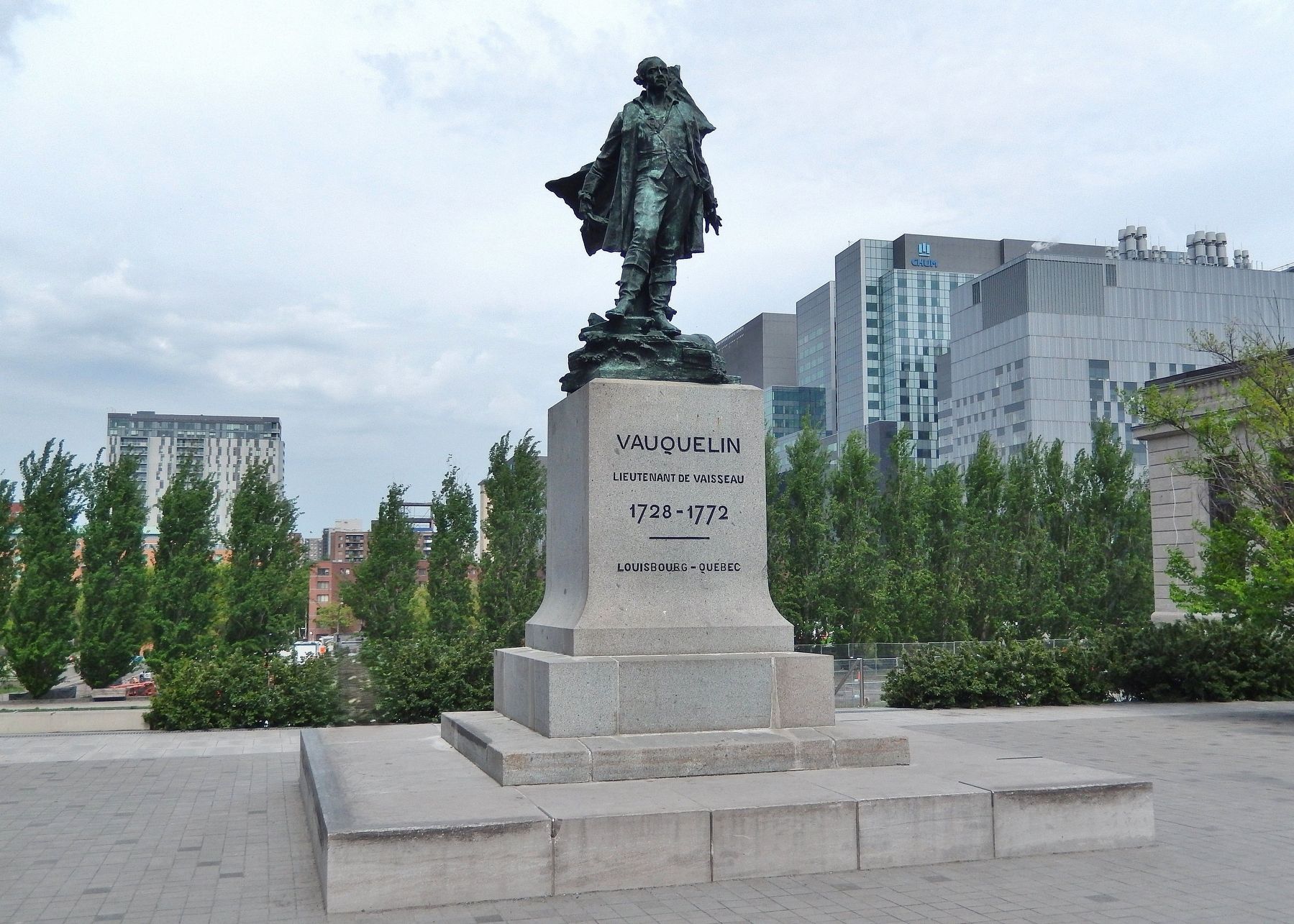
Excerpt: Il s'agit d'une statue en bronze posée sur un piédestal et une base en granit gris. Vauquelin est représenté debout, légèrement appuyé sur le mât brisé de son navire. Le personnage fait corps avec le tronçon du mât. Son pied gauche repose sur un fût de canon brisé. Il tient dans la main droite une partie d'un drapeau fixée au mât auquel il s'agrippe. Sa main gauche est tournée vers l'arrière dans un geste de protection. Le fourreau de son épée est vide. Toute l'œuvre évoque la défaite et le naufrage, mais le personnage garde la tête haute et le regard plein de défi.(Submitted on May 24, 2026, by Cosmos Mariner of Cape Canaveral, Florida.)[English translation] It is a bronze statue placed on a pedestal and a gray granite base. Vauquelin is depicted standing, slightly leaning on the broken mast of his ship. The figure is integrated with the section of the mast. His left foot rests on a broken cannon barrel. He holds in his right hand a part of a flag attached to the mast to which he clings. His left hand is turned backward in a protective gesture. The scabbard of his sword is empty. The whole work evokes defeat and shipwreck, but the figure keeps his head high and his gaze full of defiance.
Credits. This page was last revised on May 24, 2026. It was originally submitted on May 18, 2026, by Cosmos Mariner of Cape Canaveral, Florida. This page has been viewed 21 times since then. Photos: 1, 2, 3, 4, 5. submitted on May 24, 2026, by Cosmos Mariner of Cape Canaveral, Florida.
