
North Weymouth in Norfolk County, Massachusetts — The American Northeast (New England)
Webb Memorial State Park
| — | Back River Trail | — |

Photographed by G.W.Bartlett, May 14, 2026
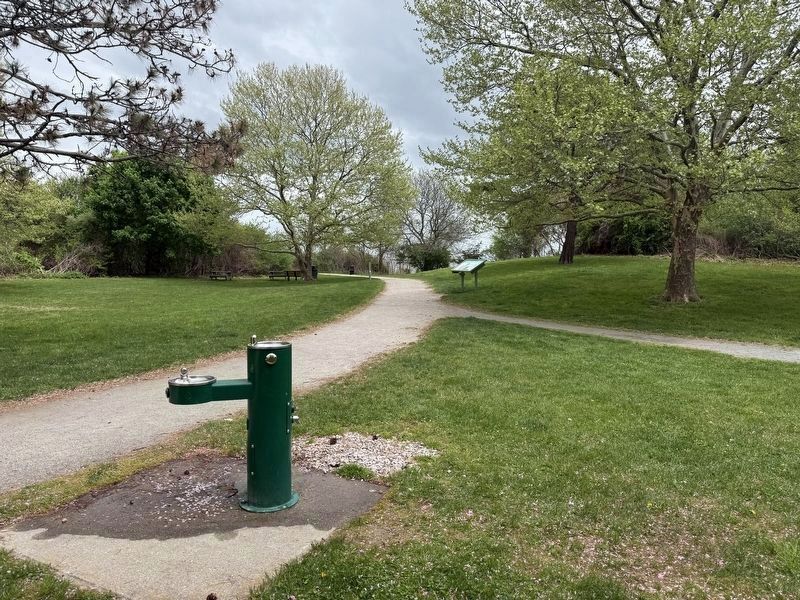
1. Webb Memorial State Park Marker
This scenic 36-acre peninsula, extending nearly half a mile into Hingham Bay, was acquired by the Commonwealth in 1978. Operated as a Nike anti-aircraft missile launch facility from 1959 to 1974, it was one of a dozen such sites that ringed the Boston metropolitan area during the Cold War.
The Park today has nearly two miles of paths popular with walkers and joggers. It also offers striking views of Hingham Bay, the Harbor Islands and the Boston skyline.
A Brief History
The two glacial hills and connecting lowland that form Weymouth Neck have been sculpted by natural and human forces for over 12,000 years. Originally called Wessagussett (Algonquian for "by the small saltwater cove"), it was occupied by Native Americans because of its wealth of finfish, shellfish and wild fruit. Artifacts from this period dating back nearly 4,000 years, have been found here and on nearby Grape Island in ancient waste heaps called middens.
In 1775, this area of Hingham Bay was the scene of a skirmish between a group of colonists and the crews of several British ships. The vessels, anchored off the Neck, were in the process of taking on hay from
this page online
Use of the Neck by European settlers was primarily agricultural until the construction in 1872 of a large complex of buildings by the Bradley Fertilizer Company. This facility, which included a small community in which many workers lived, remained in operation for close to 50 years.
The Nike missile site that was built here in the late 1950s included ten concrete block buildings that were used to assemble and arm the missiles as well as to house and feed the men stationed here. An underground storage facility, excavated within one of the hills, was equipped with elevators that could transport as many as thirty missiles to the surface and fire them at incoming bombers. The missiles were modified in the mid-60s to carry nuclear warheads. Air vents from this facility are still visible.
After a major
Photographed by G.W.Bartlett, May 14, 2026
2. Webb Memorial State Park Marker wide view
Webb Memorial State Park features gravel trails, many picnic tables, water fountain and restrooms.
William K. Webb (1923-1976)
After serving in the armed forces during World War II, William K. Webb joined the Weymouth Police Department. He rose to the rank of Lieutenant in 1954 and Captain in 1966. As an elected official, he served as a Town Meeting member for ten years and a member of the Weymouth Housing Authority for four. The park was named in his honor in 1980, four years after his death.
Erected by DEM Office of Public Information.
Topics. This memorial is listed in these topic lists: Air & Space • Parks & Recreational Areas • War, Cold • War, US Revolutionary. A significant historical year for this entry is 1959.
Location. 42° 15.494′ N, 70° 55.394′ W. Memorial is in Weymouth, Massachusetts, in Norfolk County. It is in North Weymouth. It can be reached from River Street east of Broad Reach, on the left when traveling east. Touch for map. Memorial is in this post office area: North Weymouth MA 02191, United States of America. Touch for directions.

Regionally, this memorial is in Greater Boston. It is also in the American
Photographed by G.W.Bartlett, May 14, 2026
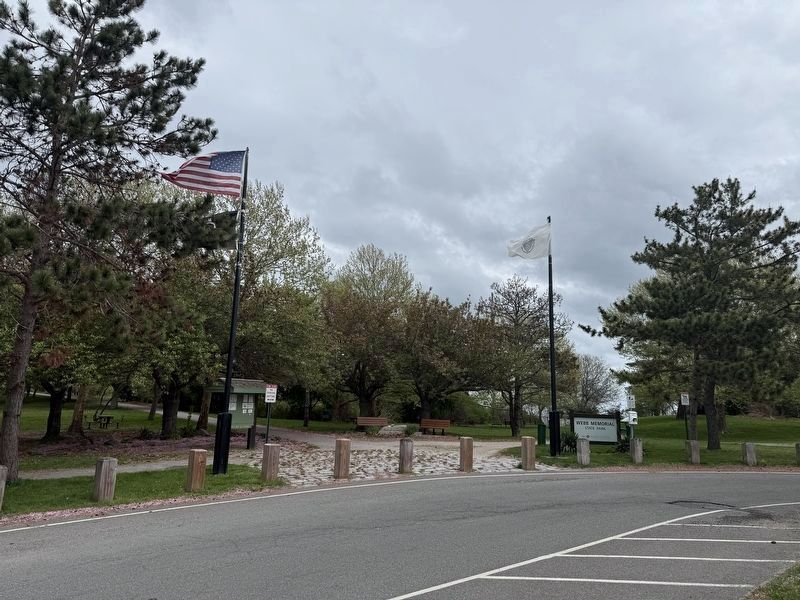
3. Webb Memorial State Park Marker
The marker is behind the Webb Memorial State Park sign and Massachusetts State flag.
Other nearby markers. At least 8 other markers are within walking distance of this marker: Grape Island Alarm (approx. 0.3 miles away); Hingham "Town Farm" (approx. 0.9 miles away); Hingham Naval Ammunition Depot (approx. 0.9 miles away); Third Almshouse (approx. 0.9 miles away); Abigail Adams to John Adams, May 18, 1778 (approx. one mile away); Great Esker Park (approx. one mile away); Abigail Adams to John Adams, August 5, 1777 (approx. one mile away); Abigail Adams to John Adams, March-April 1776 (approx. one mile away). Touch for a list and map of all markers in Weymouth.
Related marker. Click here for another marker that is related to this marker.
Also see . . .
1. Webb Memorial State Park - North & South Rivers Watershed Association.
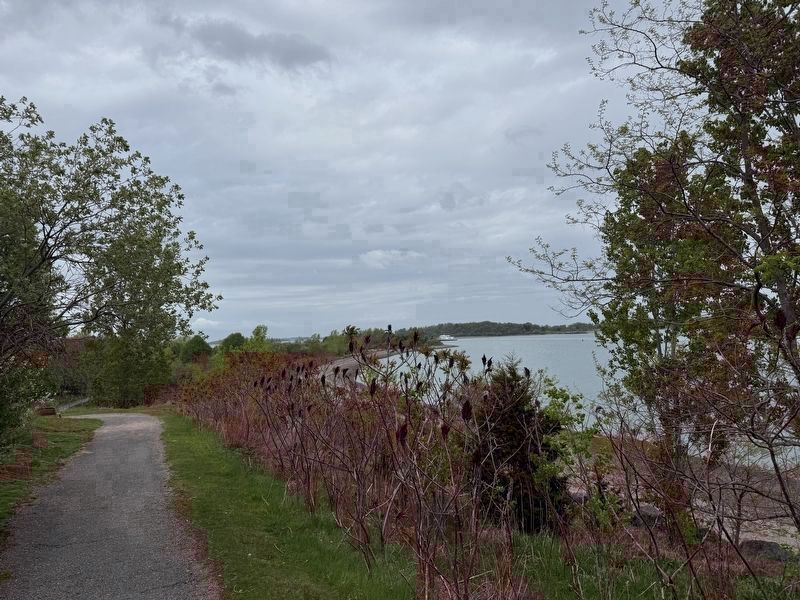
The 36-acre Webb Memorial State Park is located on a grassy peninsula between Weymouth’s Back and Fore Rivers.(Submitted on May 19, 2026, by G.W.Bartlett of Hingham, Massachusetts.)The park features one mile of easy, stroller-friendly walking trails, and is the only mainland portion of the Boston Harbor Islands National Recreation Area.Photographed by G.W.Bartlett, May 14, 20264. Webb Memorial State Park view to Grape IslandA gravel path heading north on the east side of the park with views to the waterfront and a Hingham-Hull Ferry heading for Boston between Weymouth's Eastern Neck and Grape Island through Boston Harbor Islands State Park across a cluster of native Staghorn Sumac.
2. Webb Memorial State Park - National Park Service. (Submitted on May 19, 2026, by G.W.Bartlett of Hingham, Massachusetts.)
3. Back River Trail - North & South Rivers Watershed Association.
The paved Back River Trail currently (2026) extends along the Back River in Weymouth from Bridge Street (Route 3A) through Great Esker Park and Osprey Overlook Park, for about 2 miles. The trail runs alongside the Back River, the Mill River, and Herring Run Brook.(Submitted on May 19, 2026, by G.W.Bartlett of Hingham, Massachusetts.)
It will eventually extend from Webb Memorial State Park, along Weymouth Neck to the Kibby Property and Abigail Adams Park. After passing under Route 3A via boardwalk, it will continue through Great Esker Park and Osprey Overlook Park, and then along Wharf Street, through the Durante Property, and south to Lovell Field, the Stephen Rennie Herring Run Park, Herring Run Pool Park, Iron Hill Park and Whitman’s Pond.
Credits. This page was last revised on May 25, 2026. It was originally submitted on May 19, 2026, by G.W.Bartlett of Hingham, Massachusetts. This page has been viewed 25 times since then. Photos: 1, 2, 3, 4. submitted on May 19, 2026, by G.W.Bartlett of Hingham, Massachusetts. • Michael Herrick was the editor who published this page.
