Painesville in Lake County, Ohio — The American Midwest (Great Lakes)
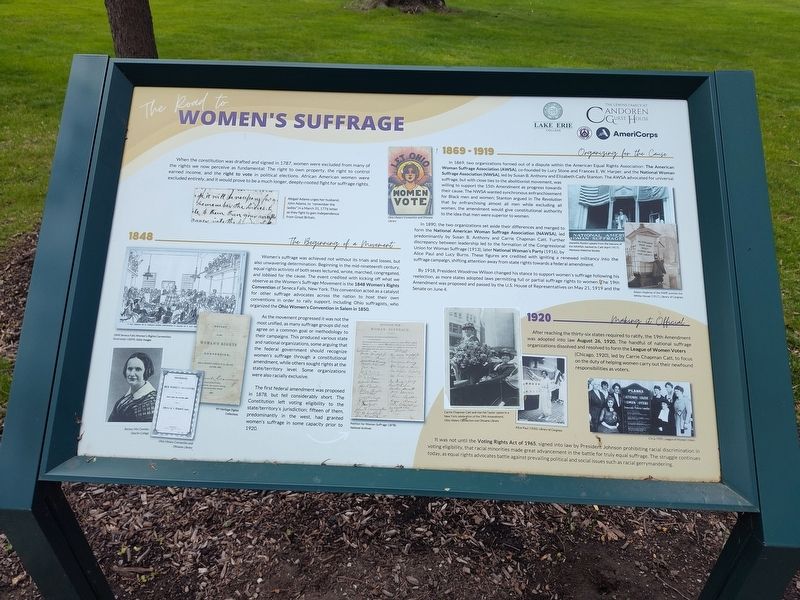
The Road to Women's Suffrage
Photographed by Craig Doda, May 2, 2026
1. The Road To Women's Suffrage Marker
When the constitution was drafted and signed in 1787, women were excluded from many of the rights we now perceive as fundamental: The right to own property, the right to control earned income, and the right to vote in political elections. African American women were excluded entirely, and it would prove to be a much longer, deeply-rooted fight for suffrage rights.
1848 The Beginning of a Movement
Women's suffrage was achieved not without its trials and losses, but also unwavering determination. Beginning in the mid-nineteenth century, equal rights activists of both sexes lectured, wrote, marched, congregated, and lobbied for the cause. The event credited with kicking off what we observe as the Women's Suffrage Movement is the 1848 Women's Rights Convention of Seneca Falls, New York. This convention acted as a catalyst for other suffrage advocates across the nation to host their own conventions in order to rally support, including Ohio suffragists, who organized the Ohio Women's Convention in Salem in 1850.
As the movement progressed it was not the most unified, as many suffrage groups did not agree on a common
this page online
The first federal amendment was proposed in 1878, but fell considerably short. The Constitution left voting eligibility to the state/territory's jurisdiction; fifteen of them, predominantly in the west, had granted women's suffrage in some capacity prior to 1920.
1869-1919 Organizing for the Cause
In 1869, two organizations formed out of a dispute within the American Equal Rights Association: The American Woman Suffrage Association (AWSA), co-founded by Lucy Stone and Frances E. W. Harper, and the National Woman Suffrage Association (NWSA), led by Susan B. Anthony and Elizabeth Cady Stanton. The AWSA advocated for universal suffrage, but with close ties to the abolitionist movement, was willing to support the 15th Amendment as progress towards their cause. The NWSA wanted synchronous enfranchisement for Black men and women;
Photographed by Craig Doda, May 2, 2026
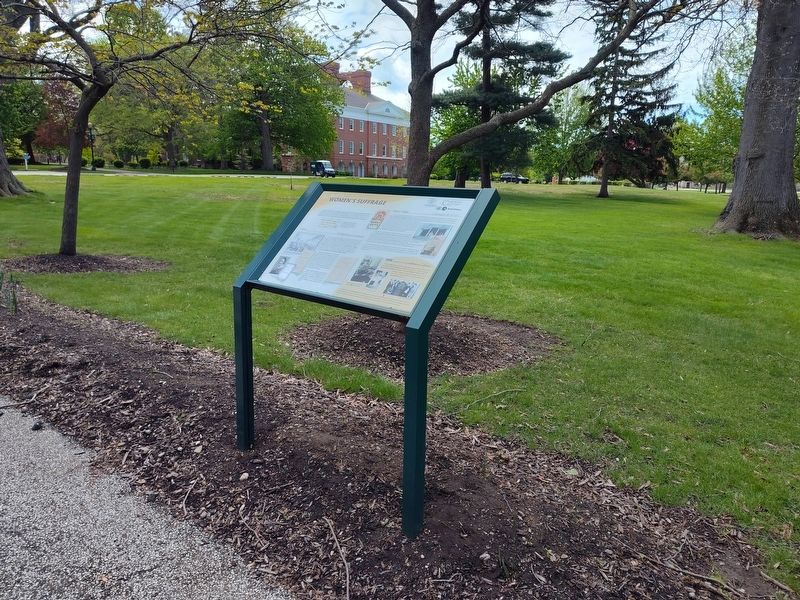
2. The Road To Women's Suffrage Marker
In 1890, the two organizations set aside their differences and merged to form the National American Woman Suffrage Association (NAWSA), led predominantly by Susan B. Anthony and Carrie Chapman Catt. Further discrepancy between leadership led to the formation of the Congressional Union for Woman Suffrage (1913), later National Woman's Party (1916), by Alice Paul and Lucy Burns. These figures are credited with igniting a renewed militancy into the suffrage campaign, shifting attention away from state rights towards a federal amendment.
By 1918, President Woodrow Wilson changed his stance to support women's suffrage following his reelection, as more states adopted laws permitting full or partial suffrage rights to women. The 19th Amendment was proposed and passed by the U.S. House of Representatives on May 21, 1919 and the Senate on June 4.
1920 Making it Official
After reaching the thirty-six states required to ratify, the 19th Amendment
Photographed by Craig Doda, May 2, 2026
3. Lake Erie College
It was not until the Voting Rights Act of 1965, signed into law by President Johnson prohibiting racial discrimination in voting eligibility, that racial minorities made great advancement in the battle for truly equal suffrage. The struggle continues today, as equal rights advocates battle against prevailing political and social issues such as racial gerrymandering.
Erected by Lake Erie College.
Topics. This historical marker is listed in these topic lists: Civil Rights • Government & Politics • Women. A significant historical date for this entry is May 21, 1919.
Location. 41° 43.115′ N, 81° 15.133′ W. Marker is in Painesville, Ohio, in Lake County. It is at the intersection of West Wasington Street and Mentor Avenue, on the right when traveling east on West Wasington Street. Touch for map. Marker is at or near this postal address: 367 Mentor Ave, Painesville OH 44077, United States of America. Touch for directions.

Regionally, this marker is in Greater Cleveland, on the Lake Erie Shore, and in the Western Reserve. It is also in the American Midwest. Globally, it is in North America, on the Great Lakes, in the Western Hemisphere, in the Western World, and in the Anglosphere. Historically, it finds itself in what was once the Haudenosaunee (Iroquois) Confederacy, the territory of the Mississippian Culture, and the Northwest Territory.
Other nearby markers. At least 8 other markers are within walking distance of this marker: Ellen Spencer Mussey 1850 - 1936 (a few steps from this marker); Harriet Taylor Upton 1853 - 1945 (a few steps from this marker); Florence Ellinwood Allen (a few steps from this marker); Betsey Mix Cowles 1810 - 1876 (a few steps from this marker); Emma Millinda Gillett 1852 - 1927 (within shouting distance of this marker); Painesville Equal Rights Association (within shouting distance of this marker); Women in Higher Ed (within shouting distance of this marker); Mary Evans (within shouting distance of this marker). Touch for a list and map of all markers in Painesville.
Credits. This page was last revised on May 27, 2026. It was originally submitted on May 19, 2026, by Craig Doda of Napoleon, Ohio. This page has been viewed 11 times since then. Photos: 1, 2, 3. submitted on May 19, 2026, by Craig Doda of Napoleon, Ohio. • Devry Becker Jones was the editor who published this page.
