Painesville in Lake County, Ohio — The American Midwest (Great Lakes)
Ellen Spencer Mussey 1850 - 1936
Pathways To Reform In Law
Photographed by Craig Doda, May 2, 2026
1. Ellen Spencer Mussey 1850 - 1936 Marker
Early Life & Local Ties: 1850-1890s
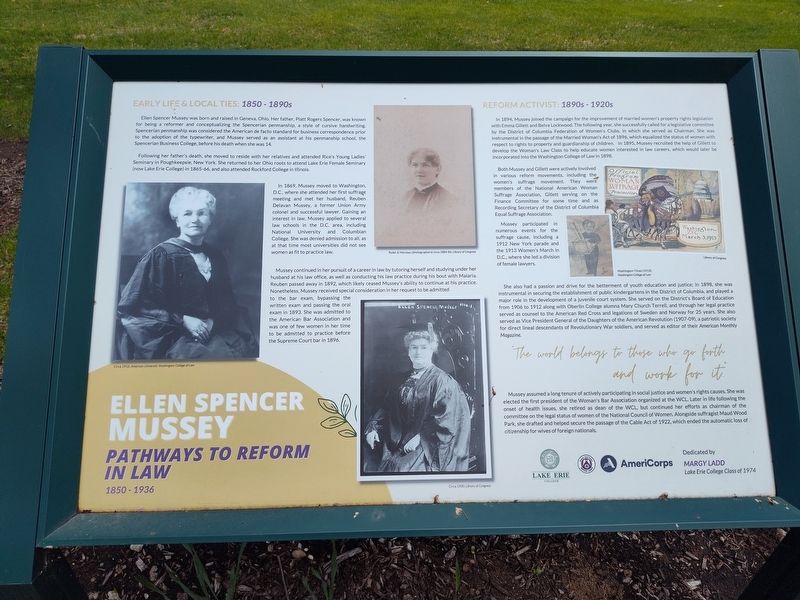
Ellen Spencer Mussey was born and raised in Geneva, Ohio. Her father, Platt Rogers Spencer, was known for being a reformer and conceptualizing the Spencerian penmanship, a style of cursive handwriting. Spencerian penmanship was considered the American de facto standard for business correspondence prior to the adoption of the typewriter, and Mussey served as an assistant at his penmanship school, the Spencerian Business College, before his death when she was 14.
Following her father's death, she moved to reside with her relatives and attended Rice's Young Ladies' Seminary in Poughkeepsie, New York. She returned to her Ohio roots to attend Lake Erie Female Seminary (now Lake Erie College) in 1865-66, and also attended Rockford College in Illinois.
In 1869, Mussey moved to Washington, D.C., where she attended her first suffrage meeting and met her husband, Reuben Delavan Mussey, a former Union Army colonel and successful lawyer. Gaining an interest in law, Mussey applied to several law schools in the D.C. area, including National University and Columbian College. She was denied admission
this page online
Mussey continued in her pursuit of a career in law by tutoring herself and studying under her husband at his law office, as well as conducting his law practice during his bout with Malaria. Reuben passed away in 1892, which likely ceased Mussey's ability to continue at his practice. Nonetheless, Mussey received special consideration in her request to be admitted to the bar exam, bypassing the written exam and passing the oral exam in 1893. She was admitted to the American Bar Association and was one of few women in her time to be admitted to practice before the Supreme Court bar in 1896.
Reform Activist: 1890S - 1920s
In 1894, Mussey joined the campaign for the improvement of married women's property rights legislation with Emma Gillett and Belva Lockwood. The following year, she successfully called for a legislative committee by the District of Columbia Federation of Women's Clubs, in which she served as Chairman. She was instrumental in the passage of the Married Woman's Act of 1896, which equalized the status of women with respect to rights to
Photographed by Craig Doda, May 2, 2026
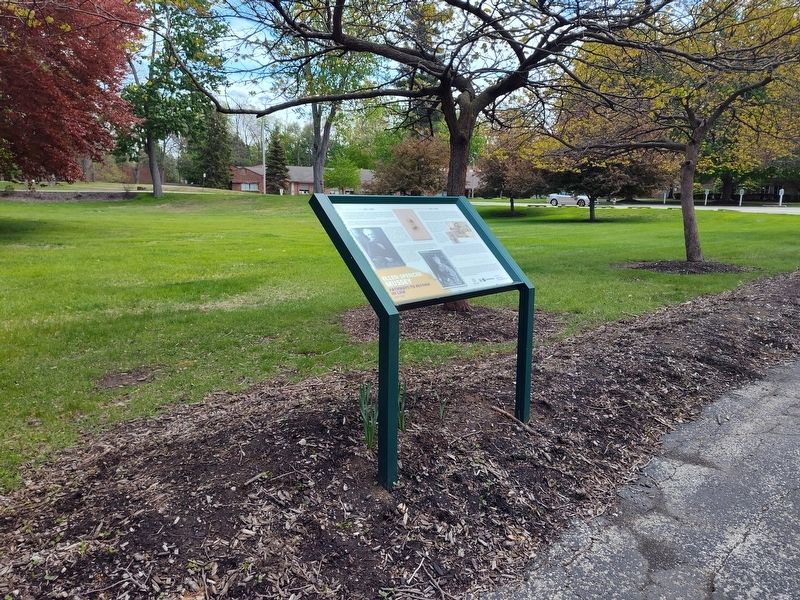
2. Ellen Spencer Mussey 1850 - 1936 Marker
Both Mussey and Gillett were actively involved in various reform movements, including the women's suffrage movement. They were members of the National American Woman Suffrage Association, Gillett serving on the Finance Committee for some time and as Recording Secretary of the District of Columbia Equal Suffrage Association.
Mussey participated in numerous events for the suffrage cause, including a 1912 New York parade and the 1913 Women's March in D.C., where she led a division of female lawyers.
She also had a passion and drive for the betterment of youth education and justice; in 1898, she was instrumental in securing the establishment of public kindergartens in the District of Columbia, and played a major role in the development of a juvenile court system. She served on the District's Board of Education from 1906 to 1912 along with Oberlin College alumna Mary Church Terrell, and through
Photographed by Craig Doda, May 2, 2026
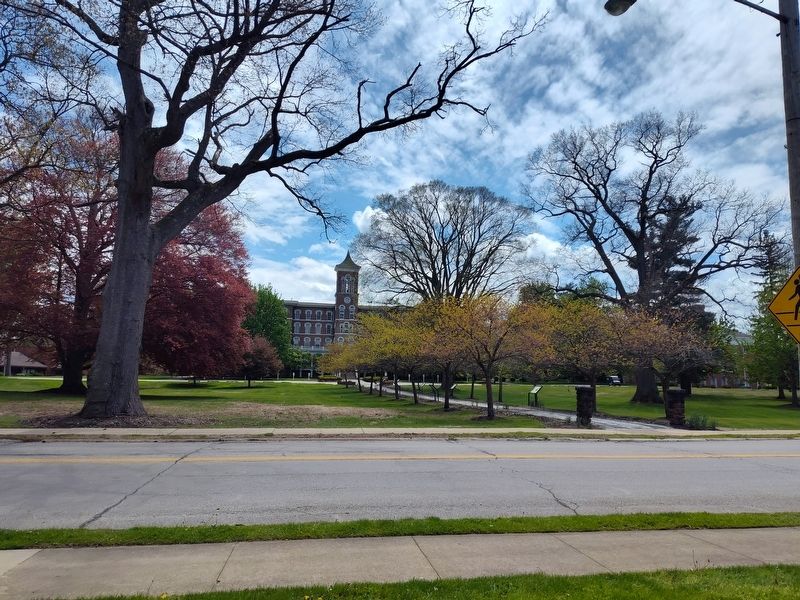
3. Lake Erie College
The world belongs to those who go forth and work for it.
Mussey assumed a long tenure of actively participating in social justice and women's rights causes. She was elected the first president of the Woman's Bar Association organized at the WCL. Later in life following the onset of health issues, she retired as dean of the WCL, but continued her efforts as chairman of the committee on the legal status of women of the National Council of Women. Alongside suffragist Maud Wood Park, she drafted and helped secure the passage of the Cable Act of 1922, which ended the automatic loss of citizenship for wives of foreign nationals.
Topics. This historical marker is listed in these topic lists: Civil Rights • Government & Politics • Women. A significant historical year for this entry is 1869.
Location. 41° 43.113′ N, 81° 15.127′ W. Marker is in Painesville, Ohio, in Lake County. It is at the intersection of West Washington Street and Mentor Avenue, on the right when traveling east on West Washington Street. Touch for map. Marker is at or near this postal address: 367 Mentor Ave, Painesville OH 44077, United States of America. Touch for directions.

Regionally, this marker is in Greater Cleveland, on the Lake Erie Shore, and in the Western Reserve. It is also in the American Midwest. Globally, it is in North America, on the Great Lakes, in the Western Hemisphere, in the Western World, and in the Anglosphere. Historically, it finds itself in what was once the Haudenosaunee (Iroquois) Confederacy, the territory of the Mississippian Culture, and the Northwest Territory.
Other nearby markers. At least 8 other markers are within walking distance of this marker: The Road to Women's Suffrage (a few steps from this marker); Florence Ellinwood Allen (a few steps from this marker); Harriet Taylor Upton 1853 - 1945 (a few steps from this marker); Betsey Mix Cowles 1810 - 1876 (a few steps from this marker); Painesville Equal Rights Association (within shouting distance of this marker); Emma Millinda Gillett 1852 - 1927 (within shouting distance of this marker); Women in Higher Ed (within shouting distance of this marker); Ohio Woman Suffrage Association 1885 Convention (within shouting distance of this marker). Touch for a list and map of all markers in Painesville.
Credits. This page was last revised on May 27, 2026. It was originally submitted on May 19, 2026, by Craig Doda of Napoleon, Ohio. This page has been viewed 16 times since then. Photos: 1, 2, 3. submitted on May 19, 2026, by Craig Doda of Napoleon, Ohio. • Devry Becker Jones was the editor who published this page.
