Painesville in Lake County, Ohio — The American Midwest (Great Lakes)
Florence Ellinwood Allen
A Journey to Justice
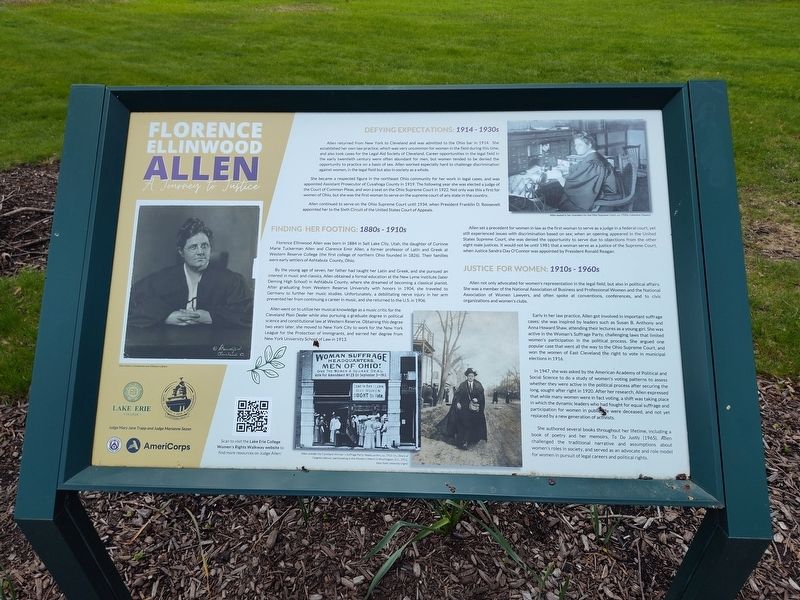
Photographed by Craig Doda, May 2, 2026
1. Florence Ellinwood Allen Marker
Defying Expectations: 1914-1930s
Allen returned from New York to Cleveland and was admitted to the Ohio bar in 1914. She established her own law practice, which was very uncommon for women in the field during this time, and also took cases for the Legal Aid Society of Cleveland. Career opportunities in the legal field in the early twentieth century were often abundant for men, but women tended to be denied the opportunity to practice on a basis of sex. Allen worked especially hard to challenge discrimination against women, in the legal field but also in society as a whole.
She became a respected figure in the northeast Ohio community for her work in legal cases, and was appointed Assistant Prosecutor of Cuyahoga County in 1919. The following year she was elected a judge of the Court of Common Pleas, and won a seat on the Ohio Supreme Court in 1922. Not only was this a first for women of Ohio, but she was the first woman to serve on the supreme court of any state in the country.
Allen continued to serve on the Ohio Supreme Court until 1934, when President Franklin D. Roosevelt appointed her to the Sixth Circuit of the
this page online
Finding Her Footing: 1880s - 1910s
Florence Ellinwood Allen was born in 1884 in Salt Lake City, Utah, the daughter of Corinne Marie Tuckerman Allen and Clarence Emir Allen, a former professor of Latin and Greek at Western Reserve College (the first college of northern Ohio founded in 1826). Their families were early settlers of Ashtabula County, Ohio.
By the young age of seven, her father had taught her Latin and Greek, and she pursued an interest in music and classics. Allen obtained a formal education at the New Lyme Institute (later Deming High School) in Ashtabula County, where she dreamed of becoming a classical pianist. After graduating from Western Reserve University with honors in 1904, she traveled to Germany to further her music studies. Unfortunately, a debilitating nerve injury in her arm prevented her from continuing a career in music, and she returned to the U.S. in 1906.
Allen went on to utilize her musical knowledge as a music critic for the Cleveland Plain Dealer while also pursuing a graduate degree in political science and constitutional law at Western Reserve. Obtaining this degree

Photographed by Craig Doda, May 2, 2026
2. Florence Ellinwood Allen Marker
Allen set a precedent for women in law as the first woman to serve as a judge in a federal court, yet still experienced issues with discrimination based on sex; when an opening appeared in the United States Supreme Court, she was denied the opportunity to serve due to objections from the other eight male justices. It would not be until 1981 that a woman serve as a justice of the Supreme Court, when Justice Sandra Day O'Connor was appointed by President Ronald Reagan.
Justice For Women: 1910s - 1960s
Allen not only advocated for women's representation in the legal field, but also in political affairs. She was a member of the National Association of Business and Professional Women and the National Association of Women Lawyers, and often spoke at conventions, conferences, and to civic organizations and women's clubs.
Early in her law practice, Allen got involved in important suffrage cases; she was inspired by leaders such as Susan B. Anthony and Anna Howard

Photographed by Craig Doda, May 2, 2026
3. Lake Erie College
In 1947, she was asked by the American Academy of Political and Social Science to do a study of women's voting patterns to assess whether they were active in the political process after securing the long, sought-after right in 1920. After her research, Allen expressed that while many women were in fact voting, a shift was taking place in which the dynamic leaders who had fought for equal suffrage and participation for women in public life were deceased, and not yet replaced by a new generation of activists.
She authored several books throughout her lifetime, including a book of poetry and her memoirs, To Do Justly (1965). Allen challenged the traditional narrative and assumptions about women's roles in society, and served as an advocate and role model for women in pursuit of legal careers and political rights.
Erected by Lake Erie College.
Topics. This historical marker is listed in these topic lists: Civil Rights • Government & Politics • Women. A significant historical year for this entry is 1914.
Location. 41° 43.107′ N, 81° 15.13′ W. Marker is in Painesville, Ohio, in Lake County. It is at the intersection of West Washington Street and Mentor Avenue, on the right when traveling east on West Washington Street. Touch for map. Marker is at or near this postal address: 367 Mentor Ave, Painesville OH 44077, United States of America. Touch for directions.

Regionally, this marker is in Greater Cleveland, on the Lake Erie Shore, and in the Western Reserve. It is also in the American Midwest. Globally, it is in North America, on the Great Lakes, in the Western Hemisphere, in the Western World, and in the Anglosphere. Historically, it finds itself in what was once the Haudenosaunee (Iroquois) Confederacy, the territory of the Mississippian Culture, and the Northwest Territory.
Other nearby markers. At least 8 other markers are within walking distance of this marker: Betsey Mix Cowles 1810 - 1876 (here, next to this marker); Ellen Spencer Mussey 1850 - 1936 (a few steps from this marker); Painesville Equal Rights Association (a few steps from this marker); The Road to Women's Suffrage (a few steps from this marker); Women in Higher Ed (a few steps from this marker); Harriet Taylor Upton 1853 - 1945 (within shouting distance of this marker); Mary Evans (within shouting distance of this marker); Ohio Woman Suffrage Association 1885 Convention (within shouting distance of this marker). Touch for a list and map of all markers in Painesville.
Credits. This page was last revised on May 27, 2026. It was originally submitted on May 19, 2026, by Craig Doda of Napoleon, Ohio. This page has been viewed 20 times since then. Photos: 1, 2, 3. submitted on May 19, 2026, by Craig Doda of Napoleon, Ohio. • Devry Becker Jones was the editor who published this page.
