Manzanar National Historic Site near Independence in Inyo County, California — The American West (Pacific Coastal)
The Manzanar Riot
Photographed by Craig Baker, May 13, 2026
1. Manzanar Riot Marker
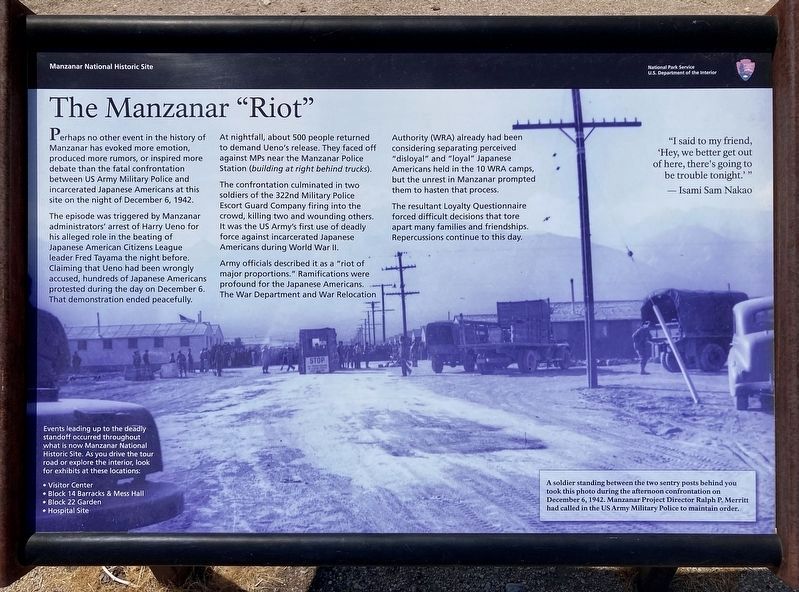
Perhaps no other event in the history of Manzanar has evoked more emotion, produced more rumors, or inspired more debate than the fatal confrontation between US Army Military Police and incarcerated Japanese Americans at this site on the night of December 6, 1942.
The episode was triggered by Manzanar administrators' arrest of Harry Ueno for his alleged role in the beating of Japanese American Citizens League leader Fred Tayama the night before. Claiming that Ueno had been wrongly accused, hundreds of Japanese Americans protested during the day on December 6. That demonstration ended peacefully.
At nightfall, about 500 people returned to demand Ueno's release. They faced off against MPs near the Manzanar Police Station (building at right behind trucks).
The confrontation culminated in two soldiers of the 322nd Military Police Escort Guard Company firing into the crowd, killing two and wounding others. It was the US Army's first use of deadly force against incarcerated Japanese Americans during World War II. Army officials described it as a "riot of major proportions." Ramifications were profound for the Japanese Americans. The War Department and War Relocation Authority (WRA) already had been considering separating perceived "disloyal" and "loyal" Japanese Americans held in the 10 WRA camps, but the unrest in Manzanar prompted them to hasten that process.
The resultant Loyalty Questionnaire forced difficult decisions that tore apart many families
this page online
Injustice, Anger, Tragedy
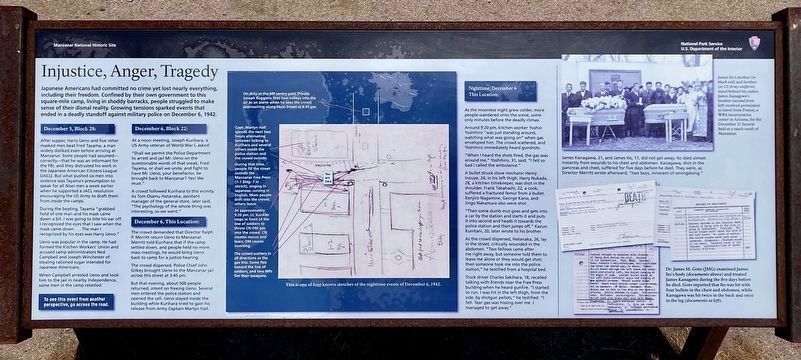
Japanese Americans had committed no crime yet lost nearly everything including their freedom. Confined by their own government to this square-mile camp, living in shoddy barracks, people struggled to make sense of their dismal reality. Growing tensions sparked events that ended in a deadly standoff against military police on December 6, 1942.
December 5, Block 28:
After supper, Harry Uno and five other masked men beat Fred Tayama, a man widely disliked even before arriving at Manzanar. Some people had assumed - correctly - that he was an informant for the FBI, and they distrusted his work in the Japanese American Citizens League (JACL). But what pushed six men into violence was Tayama's presumption to speak for all Nisei men a week earlier when he supported a JACL resolution encouraging the US Army to draft them from inside the camps.
During the beating, Tayama "grabbed hold of one man and his mask came down a bit. I was going to bite his ear off. I recognized the eyes that I saw when the mask came down... The man I recognized by his eyes was Harry Ueno."
Ueno was popular in the camp. He had formed the Kitchen Workers' Union and accused camp administrators Ned Campbell and Joseph Winchester of stealing rationed sugar intended for Japanese Americans. When Campbell arrested Ueno and took him to the jail in nearby Independence, some men in the camp rebelled.
December 6, Block 22:
At a noon meeting,
Photographed by Craig Baker, May 13, 2026
2. Manzanar Riot: Injustice, Anger, Tragedy
Click on any photo to see it full size.
"Shall we permit the Police Department to arrest and jail Mr. Ueno on the questionable words of that sneak, Fred Tayama, or shall we unite, and fight to have Mr. Ueno, your benefactor, be brought back to Manzanar? Yes! We must."
A crowd followed Kurihara to this vicinity. As Tom Osamu Hatanaka, assistant manager of the general store, later said, "The psychology of the whole thing was interesting, so we went."
December 6, This Location:
The crowd demanded that Director Ralph P. Merritt return Ueno to Manzanar. Merritt told Kurihara that if the camp settled down, and people held no more mass meetings, he would bring Ueno back to camp for a justice hearing.
The crowd dispersed. Police Chief John Gilkey brought Ueno to the Manzanar jail across this street at 3:45 pm.
But that evening, about 500 people returned, intent on freeing Ueno. Several men entered the police station and opened the cell. Ueno stayed inside the building while Kurihara tried to gain his release from Army Captain Martyn Hall.
Nighttime, December 6, This Location:
As the moonless night grew colder, more people wandered onto the scene, some only minutes before the deadly climax.
Around 9:20 pm, kitchen worker Yoshio Yoshihiro "was just standing around, watching what was going on" when gas enveloped him. The crowd scattered, and Yoshihiro immediately heard gunshots.
"When I heard the shots fired, the gas was around me," Yoshihiro, 31, said.
Photographed by Craig Baker, May 13, 2026
3. Manzanar Riot: A Deadly Standoff
A bullet struck stove mechanic Henry Inouye, 24, in his left thigh. Harry Nukada, 28, a kitchen timekeeper, was shot in the shoulder. Frank Takahashi, 22, a cook, suffered a fractured femur from a bullet. Kenjiro Nagamine, George Kano, and Jingo Nakamura also were shot.
"Then some dumb mut goes and gets into a car by the station and starts it and puts it into second and heads it towards the police station and then jumps off," Kazuo Kunitani, 20, later wrote to his brother.
As the crowd dispersed, Hatanaka, 26, lay in the street, critically wounded in the abdomen. "Two fellows came after me right away, but someone told them to leave me alone or they would get shot; then someone took me into the police station," he testified from a hospital bed.
Truck driver Charles Sakihara, 18, recalled talking with friends near the Free Press building when he heard gunfire. "I started to run. I was hit in the left thigh, from the side, by shotgun pellets," he testified. "I fell. Tear gas was hissing over me. I managed to get away."
illustration details:
On duty at the MP sentry post, Private Joseph Ruggiero fires two volleys into the air as an alarm when he sees the crowd approaching along Main Street at 6:45 pm.
Capt. Martyn Hall spends the next two hours alternating between talking to Kurihara and several others inside the police station and the crowd outside.
During that time, people fill the street outside the Manzanar Free Press (1-1
Photographed by Craig Baker, May 13, 2026
4. Manzanar Riot: A Historical Find
At approximately 9:20 pm, Lt. Kunkler steps in front of the line of soldiers to throw CN-DM gas into the crowd. CN creates mucus and tears; DM causes vomiting.
The crowd scatters in all directions as the gas hits. Some flee toward the line of soldiers, and two MPs fire their weapons.
A Deadly Standoff
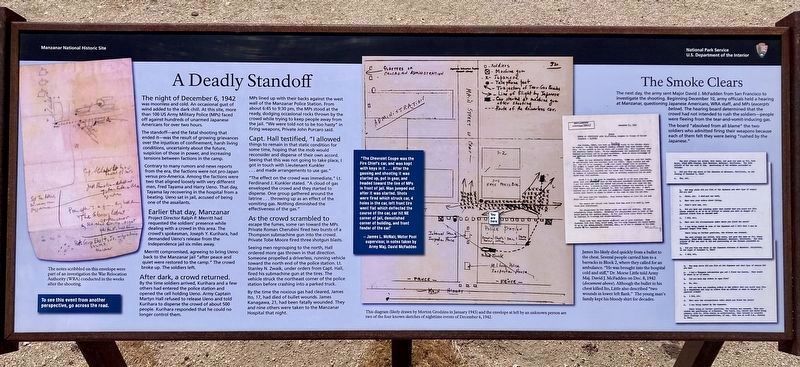
The night of December 6, 1942 was moonless and cold. An occasional gust of wind added to the dark chill. At this site, more than 100 US Army Military Police (MPs) faced off against hundreds of unarmed Japanese Americans for over two hours.
The standoff - and the fatal shooting that ended it - was the result of growing grievances over the injustices of confinement, harsh living conditions, uncertainty about the future, suspicion of those in power, and increasing tensions between factions in the camp.
Contrary to many rumors and news reports from the era, the factions were not pro-Japan versus pro-America. Among the factions were two that aligned loosely with very different men, Fred Tayama and Harry Ueno. That day, Tayama lay recovering in the hospital from a beating. Ueno sat in jail, accused of being one of the assailants.
Earlier that day, Manzanar Project Director Ralph P. Merritt had requested the soldiers' presence while dealing with a crowd in this area. The crowd's spokesman, Joseph Y. Kurihara, had demanded Uno's release from the Independence jail six miles away.
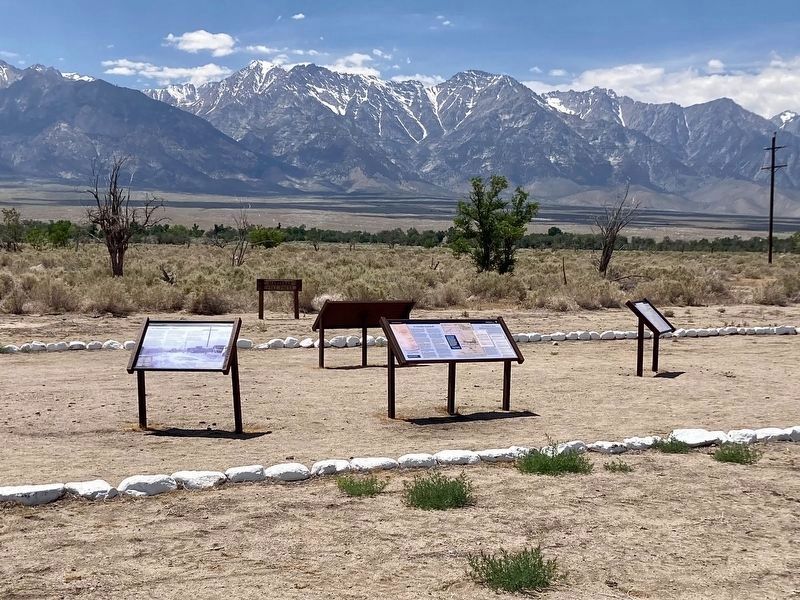
Photographed by Craig Baker, May 13, 2026
5. Manzanar Riot Markers
Merritt compromised, agreeing to bring Ueno back to the Manzanar jail "after peace and quiet were restored to the camp." The crowd broke up. The soldiers left.
After dark, a crowd returned. By the time soldiers arrived, Kurihara and a few others had entered the police station and opened the cell holding Ueno. Army Captain Martyn Hall refused to release Ueno and told Kurihara to disperse the crowd of about 500 people. Kurihara responded that he could no longer control them.
MPs lined up with their backs against the west wall of the Manzanar Police Station. From about 6:45 to 9:30 pm, the MPs stood at the ready, dodging occasional rocks thrown by the crowd while trying to keep people away from the jail. "We were told not to be too hasty" in firing weapons, Private John Purcaro said.
Capt. Hall testified, "I allowed things to remain in that static condition for some time, hoping that the mob would reconsider and disperse of their own accord. Seeing that this was not going to take place, I got in touch with Lieutenant Kunkler ...and made arrangements to use gas."
"The effect on the crowd was immediate," Lt. Ferdinand J. Kunkler stated. "A cloud of gas enveloped the crowd and they started to disperse. One group gathered around the latrine... throwing up as an effect of the vomiting gas. Nothing diminished the effectiveness of the gas."
As the crowd scrambled to escape the fumes, some ran toward the MPs. Private Roman Cherubini fired two bursts of a Thompson submachine gun into the crowd. Private
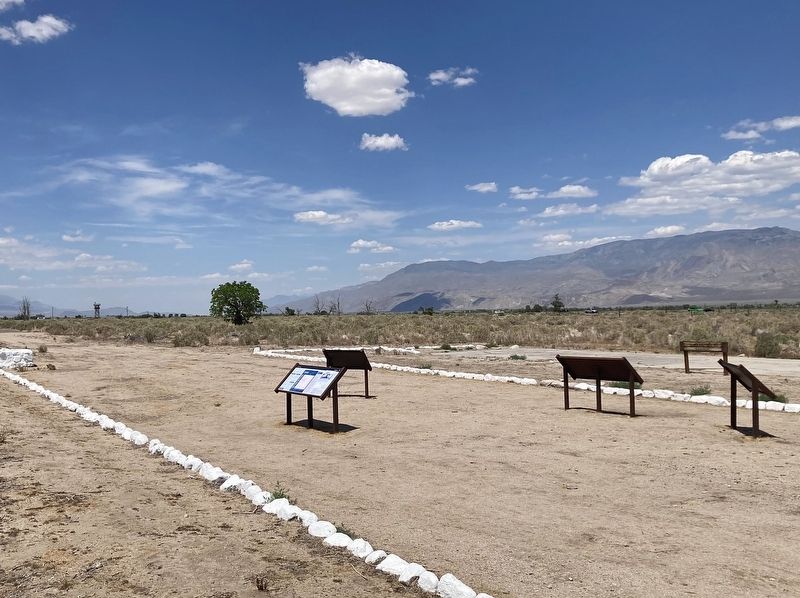
Photographed by Craig Baker, May 13, 2026
6. Manzanar Riot Markers
Seeing men regrouping to the north, Hall ordered more gas thrown in that direction. Someone propelled a driverless, running vehicle toward the north end of the police station. Lt. Stanley N. Zwaik, under orders from Capt. Hall, fired his submachine gun at the tires. The vehicle struck the northeast corner of the police station before crashing into a parked truck.
By the time the noxious gas had cleared, James Ito, 17, had died of bullet wounds. James Kanagawa, 21, had been fatally wounded. They and nine others were taken to the Manzanar Hospital that night.
The Smoke Clears
The next day, the army sent Major David J. McFadden from San Francisco to investigate the shooting. Beginning December 10, army officials held a hearing at Manzanar, questioning Japanese Americans, WRA staff, and MPs (excerpts below). The hearing board determined that the crowd had not intended to rush the soldiers - people were fleeing from the tear-and-vomit-inducing gas. The board "absolved from all blame" the two soldiers who admitted firing their weapons because each of them felt they were being "rushed by the Japanese."
A Historical Find
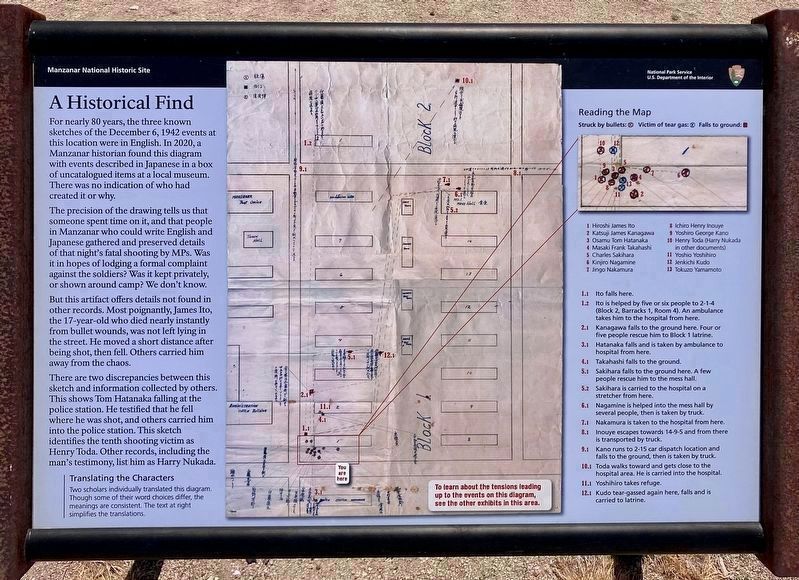
For nearly 80 years, the three known sketches of the December 6, 1942 events at this location were in English. In 2020, a Manzanar historian found this diagram with events described in Japanese in a box of uncatalogued items at a local museum. There was no indication of who had created it or why.
The precision of the drawing
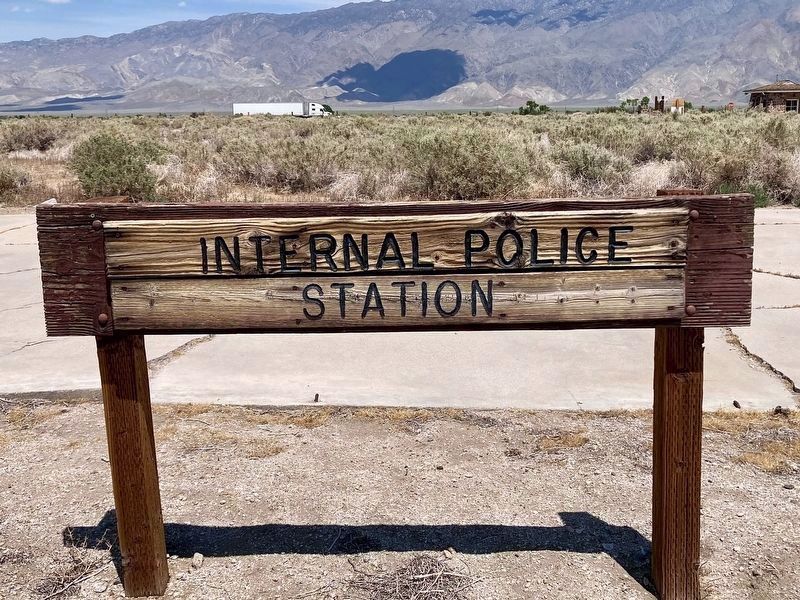
Photographed by Craig Baker, May 13, 2026
7. Police Station location
But this artifact offers details not found in other records. Most poignantly, James Ito, the 17-year-old who died nearly instantly from bullet wounds, was not left lying in the street. He moved a short distance after being shot, then fell. Others carried him away from the chaos.
There are two discrepancies between this sketch and information collected by others. This shows Tom Hatanaka falling at the police station. He testified that he fell where he was shot, and others carried him into the police station. This sketch identifies the tenth shooting victim as Henry Toda. Other records, including the man's testimony, list him as Harry Nukada.
Erected by National Park Service.
Topics. This historical marker is listed in these topic lists: Asian Americans • Civil Rights • Law Enforcement • War, World II. A significant historical date for this entry is December 6, 1942.
Location. 36° 43.564′ N, 118° 8.742′ W. Marker is near Independence, California, in Inyo County. It is in Manzanar National Historic Site. It can be reached from Manzanar Reward Road west of U.S. 395. Touch for map. Marker is at or near this postal address: 5001 US-395, Independence CA 93526, United States of America. Touch for directions.

Regionally, this marker is in California’s Sierra Nevada. It is also in the American Mountain West. Globally, it is in North America, on the Ring of Fire, in the Pacific Rim, in the Western Hemisphere, in the Western World, and in the Anglosphere. Historically, it finds itself in what was once New Spain and also Mexico’s Alta California.
Other nearby markers. At least 8 other markers are within walking distance of this marker: First Street, Manzanar, USA (within shouting distance of this marker); Managing Manzanar (within shouting distance of this marker); A Community Apart (about 400 feet away, measured in a direct line); Manzanar (approx. 0.2 miles away); Manzanar National Historic Site (approx. 0.2 miles away); A Community's Living Room (approx. 0.2 miles away); Crowded Quarters (approx. ¼ mile away); Block 14 (approx. ¼ mile away). Touch for a list and map of all markers in Independence.
Credits. This page was last revised on May 30, 2026. It was originally submitted on May 24, 2026, by Craig Baker of Sylmar, California. This page has been viewed 40 times since then. Photos: 1, 2, 3, 4, 5, 6. submitted on May 24, 2026, by Craig Baker of Sylmar, California. 7. submitted on May 25, 2026, by Craig Baker of Sylmar, California.
