Horatio Nelson
(1758-1805)


Horatio Nelson est entré dans la marine britannique dès l'âge de douze ans. Il se rend aux Indes, puis participe à la guerre de l'Indépendance américaine. En 1793, il est associé aux opérations menées contre la France par l'escadre britannique en Méditerranée. L'amiral Nelson est surtout célèbre pour sa participation à la bataille de Trafalgar où sa flotte parviendra à briser la ligne de défense, lui assurant ainsi la victoire, mais où il trouvera aussi la mort.
Collection municipale d'art public
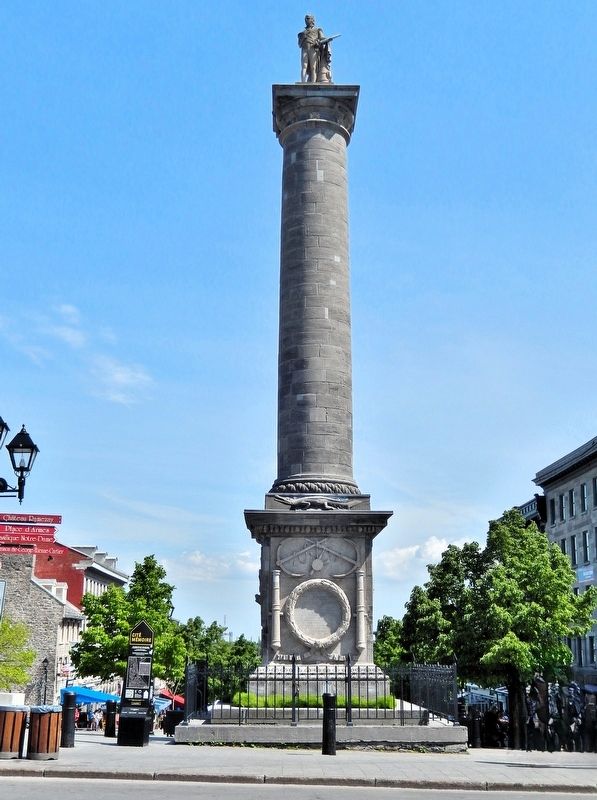
Titre : Monument à l'amiral Horatio Nelson (Colonne Nelson)
Artiste : Robert Mitchell
Matériaux : Statue — calcaire gris de Montréal; Colonne : calcaire de l'Indiana; Médaillons et inscriptions : grès
Fabrication : Une réplique de la statue originale a été réalisée en 1998 par Lawrence Voaides-Cajban, en raison de la dégradation de sa pierre artificielle. Coade and Sealy.
Installation : 1803
Acquisition : Commande à la suite d'une souscription publique
Emplacement : Place Jacques-Cartier, Arrondissement de Ville-Marie
www: ville.montreal.qc.ca/artpublic
Horatio Nelson entered the British Navy
this page online
Municipal Public Art Collection
Title: Monument to Admiral Horatio Nelson (Nelson Column)
Artist: Robert Mitchell
Materials: Statue — Montreal grey limestone; Column: Indiana limestone; Medallions and inscriptions: sandstone
Manufacture: A replica of the original statue was made in 1998 by Lawrence Voaides-Cajban, due to the deterioration of its artificial stone. Coade and Sealy
Installation: 1803
Acquisition: Commission following a public subscription
Location: Place Jacques-Cartier, Ville-Marie Borough
www: ville.montreal.qc.ca/artpublic
Topics. This historical marker is listed in these topic lists: Arts, Letters, Music • Colonial Era • War, US Revolutionary • Wars, Non-US. A significant historical year for this entry is 1793.
Location. 45° 30.502′ N, 73° 33.228′ W.


Regionally, this marker is in Central Canada. Globally, it is in North America, the Western Hemisphere, and the Western World. Historically, it finds itself in what was once a British colony, the Viceroyalty of New France, the Haudenosaunee (Iroquois) Confederacy, and Rupert’s Land.
Other nearby markers. At least 8 other markers are within walking distance of this marker: Le Château Ramezay / Château Ramezay (here, next to this marker); The Nelson Column, Montreal (a few steps from this marker); Entrez dans l'histoire! / Step into History! (within shouting distance of this marker); Jacques Viger (within shouting distance of this marker); Place Vauquelin (within shouting distance of this marker); Un jardin à la mode de Nouvelle-France / A Garden in the Style of New France (within shouting distance of this marker); Château de Ramezay
Related markers. Click here for a list of markers that are related to this marker.
Also see . . .
1. Horatio Nelson (Wikipedia).
Excerpt: Vice-Admiral of the White Horatio Nelson, 1st Viscount Nelson, 1st Duke of Bronte was a Royal Navy officer whose leadership, grasp of strategy, and unconventional tactics led to multiple decisive British naval victories during the French Revolutionary and Napoleonic Wars. Trafalgar Square is dedicated to him. He is widely regarded as one of the greatest admirals in history. Nelson's influence continued long after his death and saw periodic revivals of interest, especially during times of crisis in Britain. His death at the pivotal Battle of Trafalgar solidified his public status as a hero. Nelson has been frequently depicted in art and literature; appearing in paintings by Benjamin West and Arthur William Devis, and in books and biographies by John McArthur, James Stanier Clarke and Robert Southey. The city of Nelson in New Zealand is named after him. A number of monuments and memorials were constructed across Britain and abroad to honor his achievements.(Submitted on May 25, 2026, by Cosmos Mariner of Cape Canaveral, Florida.)
2. Nelson's Column (Montreal) (Wikipedia).
Excerpt: Nelson's Column is dedicated to the memory of Admiral Horatio Nelson, following his death at the Battle of Trafalgar. Subsequent to the destruction of Nelson's Pillar in Dublin (1808–1966), Montreal's pillar now stands as the second oldest "Nelson's Column" in the world, after the Nelson Monument in Glasgow. It is the city's oldest monument and the oldest war monument in Canada.(Submitted on May 25, 2026, by Cosmos Mariner of Cape Canaveral, Florida.)
3. Monument à Nelson (Montréal Bureau of Public Art).
Excerpt: Le monument se compose d’une base quadrangulaire d’où s'élève une colonne à fût circulaire d'ordre dorique. Sa forme et ses proportions sont inspirées de la colonne de Trajan, à Rome. Des panneaux, rehaussés de médaillons en bas-relief et d'inscriptions gravées, occupent chacune des faces de la base. Ils rappellent les batailles et les exploits par lesquels s'est illustré l’amiral Lord Nelson.(Submitted on May 25, 2026, by Cosmos Mariner of Cape Canaveral, Florida.)Tout en haut de la colonne, dont la base est enserrée dans une glène de cordage, sur une plate-forme carrée, est déposée la statue de Nelson. Il est vêtu de son costume d'amiral et porte tous les insignes dont il fut décoré. Son pied droit est pointé vers l’avant, il se tient le bras gauche appuyé sur un tronçon de mât entouré de cordages et de palans, une lunette d'approche à la main. Du côté de son bras manquant (le bras droit), la manche de sa veste est repliée sur la poitrine. La statue est environ une fois et demie grandeur nature. À l’origine, la statue et les panneaux décoratifs étaient en pierre Coade, un matériau synthétique mis au point par la Coade & Sealy's Lambeth Company de Londres, dont la recette est aujourd’hui disparue.
[English translation] The monument consists of a quadrangular base from which rises a circular-shafted column of the Doric order. Its shape and proportions are inspired by Trajan's Column in Rome. Panels, enhanced with bas-relief medallions and engraved inscriptions, occupy each face of the base. They recall the battles and exploits through which Admiral Lord Nelson distinguished himself.
At the very top of the column, whose base is encased in a coil of rope, on a square platform, stands the statue of Nelson. He is dressed in his admiral's uniform and wears all the insignia with which he was decorated. His right foot is pointed forward, he stands with his left arm resting on a section of mast surrounded by ropes and pulleys, a spyglass in hand. On the side of his missing arm (the right arm), the sleeve of his jacket is folded across his chest. The statue is approximately one and a half times life-size. Originally, the statue and the decorative panels were made of Coade stone, a synthetic material developed by Coade & Sealy's Lambeth Company in London, the recipe for which is now lost.
Credits. This page was last revised on May 25, 2026. It was originally submitted on May 25, 2026, by Cosmos Mariner of Cape Canaveral, Florida. This page has been viewed 9 times since then. Photos: 1, 2, 3. submitted on May 25, 2026, by Cosmos Mariner of Cape Canaveral, Florida.
