East Melbourne in Melbourne, Victoria, Australia — Oceania
Fitzroy Gardens
Trees in Time

Photographed by Dean Barton-Ancliffe, May 11, 2026
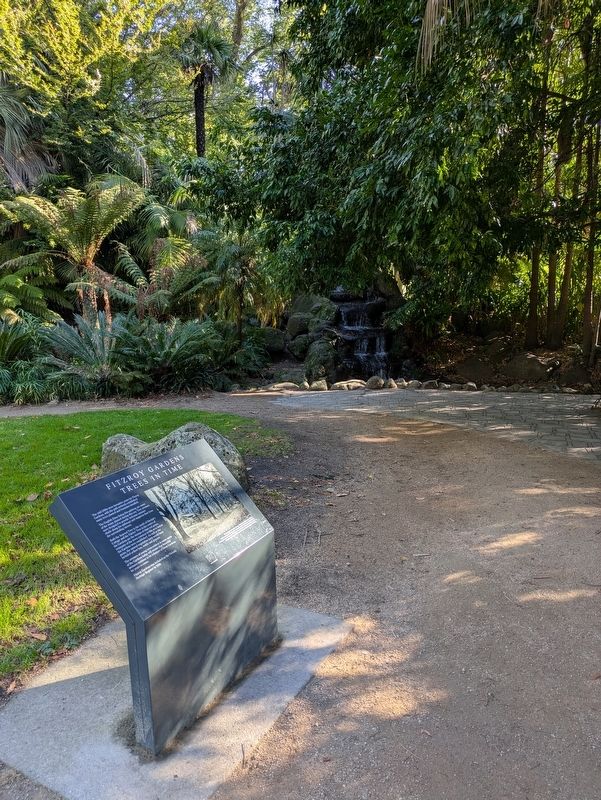
1. Fitzroy Gardens Trees in Time Marker
The English Elms lining this pathway are some of the many planted during this era. Tree avenues were designed to provide welcome summer shade along the pathways and suppress dust from the surrounding streets.
Both the Scarred Tree to the south of Sinclair's Cottage and the Fairies' Tree in the centre of the Gardens are the stumps of river red gums, remnants of the trees common to this area before the Gardens were established. As well as the gums, the natural vegetation here would have included yellow box, wattle and grasses.
The avenues of young trees evident in some parts of the Gardens today will ensure that beautiful avenues continue to be a feature of these Gardens for years to come.
Fitzroy Gardens was included on the Victoria Heritage Register in 1998.
(Picture Caption) Elm Avenue and Sinclair's Cottage c1910 (City of Melbourne Archive).
While a common tree in the parks and gardens around Melbourne, English Elms (Ulmus procera) are now rare worldwide, due to the effects
this page online
Erected by City of Melbourne.
Topics. This historical marker is listed in these topic lists: Colonial Era • Parks & Recreational Areas. A significant historical year for this entry is 1850.
Location. 37° 48.822′ S, 144° 58.82′ E. Marker is in East Melbourne, Victoria, in Melbourne. It can be reached from Wellington Parade (Route 30) 0.2 kilometers north of Jolimont Road. Touch for map. Marker is at or near this postal address: Wellington Parade, East Melbourne VIC 3002, Australia. Touch for directions.

Regionally, it is in Oceania, in Australasia, in the Pacific Ocean, in South Pacific, on the Pacific Rim, in the Western World, and in the Anglosphere. Historically, it finds itself in what was once a British colony.
Other nearby markers. At least 8 other markers are within walking distance of this marker: The Fairies Tree (within shouting distance of this marker); Sinclair's Cottage (within shouting distance of this marker); Model Tudor Village (about 90 meters away, measured in a direct line); Scarred Tree (about 120
Photographed by Dean Barton-Ancliffe, May 11, 2026
2. Fitzroy Gardens Trees in Time Marker
Also see . . . Fitzroy Gardens. Victorian Heritage Database
The Fitzroy Gardens were set aside as a public reserve, then known as Fitzroy Square, in 1848. Partially cleared and fenced during the 1840s and 1850s, it was not until 1859 that the reserve was laid out and developed as a garden under the supervision of Deputy Surveyor-General Clement Hodgkinson with the assistance of gardener James Sinclair. Fitzroy Gardens retain their original path system, albeit somewhat simplified and resurfaced. They also retain avenues of mature elms which are of national significance in their own right, together with remnants of the 1860s and 1870s mix of conifers and other specimen trees, and examples of ribbon border planting and sub-tropical planting of the late nineteenth century. A substantial collection of nineteenth century buildings also survives within the Gardens.(Submitted on May 27, 2026, by Dean Barton-Ancliffe of Rowville, Victoria.)
Like many nineteenth century gardens, the Fitzroy Gardens presents a layering of later phases of development, each curator introducing a slightly different landscape style and altering its overall character. In particular, the Gardens underwent major change in the interwar period, with the removal of large numbers of trees and the introduction of a new garden aesthetic. This period also saw the modification of path alignments and detailing and the expansion of the works area, as well as the addition of a number of distinctive new buildings, structures and works of sculpture. The interwar character is still visible to a large degree in the fabric of the place and demonstrates a major phase in its history. Today, the Fitzroy Gardens present as a series of layers that combine to create a cultural landscape of considerable individuality and diversity.
Credits. This page was last revised on May 28, 2026. It was originally submitted on May 27, 2026, by Dean Barton-Ancliffe of Rowville, Victoria. This page has been viewed 13 times since then. Photos: 1, 2. submitted on May 27, 2026, by Dean Barton-Ancliffe of Rowville, Victoria. • Andrew Ruppenstein was the editor who published this page.
