Takoma Park in Montgomery County, Maryland — The American Northeast (Mid-Atlantic)
Heffner Park and Community Center
The Place To Go
| — | Remarkable Montgomery: Untold Stories | — |
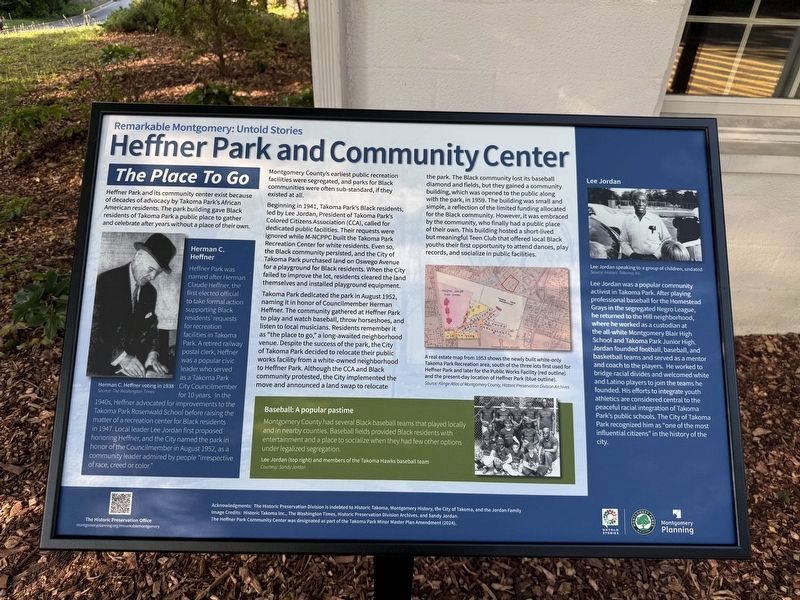
Heffner Park and its community center exist because of decades of advocacy by Takoma Park's African American residents. The park building gave Black residents of Takoma Park a public place to gather and celebrate after years without a place of their own.
Montgomery County's earliest public recreation facilities were segregated, and parks for Black communities were often sub-standard, if they existed at all.
Beginning in 1941, Takoma Park's Black residents, led by Lee Jordan, President of Takoma Park's Colored Citizens Association (CCA), called for dedicated public facilities. Their requests were ignored while M-NCPPC built the Takoma Park Recreation Center for white residents. Even so, the Black Community persisted, and the City of Takoma Park purchased land on Oswego Avenue for a playground for Black residents. When the city failed to improve the lot, residents cleared the land themselves and installed playground equipment.
Takoma Park dedicated the park in August 1952, naming it in honor of Councilmember Herman Heffner. The community gathered at Heffner Park to play and watch baseball, throw horseshoes, and
this page online
Herman C. Heffner
Heffner Park was named after Herman Claude Heffner, the first elected official to take formal action supporting Black residents' requests for recreation facilities in Takoma Park. A retired railway postal clerk,
Photographed by Devry Becker Jones (CC0), May 30, 2026
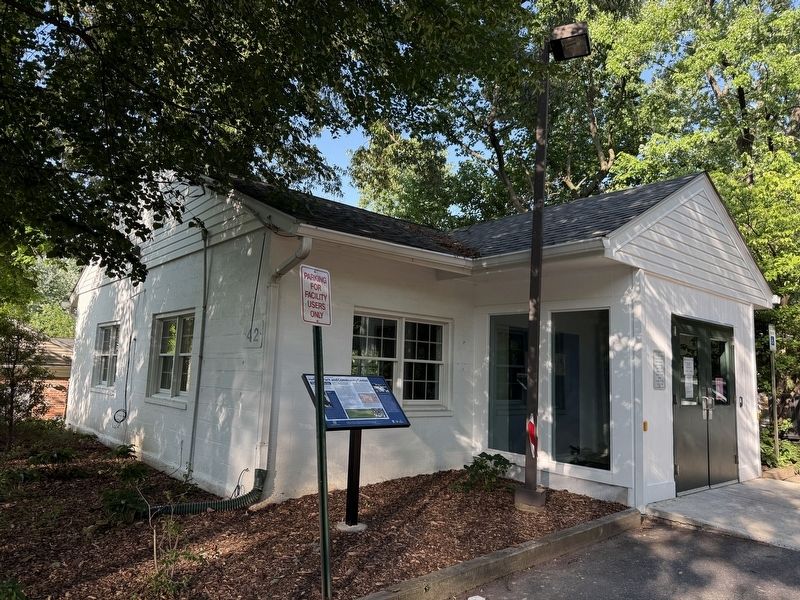
2. Heffner Park and Community Center Marker in front of the community center
Lee Jordan
Lee Jordan was a popular community activist in Takoma Park. After playing professional baseball for the Homestead Grays in the segregated Negro League, he returned to the Hill neighborhood, where he worked as a custodian at the all-white Montgomery Blair High School and Takoma Park Junior High. Jordan founded football, baseball, and basketball teams and served as a mentor and coach to the players. He worked to bridge racial divides and welcomed white and Latino players to join the teams he founded. His efforts to integrate youth athletics are considered central to the peaceful racial integration of Takoma Park's public schools. The City of Takoma Park recognized
Photographed by Devry Becker Jones (CC0), May 30, 2026
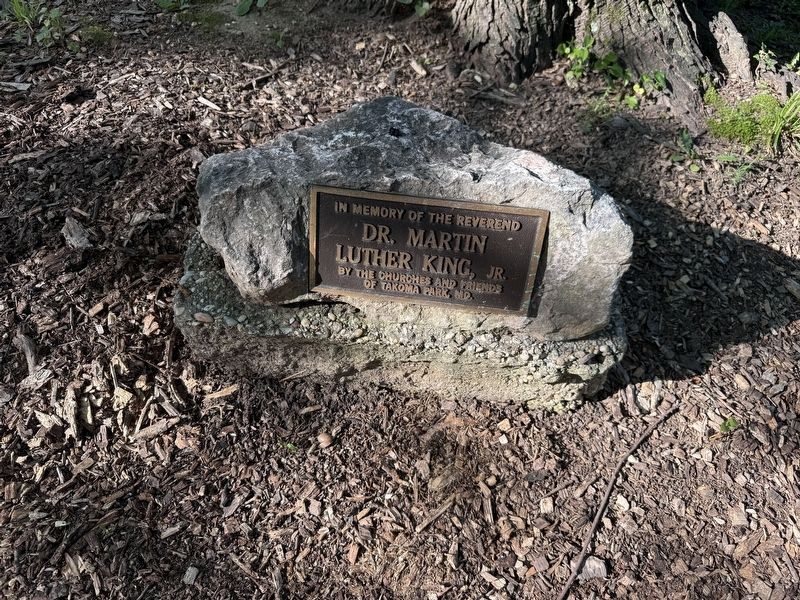
3. Dedication plaque in the park
Dr. Martin
Luther King, Jr.
by the churches and friends
of Takoma Park, MD.
Baseball: A popular pastime
Montgomery County had several Black baseball teams that played locally and in nearby counties. Baseball fields provided Black residents with entertainment and a place to socialize when they had few other options under legalized segregation.
[Caption:]
A real estate map from 1953 shows the newly built white-only Takoma Park Recreation area, south of the three lots first used for Heffner Park and later for the Public Works Facility (red outline) and the present-day location of Heffner Park (blue outline).
Erected by Montgomery Parks.
Topics and series. This historical marker is listed in these topic lists: African Americans • Civil Rights • Parks & Recreational Areas • Sports. In addition, it is included in the Maryland, Montgomery Parks series list. A significant historical month for this entry is August 1952.
Location. 38° 59.121′ N, 77° 0.562′ W. Marker is in Takoma Park, Maryland, in Montgomery County. It is on Oswego Avenue south of Ritchie Avenue, on the right when traveling south. Touch for map. Marker is at or near this postal address: 42 Oswego Ave, Silver Spring MD 20910, United States of America. Touch for directions.

Regionally, this marker is in the Washington Metropolitan Area. It is also in the American Mid-Atlantic. Globally, it is in North America, the Western Hemisphere, the Western World, and the Anglosphere. Historically, it finds itself in what was once one of the original Thirteen Colonies and also the Antebellum South.
Other nearby markers. At least 8 other markers are within walking distance of this marker: Lee Jordan Field (approx. 0.2 miles away); Lee Jordan (approx. 0.2 miles away); Sligo Creek Waterworks (approx. ¼ mile away); "The Presidents Tree" (approx. 0.3 miles away); In Memory of Sgt. Christopher Thornton (approx. 0.3 miles away); Veterans Memorial (approx. 0.3 miles away); Centennial Garden (approx. 0.4 miles away); Carroll Avenue Bridge (approx. half a mile away). Touch for a list and map of all markers in Takoma Park.
Credits. This page was last revised on May 30, 2026. It was originally submitted on May 30, 2026, by Devry Becker Jones of Washington, District of Columbia. This page has been viewed 18 times since then. Photos: 1, 2, 3. submitted on May 30, 2026, by Devry Becker Jones of Washington, District of Columbia.
