
Whitemarsh Island in Chatham County, Georgia — The American South (South Atlantic)
Ossabaw Island Hog
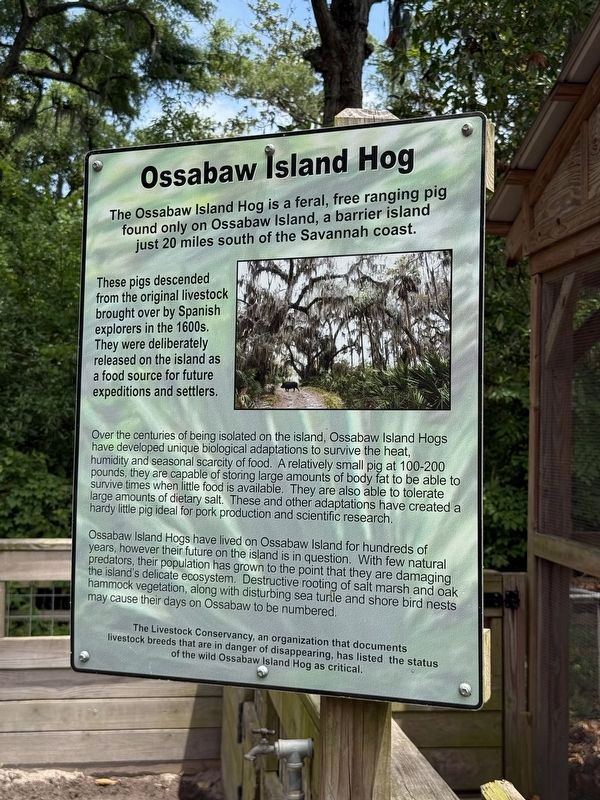
These pigs descended from the original livestock brought over by Spanish explorers in the 1600s. They were deliberately released on the island as a food source for future expeditions and settlers.
Over the centuries of being isolated on the island, Ossabaw Island Hogs have developed unique biological adaptations to survive the heat, humidity and seasonal scarcity of food. A relatively small pig at 100-200 pounds, they are capable of storing large amounts of body fat to be able to survive times when little food is available. They are also able to tolerate large amounts of dietary salt. These and other adaptations have created a hardy little pig ideal for pork production and scientific research.
Ossabaw Island Hogs have lived on Ossabaw Island for hundreds of years, however their future on the island is in question. With few natural predators, their population has grown to the point that they are damaging the island's delicate ecosystem. Destructive rooting of salt marsh
this page online
Erected by Oatland Island Wildlife Center.
Topics. This historical marker is listed in these topic lists: Agriculture • Animals • Colonial Era • Exploration.
Location. 32° 2.997′ N, 81° 1.332′ W. Marker is on Whitemarsh Island, Georgia, in Chatham County. It can be reached from Barley Drive west of Sandtown Road, on the right when traveling west. Touch for map. Marker is at or near this postal address: 711 Sandtown Road Barley Dr, Savannah GA 31410, United States of America. Touch for directions.

Regionally, this marker is in Georgia’s Coastal Plain, on the Georgia Coast and the Golden Isles, in Greater Savannah, and on the Sea Islands. It is also in the American South, specifically in the Deep South, and on the Eastern Seaboard. Globally, it is
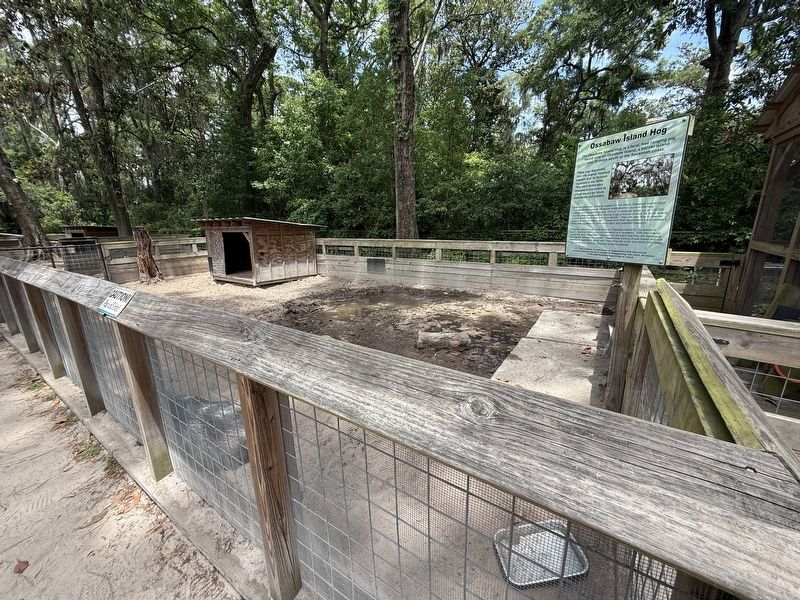
Other nearby markers. At least 8 other markers are within walking distance of this marker: American Bison (about 500 feet away, measured in a direct line); The Story of the American Bison (about 500 feet away); a different marker also named The American Bison (about 600 feet away); Gray Wolf (about 700 feet away); Delk-Dawson Heritage Homestead (approx. 0.2 miles away); Cane Grinder (approx. 0.2 miles away); Cane Boiler (approx. 0.2 miles away); EF-1 Tornado Strikes! (approx. 0.2 miles away). Touch for a list and map of all markers in Whitemarsh Island.
Credits. This page was last revised on May 31, 2026. It was originally submitted on May 31, 2026, by Devry Becker Jones of Washington, District of Columbia. This page has been viewed 13 times since then. Photos: 1, 2. submitted on May 31, 2026, by Devry Becker Jones of Washington, District of Columbia.
