Bristol in Bristol County, Rhode Island — The American Northeast (New England)
Mount Hope
Sacred Land of the Pokanokets
| — | A Sowams Heritage Area Site | — |
Photographed by David Weed
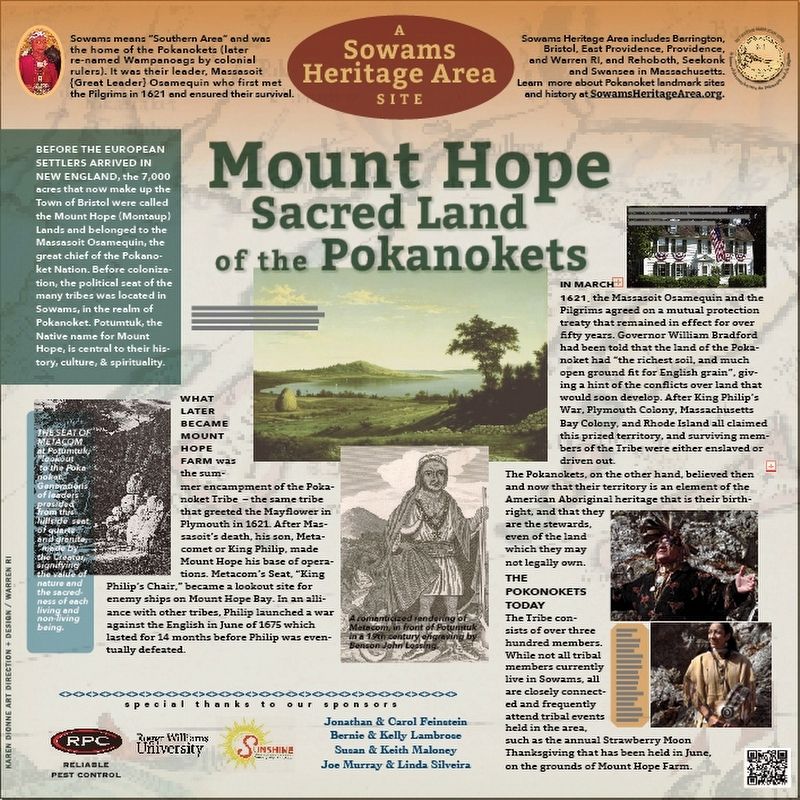
1. Mount Hope Sacred Land of the Pokanokets Marker
Mount Hope (originally Montaup in the Pokanoket language) is a wooded promontory on the eastern shore of Bristol, Rhode Island overlooking the part of Narragansett Bay known as Mount Hope Bay. Before the European settlers arrived in New England, the 7,000 acres that now make up the Town of Bristol were called the Mount Hope Lands and belonged to Massasoit Osamequin, the great sachem of the Pokanoket Nation.
What later became Mount Hope Farm was the summer camp of the Pokanoket Tribe – the same tribe that greeted the Mayflower in Plymouth in 1620 – so it is possible that at least one of the first “Thanksgiving Feasts” was held on this property. After Massasoit’s death, his son, Metacomet or King Philip, made Mount Hope his base of operations. “King Philip’s Chair,” a rocky quartz ledge on the mountain, was a lookout site for enemy ships on Mount Hope Bay. In an alliance with other tribes, Philip launched a war against the English in June of 1675 which lasted for 14 months before Philip was eventually defeated.
After the War, Plymouth Colony, Massachusetts Bay Colony, and Rhode Island all claimed this prized territory,
this page online
Prior to colonization, the political seat of the many tribes was located in Sowams, or “southern area”, in the realm of Pokanoket. Potumtuk, the Native name for Mount Hope, is one of Bristol’s significant colonial sites.
In March 1621, the Massasoit Osamequin and the Pilgrims agreed on a mutual protection treaty that remained in effect for over fifty years. Governor William Bradford had been told that the land of the Pokanoket had “the richest soil, and much open ground fit for English grain”, giving a hint of the conflicts over land that would soon develop. The Pokanokets, on the other hand, believed then and now that their territory is an element of the American Aboriginal heritage that is their birthright, and that they are the stewards, even of the land which they may not legally own.
Today, the Tribe consists of over three hundred members. While not all tribal members currently live in Sowams, all are closely connected and frequently attend tribal events held in the area, such as the annual Strawberry Moon Thanksgiving that has been held
Photographed by David Weed, circa June 17, 2021
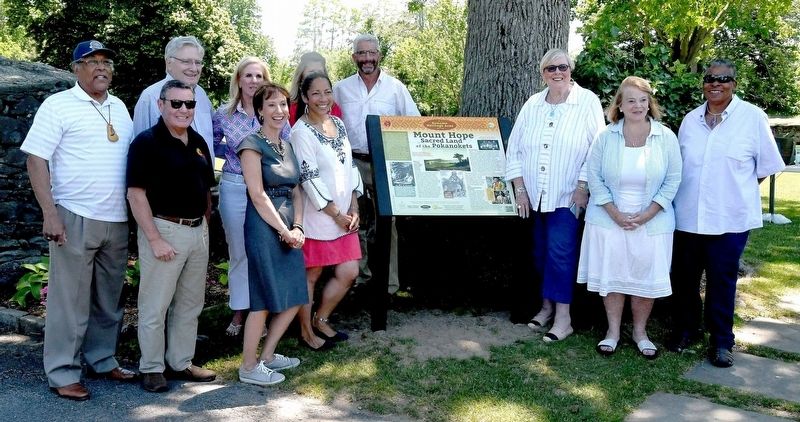
2. Mount Hope Marker unveiling
Erected by Sowams Heritage Area.
Topics and series. This historical marker is listed in these topic lists: Indigenous Peoples and Communities • Parks & Recreational Areas • Settlements & Settlers. In addition, it is included in the King Philip's War 1675-1676 series list. A significant historical month for this entry is March 1621.
Location. 41° 40.167′ N, 71° 15.418′ W. Marker is in Bristol, Rhode Island, in Bristol County. It can be reached from Metacom Avenue (Rhode Island Route 136) 0.1 miles south of Mount Hope Avenue, on the right when traveling north. The marker is approximately 25 yards to the left of the 1745 Governor Bradford House at Mt. Hope Farm. Touch for map. Marker is at or near this postal address: 250 Metacom Ave, Bristol RI 02809, United States of America. Touch for directions.

Regionally, this marker is in Greater Providence and on Narragansett Bay. It is also in the American Northeast, in New England, and on the Eastern Seaboard. Globally, it is in the North Atlantic Region, North America, the Western Hemisphere, the Western World, and the Anglosphere. Historically, it finds itself in what was once one of the original Thirteen Colonies.
Other nearby markers. At least 8 other markers are within walking distance of this marker: In the Miery Swamp (approx. 0.7 miles away); East Burial Ground (approx. 0.7 miles away); Founders and Builders of Bristol (approx. 0.7 miles away); Lawson-Raiola Square (approx. 0.9 miles away); Early Bristol 17th Century Beginnings (approx. 0.9 miles away); First Congregational Church (approx. 0.9 miles away); Tow Tank Model (approx. 0.9 miles away); Smith House (approx. 0.9 miles away). Touch for a list and map of all markers in Bristol.
Related markers. Click here for a list of markers that are related to this marker.
Also see . . .
1. Timeline and Battles of King Philip's War.
King Philip's War (1675-1678) was the pivotal engagement between the second generation of English immigrants who had arrived in New England and the Native American tribes of the region.(Submitted on April 16, 2026, by G.W.Bartlett of Hingham, Massachusetts.)
2. The Pokanoket Tribe.
Our people have existed on these lands for more than 10,000 years before colonization.(Submitted on April 17, 2026, by G.W.Bartlett of Hingham, Massachusetts.)
3. Metacomet Ridge - Wikipedia.
A number of features associated with the Metacomet Ridge are named after the sachem, including the Metacomet Trail, the Metacomet-Monadnock Trail, King Philip's Cave, King Philip Mountain, and Sachem Head. According to legend, Metacomet orchestrated the burning of Simsbury, Connecticut, and watched the conflagration from Talcott Mountain near the cave now named after him.(Submitted on April 19, 2026, by G.W.Bartlett of Hingham, Massachusetts.)
Credits. This page was last revised on June 1, 2026. It was originally submitted on November 18, 2021, by David Weed of Warren, Rhode Island. This page has been viewed 2,474 times since then and 246 times this year. Last updated on June 1, 2026, by G.W.Bartlett of Hingham, Massachusetts. Photos: 1. submitted on November 18, 2021, by David Weed of Warren, Rhode Island. 2. submitted on November 17, 2024, by David Weed of Warren, Rhode Island. • Devry Becker Jones was the editor who published this page.
