River Bottoms in Provo in Utah County, Utah — The American Mountains (Southwest)
Utah’s Largest Indian Battle was Called the “Battle of Provo River.”
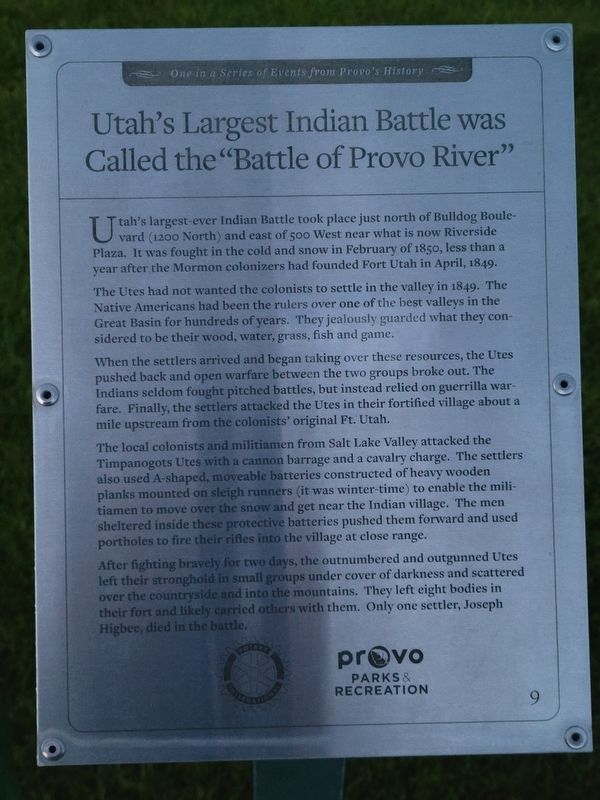
Photographed by Jeremy Snow, May 31, 2026
1. Utah's Largest Indian Battle Marker
The Utes had not wanted the colonists to settle in the valley in 1849. The native Americans had been the rulers over one of the best valleys in the Great Basin for hundreds of years. They jealously guarded what they considered to be their wood, water, grass, fish and game.
When the settlers arrived and began taking over these resources, the Utes pushed back and open warfare between the two groups broke out. The Indians seldom fought pitched battles but instead relied on guerrilla warfare. Finally, the settlers attacked the Utes in their fortified village about a mile upstream from the colonists’ original Ft. Utah.
The local colonists and militiamen from Salt Lake valley attacked the Timanogots Utes with a cannon barrage and a cavalry charge. The settlers also used A-shaped, moveable batteries constructed of heavy wooden planks mounted
this page online
After fighting bravely for two days, the outnumbered and outgunned Utes left their stronghold in small groups under cover of darkness and scattered over the countryside and into the mountains. They left eight bodies in their fort and likely carried others with them. Only one settler, Joseph Higbee, died in the battle.
Erected by Provo Parks and Recreation.
Topics. This historical marker is listed in these topic lists: Indigenous Peoples and Communities • Settlements & Settlers • Wars, US Indian. A significant historical month for this entry is February 1850.
Location. 40° 16.995′ N, 111° 39.564′ W. Marker is in Provo, Utah, in Utah County. It is in River Bottoms. It is on West 3700 North, on the right when traveling north. Touch for map. Marker is at or near this postal address: 36 W 3700 N, Provo UT 84604, United States of America. Touch for directions.

Regionally,
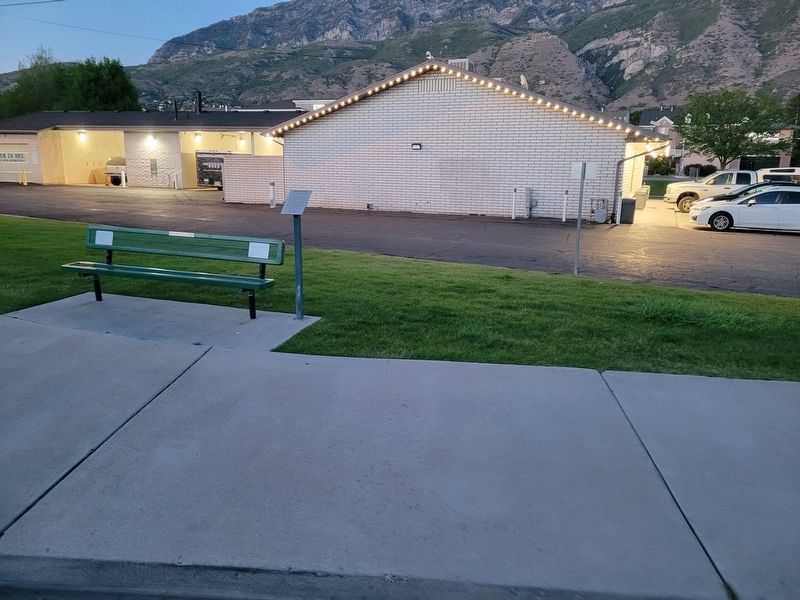
Photographed by Jeremy Snow, May 31, 2026
2. Utah’s Largest Indian Battle was Called the “Battle of Provo River.” Marker
Other nearby markers. At least 8 other markers are within 2 miles of this marker, measured as the crow flies: First Orem Chapel (approx. 1.3 miles away); Cedo Building (Former LDS Seminary) (approx. 1½ miles away); Proctor Academy Helped Educate Provo’s Youth (approx. 1.6 miles away); Provo Had a “Pest House” for Those with Communicable Diseases (approx. 1.6 miles away); Army Troops Caused the “Provo Riot” in 1870 (approx. 1.6 miles away); Provo’s First Bank was Late in Coming but Didn’t Last Long (approx. 1.6 miles away); Choosing the Site of Provo’s First Tabernacle Caused Some Controversy (approx. 1.6 miles away); Provo’s North Park Had a Community Ice Skating Rink in the 1930s (approx. 1.6 miles away). Touch for a list and map of all markers in Provo.
Credits. This page was last revised on June 3, 2026. It was originally submitted on June 2, 2026, by Jeremy Snow of Cedar City, Utah. This page has been viewed 13 times since then. Photos: 1, 2. submitted on June 2, 2026, by Jeremy Snow of Cedar City, Utah. • Andrew Ruppenstein was the editor who published this page.
