
Centre in Cork in County Cork, Munster, Ireland — Irish South-West ((Éire) North Atlantic Ocean)
Sráid Anraí
⎯⎯⎯
Henry Street
⎯⎯⎯
Sráid Grattan
⎯⎯⎯
Grattan Street
Photographed by Ian Lefkowitz, May 14, 2026
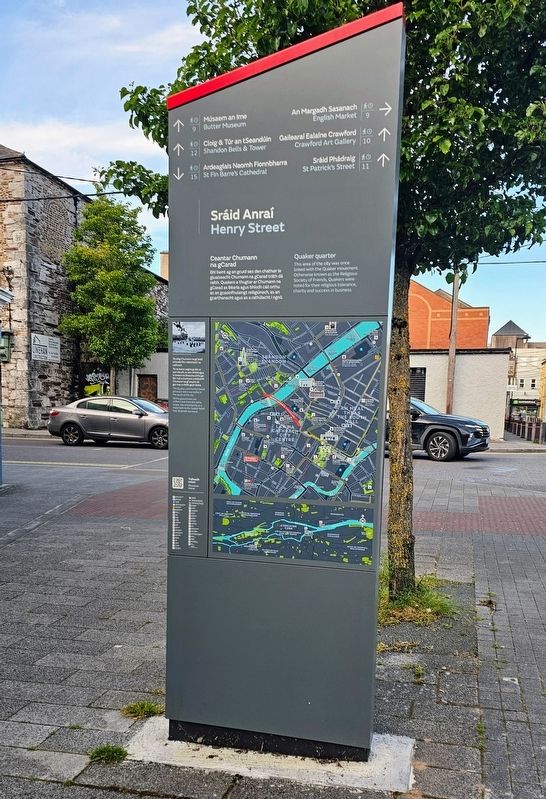
1. Sráid Anraí / Henry Street side of marker
 (West face)
Sráid Anraí
Henry Street
Ceantar Chumann na gCarad
Bhí baint ag an gcuid seo den chathair le gluaiseacht Chumann na gCarad tráth dá raibh. Quakers a thugtar ar Chumann na gCarad as Béarla agus bhíodh cáil orthu as an gcaoinfhulaingt reiligiúnach, as an gcarthanacht agus as a rathúlacht i ngnó.
Quaker Quarter
This area of the city was once linked with the Quaker movement. Otherwise known as the Religious Society of Friends, Quakers were noted for their religious tolerance, charity and success in business.
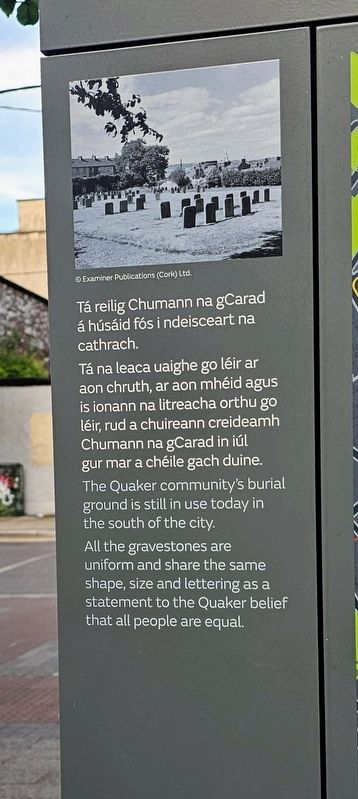
Tá reilig Chumann na gCarad á húsáid fós i ndeisceart na cathrach.
Tá na leaca uaighe go léir ar aon chruth, ar aon mhéid agus is ionann na litreacha orthu go léir, rud a chuireann creideamh Chumann na gCarad in iúl gur mar a chéile gach duine.
The Quaker community’s burial ground is still in use today in the south of the city.
All the gravestones are uniform and share the same shape, size and lettering as a statement to the Quaker belief that all people are equal.
(East face)
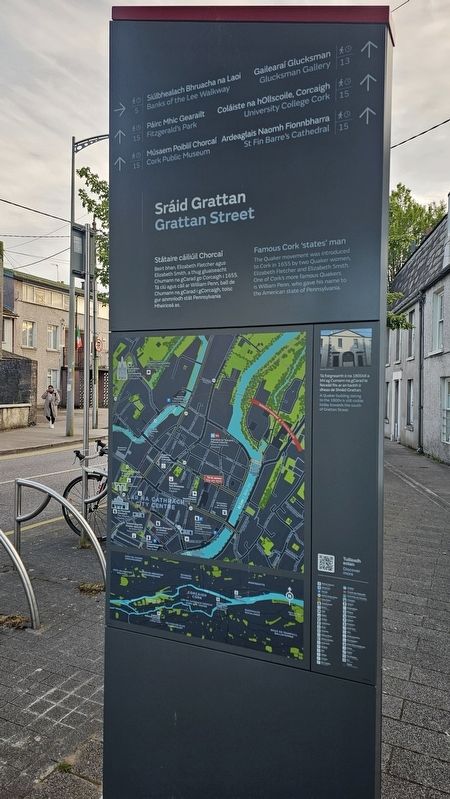
Sráid Grattan
Grattan Street
Státaire cáiliúil Chorcaí
Beirt bhan, Elizabeth Fletcher agus Elizabeth Smith, a thug gluaiseacht Chumann na gCarad go Corcaigh i 1655. Tá clú agus cáil ar William Penn, ball de Chumann na gCarad i gCorcaigh, toisc gur ainmníodh stát Pennsylvania Mheiriceá as.
Famous Cork ‘states’ man
The Quaker movement was introduced to Cork in 1655 by two Quaker women, Elizabeth Fletcher and Elizabeth Smith. One of Cork’s more famous Quakers is William Penn, who gave his name to the American state of Pennsylvania.
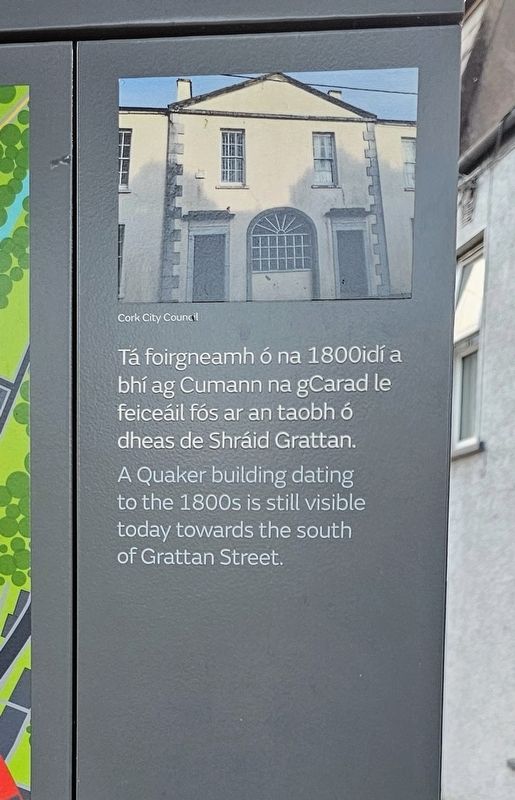
Tá foirgneamh ó na 1800idí a bhí ag Cumann na gCarad le feiceáil fós ar an taobh ó dheas de Shráid Grattan.
A Quaker building dating to the 1800s is still visible today towards the south of Grattan Street.
Topics and series.
this page online
Location. 51° 53.995′ N, 8° 28.847′ W. Marker is in Cork, Munster, in County Cork. It is in Centre. It is at the intersection of Grattan Street and Henry Street, on the left when traveling north on Grattan Street. Touch for map. Marker is at or near this postal address: 37 Grattan Street, Cork, Munster, Ireland. Touch for directions.

Regionally, it is on the Atlantic Ocean, in the North Atlantic Region, on the Atlantic Arc, in Europe, on the Island of Ireland, on the Celtic Fringe, in the European Union, in Atlantic Europe, on one of the British Isles, in the Western World, and in the Anglosphere. Historically, it finds itself in what was once a British colony.
Other nearby markers. At least 8 other markers are within walking distance of this marker: Pádraig Ó h-Ainlí (within shouting distance of this marker); The Burning of Cork 1920 (about 90 meters away, measured in a direct line); Láthair Chaisleán an Scidígh / Site of Skiddys Castle
Photographed by Ian Lefkowitz, May 14, 2026
2. Sráid Grattan / Grattan Street side of marker
Photographed by Ian Lefkowitz, May 14, 2026
3. Sráid Anraí / Henry Street Marker
A closeup of the photo inset facing Henry Street.
Photographed by Ian Lefkowitz, May 14, 2026
4. Sráid Grattan / Grattan Street Marker
A close-up of the photo inset facing Grattan Street.
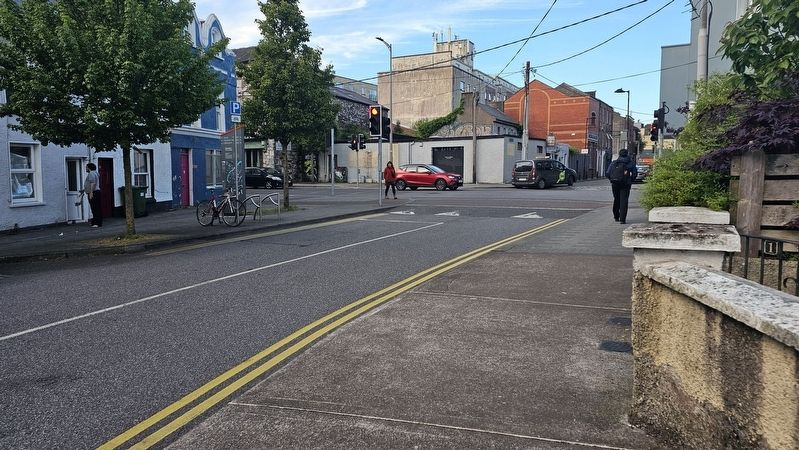
Photographed by Ian Lefkowitz, May 14, 2026
5. Henry Street & Grattan Street
The historical wayfinding marker is located at the corner of Henry Street & Grattan Street.
Credits. This page was last revised on June 4, 2026. It was originally submitted on June 4, 2026, by Ian Lefkowitz of New York, New York. This page has been viewed 13 times since then. Photos: 1, 2, 3, 4, 5. submitted on June 4, 2026, by Ian Lefkowitz of New York, New York. • Andrew Ruppenstein was the editor who published this page.
