
Centre in Cork in County Cork, Munster, Ireland — Irish South-West ((Éire) North Atlantic Ocean)
An Area of Great Historical Significance
Photographed by Ian Lefkowitz, May 14, 2026
1. An Area of Great Historical Significance Marker
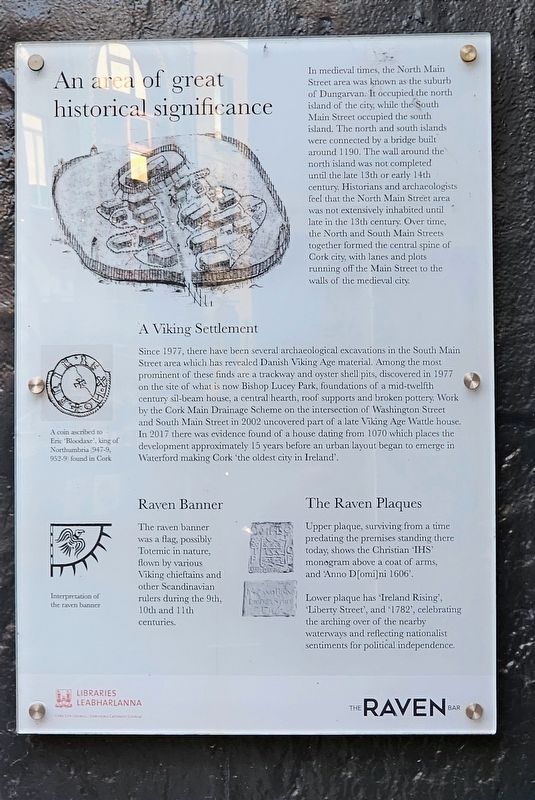
In medieval times, the North Main Street area was known as the suburb of Dungarvan. It occupied the north island of the city, while the South Main Street occupied the south island. The north and south islands were connected by a bridge built around 1190. The wall around the north island was not completed until the late 13th or early 14th century. Historians and archaeologists feel that the North Main Street area was not extensively inhabited until late in the 13th century. Over time, the North and South Main Streets together formed the central spine of Cork city, with lanes and plots running off the Main Street to the walls of the medieval city.
A Viking Settlement
Since 1977, there have been several archaeological excavations in the South Main Street area which has revealed Danish Viking Age material. Among the most prominent of these finds are a trackway and oyster shell pits, discovered in 1977 on the site of what is now Bishop Lucey Park, foundations of a mid-twelfth century sil-beam house, a central hearth, roof supports and broken pottery. Work by the Cork Main Drainage Scheme on the intersection of Washington Street and South Main Street in 2002 uncovered part of a late Viking Age Wattle house. In 2017 there was evidence found of a house dating from 1070 which places the development approximately 15 years before an urban layout began to emerge in Waterford making Cork ‘the oldest city in Ireland’.
A coin ascribed to Eric ‘Bloodaxe’, king of Northumbria (947–9, 952–9) found in Cork
Raven Banner
The raven banner was a flag, possibly Totemic in nature, flown by various Viking chieftains and other Scandinavian rulers during the 9th, 10th and 11th centuries.
Interpretation of the raven banner
The Raven Plaques
Upper plaque, surviving from a time predating the premises standing
this page online
Lower plaque has ‘Ireland Rising’, ‘Liberty Street’, and ‘1782’, celebrating the arching over of the nearby waterways and reflecting nationalist sentiments for political independence.
Erected by The Raven Bar.
Topics. This historical marker is listed in these topic lists: Anthropology & Archaeology • Roads & Vehicles. A significant historical year for this entry is 1070 CE.
Location. 51° 53.897′ N, 8° 28.644′ W. Marker is in Cork, Munster, in County Cork. It is in Centre. It is at the intersection of South Main Street and Liberty Street, on the left when traveling west on South Main Street. Touch for map. Marker is at or near this postal address: 100 S Main Street, Cork, Munster T12 VY4X, Ireland. Touch for directions.

Regionally, it is on the Atlantic Ocean, in the North Atlantic Region, on the Atlantic Arc, in Europe, on the Island of Ireland, on the Celtic Fringe, in the European Union, in Atlantic Europe, on one of the British Isles, in the Western World, and in the Anglosphere. Historically, it finds itself in
Photographed by Ian Lefkowitz, May 14, 2026
2. An Area of Great Historical Significance Marker
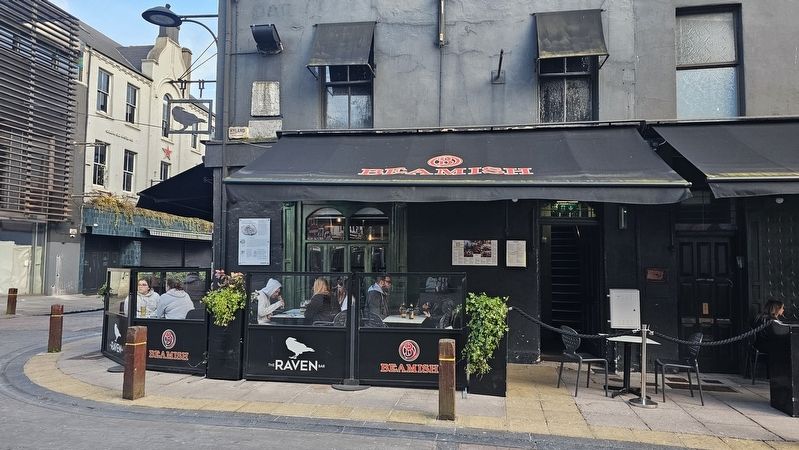
The marker is located on the left-hand side of this image, above the outdoor seating area.
Other nearby markers. At least 8 other markers are within walking distance of this marker: John George MacCarthy M.P. (within shouting distance of this marker); Castle Street / North Main Street (within shouting distance of this marker); Sráid an Chaisleáin / Castle Street / An Phríomhshráid Thuaidh / North Main Street (within shouting distance of this marker); Mary Aikenhead (about 120 meters away, measured in a direct line); Sráid an Chapaill Bhuí / Grand Parade / Cearnóg Daunt / Daunt’s Square (about 120 meters away); Sráid Mhargadh an Arbhair / Cornmarket Street (about 120 meters away); Eaglais na Tríonóide / Holy Trinity Church (about 120 meters away); Don Juan de Aquila (about 120 meters away). Touch for a list and map of all markers in Cork.
Photographed by Ian Lefkowitz, May 14, 2026
3. The Raven Bar
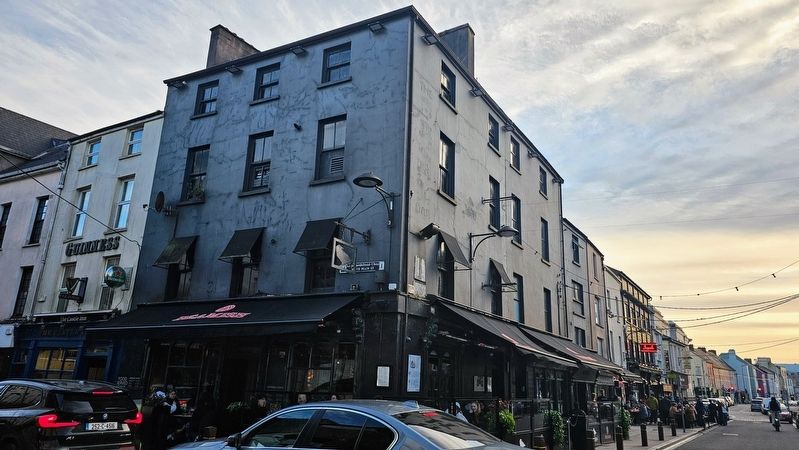
A view of the bar that created the marker, located on South Main Street.
Credits. This page was last revised on June 4, 2026. It was originally submitted on June 4, 2026, by Ian Lefkowitz of New York, New York. This page has been viewed 10 times since then. Photos: 1, 2, 3. submitted on June 4, 2026, by Ian Lefkowitz of New York, New York. • Andrew Ruppenstein was the editor who published this page.
