
Centre in Cork in County Cork, Munster, Ireland — Irish South-West ((Éire) North Atlantic Ocean)
Sráid Phádraig
⎯⎯⎯
St Patrick's Street

Photographed by Ian Lefkowitz, May 14, 2026
1. Sráid Phádraig / St Patrick's Street Marker, Side One
 Sráid Phádraig
St Patrick’s Street
Loscadh Chorcaí
I mí na Nollag 1920, agus Éireannaigh i lár an troda ar son an neamhspleáchais ón mBreatain, chuir fórsaí na Breataine gnólachtaí ar fud Chathair Chorcaí trí thine. Scaip tine ollmhór go tapaidh agus dódh codanna móra den tsráid go talamh.
The Burning of Cork
In December 1920, at the height of Ireland’s struggle for independence from Britain, business premises throughout Cork City were set ablaze by British forces. A massive fire spread quickly and large sections of this street were reduced to rubble.
Cork Public Museum
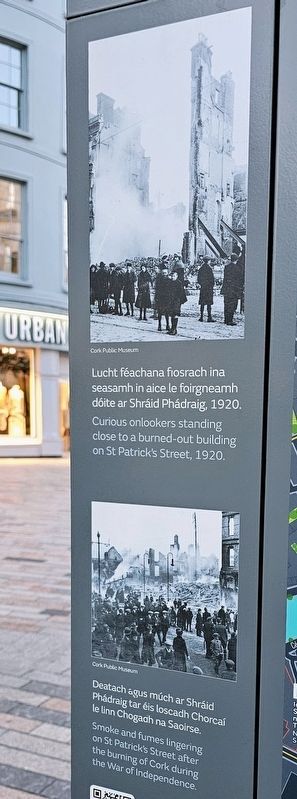
Lucht féachana fiosrach ina seasamh in aice le foirgneamh dóite ar Shráid Phádraig, 1920.
Curious onlookers standing close to a burned-out building on St Patrick’s Street, 1920.
Cork Public Museum
Deatach agus múch ar Shráid Phádraig tar éis loscadh Chorcaí le linn Chogadh na Saoirse.
Smoke and fumes lingering on St Patrick’s Street after the burning of Cork during the War of Independence.
‘Bhí stuaiceanna eaglaise,
is bóithre iarainn á lúbadh,
cróithe is bróinte muilinn
á smiotadh, fallaí
is leacacha sráide
ag tabhairt uathu’Sliocht as an dán Corcach le Louis de Paor.
‘Through the brewery’s malted-barley smoke
With city lights below us clustered
Like a bright basket of lemons.’Sliocht as an dán Patrick’s Hill le Róisín Kelly (r.1990).
Excerpt from Patrick’s Hill by Roisin Kelly (b.1990).
Excerpt from the poem Corcach by Louis de Paor.
Sráid Phádraig
St Patrick’s Street
Cad faoi na madraí uisce?
Téigh chuig 124 Sráid Phádraig. Ag bun éadan an tsiopa seo feicfidh tú trach beag uisce agus an focal ‘Madraí’ greanta air. Ba í iarrúinéir an tsiopa, Knolly Stokes a d’iarr ar an dealbhóir iomráiteach ó Chorcaigh, Séamus Murphy é a dhéanamh. Bhí cion mór ag Knolly ar mhadraí agus d’ordaigh sé gur chóir go mbeadh uisce ar fáil anseo i gcónaí do mhadraí a bheadh ag dul thar bráid.
A trough to get your snout into
Go to 124 St Patrick’s Street. At the base of this shopfront you’ll see a small drinking trough inscribed with the word ‘Madraí’, the Irish for dogs. It was carved on behalf of the building’s former owner Knolly Stokes by renowned Cork sculptor Seamus Murphy. A keen canine lover, Knolly specified that there should always be a refreshment spot here for passing hounds.
Topics.
this page online
Location. 51° 53.917′ N, 8° 28.322′ W. Marker is in Cork, Munster, in County Cork. It is in Centre. It is at the intersection of Saint Patrick's Street and Opera Lane, on the left when traveling east on Saint Patrick's Street. Touch for map. Marker is at or near this postal address: 100 St Patrick's Street, Cork, Munster, Ireland. Touch for directions.

Regionally, it is on the Atlantic Ocean, in the North Atlantic Region, on the Atlantic Arc, in Europe, on the Island of Ireland, on the Celtic Fringe, in the European Union, in Atlantic Europe, on one of the British Isles, in the Western World, and in the Anglosphere. Historically, it finds itself in what was once a British colony.
Other nearby markers. At least 8 other markers are within walking distance of this marker: "The Echo Boy" (within shouting distance of this marker); Gaelic Athletic Association Second Meeting (within shouting distance of this marker); John Francis Maguire M.P. (within shouting distance of

Photographed by Ian Lefkowitz, May 14, 2026
2. Sráid Phádraig / St Patrick''s Street Marker, Side Two
Also see . . . Burning of Cork (Wikipedia).
The burning of Cork by British forces took place during the Irish War of Independence on the night of 11–12 December 1920. It followed an Irish Republican Army (IRA) ambush of a British Auxiliary patrol in the city, which wounded twelve Auxiliaries, one fatally. In retaliation, the Auxiliaries, Black and Tans and British soldiers burned homes near the ambush site, before looting and burning numerous buildings in the centre of Cork, Ireland's third-biggest city. Many Irish civilians reported being beaten, shot at, and robbed by British forces. Firefighters testified that British forces(Submitted on June 5, 2026, by Ian Lefkowitz of New York, New York.)hindered their attempts to tackle the blazes by intimidation, cutting their hoses and shooting at them. Two unarmed IRA volunteers were also shot dead at their home in the north of the city.Photographed by Ian Lefkowitz, May 14, 20263. Sráid Phádraig / St Patrick's Street MarkerA close-up of the images on the marker.
Photographed by Ian Lefkowitz, May 14, 2026
4. Sráid Phádraig / St Patrick's Street Marker
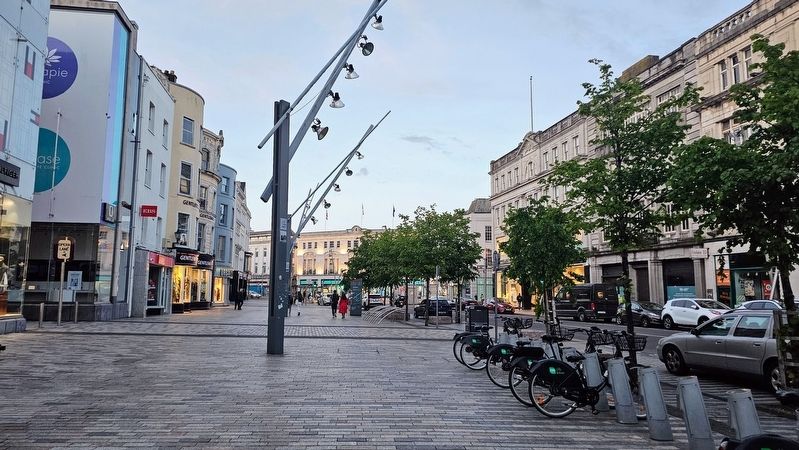
The marker is located in central St. Patrick's Street.

By National Library of Ireland on The Commons - The Burning of Cork, December 14, 1920
5. St Patrick's Street after the Burning of Cork
Credits. This page was last revised on June 5, 2026. It was originally submitted on June 5, 2026, by Ian Lefkowitz of New York, New York. This page has been viewed 8 times since then. Photos: 1, 2, 3, 4, 5. submitted on June 5, 2026, by Ian Lefkowitz of New York, New York. • Andrew Ruppenstein was the editor who published this page.
