De Cocksdorp in Texel, North Holland, Netherlands — Northwestern Europe
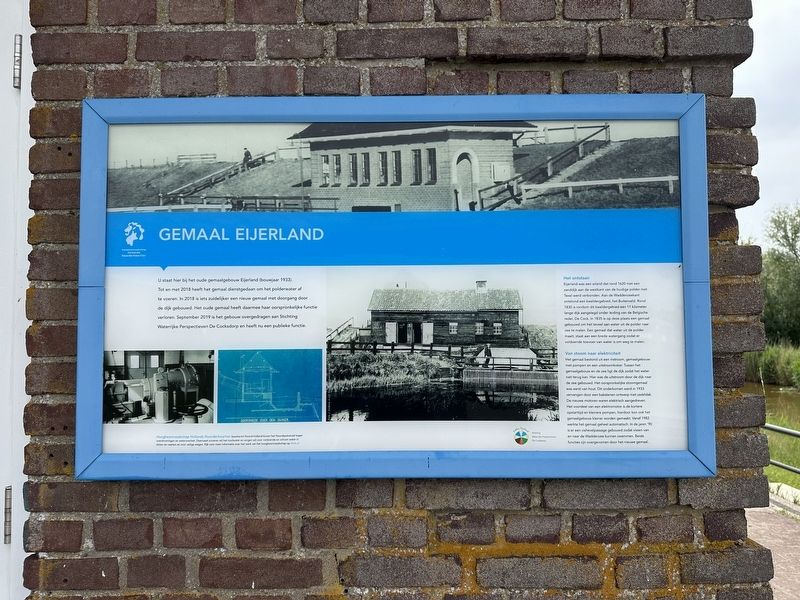
Gemaal Eijerland
⎯⎯⎯
Eijerland Pumping Station
Photographed by Andrew Ruppenstein, June 1, 2026
1. Gemaal Eijerland / Eijerland Pumping Station Marker

U staat hier bij het oude gemaalgebouw Eijerland (bouwjaar 1933). Tot en met 2018 heeft het gemaal dienstgedaan om het polderwater af te voeren. In 2018 is iets zuidelijker een nieuw gemaal met doorgang door de dijk gebouwd. Het oude gemaal heeft daarmee haar oorspronkelijke functie verloren. September 2019 is het gebouw overgedragen aan Stichting Waterrijke Perspectieven De Cocksdorp en heeft nu een publieke functie.
Het ontstaan
Eijerland was een eiland dat rond 1620 met een zanddijk aan de westkant van de huidige polder met Texel werd verbonden. Aan de Waddenzeekant ontstond een kweldergebied, het Buitenveld. Rond 1830 is rondom dit kweldergebied een 11 kilometer lange dijk aangelegd onder leiding van de Belgische reder, De Cock In 1835 is op deze plaats een gemaal gebouwd om het teveel aan water uit de polder naar zee te malen. Een gemaal dat water uit de polder maalt, staat aan een brede watergang zodat er voldoende toevoer van water is om weg te malen.
Van stoom naar elektriciteit
Het gemaal bestond uit een instroom, gemaalgebouw met pompen en een uitstroomkoker.
this page online
Eijerland Pumping Station
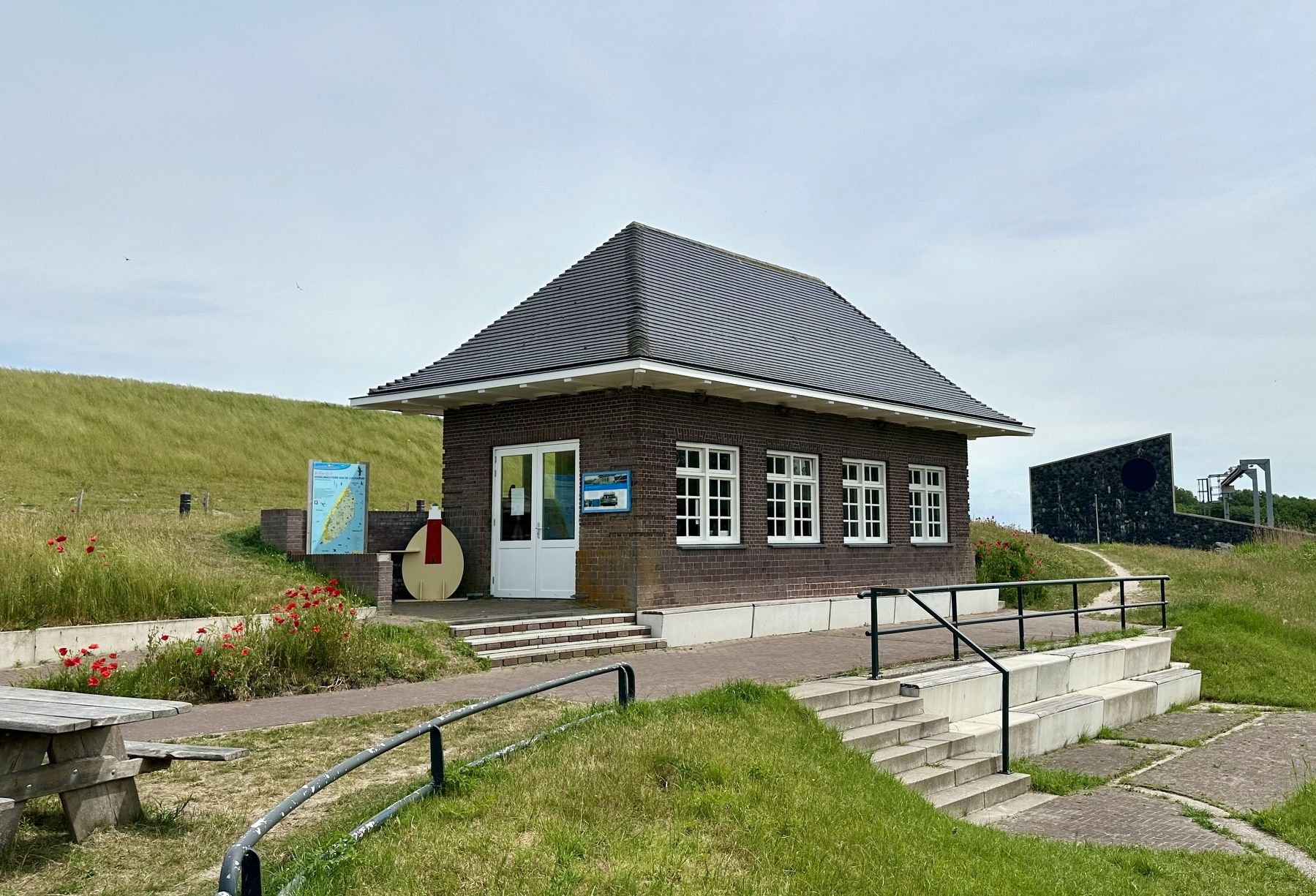
You are standing here at the old Eijerland pumping station building (built in 1933). The pumping station served to drain the polder water until 2018. In 2018, a new pumping station with a passage through the dike was built slightly further south. Consequently, the old pumping station lost its original function. In September 2019, the building was transferred to the Waterrijke Perspectieven De Cocksdorp Foundation and
Photographed by Andrew Ruppenstein, June 1, 2026
2. Gemaal Eijerland / Eijerland Pumping Station and Marker
The Origin
Eijerland was an island that was connected to Texel around 1620 by a sand dike on the west side of the current polder. On the Wadden Sea side, a salt marsh area formed, the Buitenveld. Around 1830, an 11-kilometer-long dike was constructed around this salt marsh area under the direction of the Belgian shipowner, De Cock. In 1835, a pumping station was built at this location to pump the excess water from the polder into the sea. A pumping station that pumps water out of the polder is situated on a wide waterway so that there is a sufficient supply of water to pump away.
From steam to electricity
The pumping station consisted of an inlet, a pumping station building with pumps, and an outlet pipe. The dike lies between the pumping station building and the sea to prevent water from flowing back. Here, the outflow through the dike to the sea was constructed. The original steam pumping station was initially made of wood. This structure was replaced in 1933 by a brick design with a gable roof. The new motors were electrically driven. The advantage of an electric motor is the shorter start-up time and smaller pumps; this also allowed the pumping station building to be made smaller. From 1982, the pumping station operated fully automatically. In the 1990s, a fish ladder passage was built to allow fish to swim to and from the Wadden Sea. Both functions have been taken over by the new pumping station.
Erected by Hoogheemraadschap Hollands Noorderkwartier.
Topics. This historical marker is listed in these topic lists: Environment • Man-Made Features. A significant historical month for this entry is September 2019.
Location. 53° 9.465′ N, 4° 52.598′ E. Marker is in De Cocksdorp, Noord-Holland (North Holland), in Texel. It is at the intersection of Stengweg and Kikkertstraat, on the left when traveling north on Stengweg. Touch for map. Marker is at or near this postal address: Stengweg 29, De Cocksdorp, Noord-Holland 1795, Netherlands. Touch for directions.

Regionally, this marker is on the German Wadden Sea. Globally, it is in Europe, the European Union, Atlantic Europe, the Benelux Low Countries, the Schengen Area, Western Europe, and the Western World. Historically, it finds itself in what was once the Holy Roman Empire.
Other nearby markers. At least 8 other markers are within walking distance of this marker: De Waddenkerk / The Wadden Church (about 90 meters away, measured in a direct line); De Cocksdorp openbare lagere school / De Cocksdorp Public Primary School (about 120 meters away); Stengweg (about 150 meters away); De Cocksdorp - Kikkertstraat 59, Polderhuis (about 210 meters away); De Posthoorn / The Post Horn (about 240 meters away); De Cocksdorp - Kikkerstraat 47 (approx. 0.2 kilometers away); De Strekdam / The Breakwater (approx. 0.3 kilometers away); De Gele Buurt / The “Yellow Neighborhood” (approx. 0.3 kilometers away). Touch for a list and map of all markers in De Cocksdorp.
Credits. This page was last revised on June 5, 2026. It was originally submitted on June 5, 2026, by Andrew Ruppenstein of Lamorinda, California. This page has been viewed 12 times since then. Photos: 1, 2. submitted on June 5, 2026, by Andrew Ruppenstein of Lamorinda, California.
