Torrington in Northwest Hills Region, Connecticut — The American Northeast (New England)
John Brown Birthplace
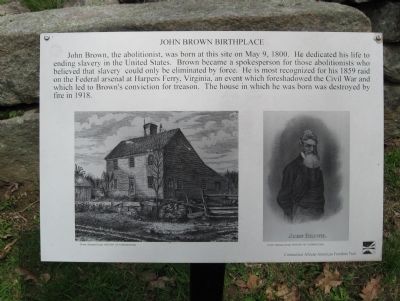
Photographed by Michael Herrick, April 21, 2010
1. John Brown Birthplace Marker
John Brown, the abolitionist, was born at this site on May 9, 1800. He dedicated his life to ending slavery in the United States. Brown became a spokesperson for those abolitionists who believed that slavery could only be eliminated by force. He is most recognized for his 1859 raid on the Federal arsenal at Harpers Ferry, Virginia, an event which foreshadowed the Civil War and which led to Brown's conviction for treason. The house in which he was born was destroyed by fire in 1918.
Connecticut African American Freedom Trail
Topics. This historical marker is listed in these topic lists: Abolition & Underground RR • War, US Civil. A significant historical date for this entry is May 9, 1800.
Location. 41° 50.348′ N, 73° 10.234′ W. Marker is in Torrington in Northwest Hills Region, Connecticut. It is on John Brown Road one mile west of Town Farm Road, on the right when traveling west. Touch for map. Marker is in this post office area: Torrington CT 06790, United States of America. Touch for directions.

Regionally, this marker is in the Berkshire Foothills and in the Litchfield Hills. It is also in the American Northeast
this page online
Other nearby markers. At least 8 other markers are within 4 miles of this marker, measured as the crow flies: Warrenton Woolen Mill (approx. 2.9 miles away); Goshen Civil War Monument (approx. 2.9 miles away); Goshen Korean War and Vietnam War Monument (approx. 2.9 miles away); Goshen French and Indian War & Revolutionary War Memorial (approx. 2.9 miles away); Goshen World War II Monument (approx. 3 miles away); Goshen World War I Monument (approx. 3 miles away); Goshen (approx. 3 miles away); McCall Foundation (approx. 3.2 miles away). Touch for a list and map of all markers in Torrington.
Also see . . .
1. Visit the John Brown Birthplace. Torrington Historical Society website entry (Submitted on April 27, 2010, by Michael Herrick of Southbury, Connecticut.)
2. John Brown (abolitionist). Wikipedia entry (Submitted on April 27, 2010, by Michael Herrick of Southbury, Connecticut.)
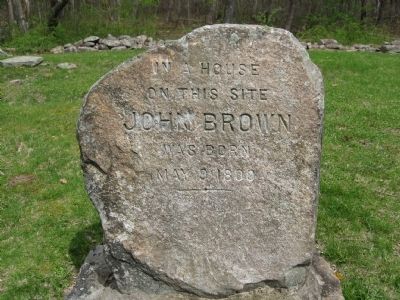
Photographed by Michael Herrick, April 21, 2010
2. Granite Marker on the Site
On This Site
John Brown
Was Born
May 9 1800
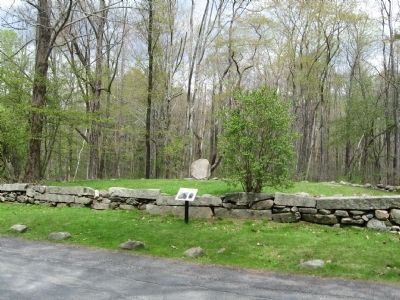
Photographed by Michael Herrick, April 21, 2010
3. John Brown Birthplace Marker
The remains of the foundation surround the granite marker
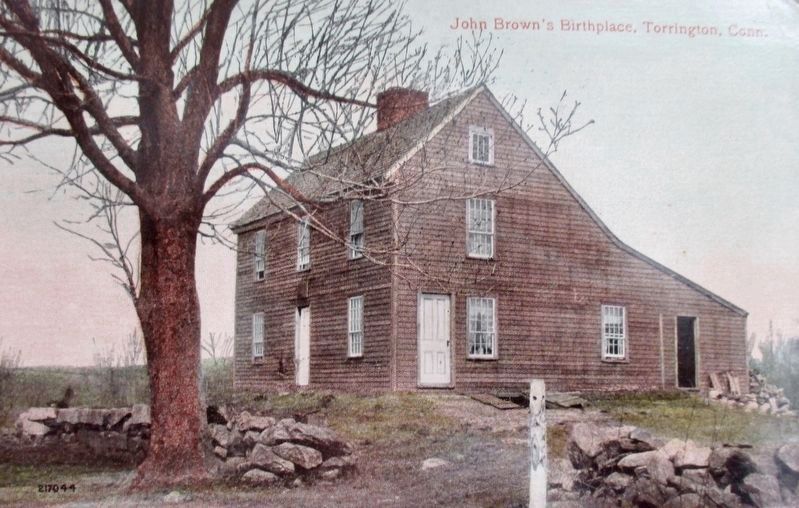
Postcard published by the Leighton and Valentine Co., New York City, circa 1912
4. John Brown's Birthplace, Torrington, Conn.
Photographed by Allen C. Browne, April 1, 2016
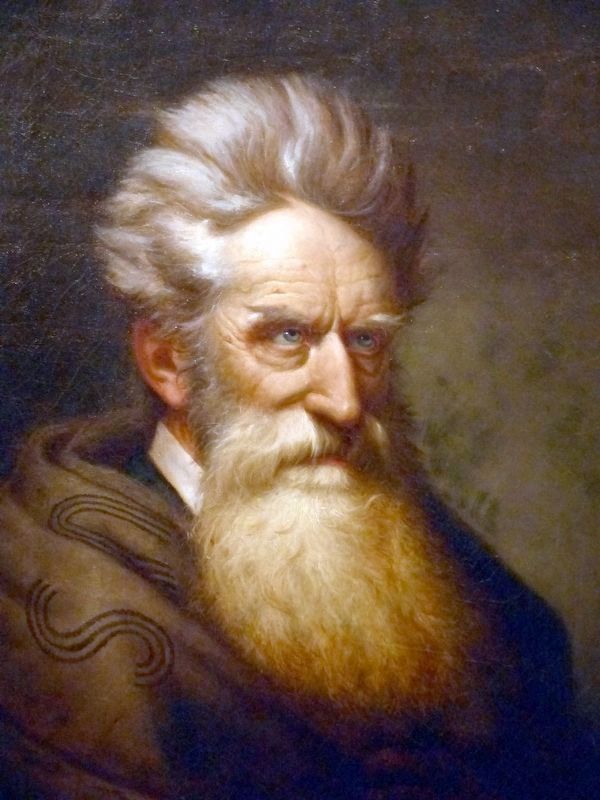
5. John Brown
This 1872 painting (detail) of John Brown (1800-1859) by Ole Peter Hansen Balling hangs in the National Portrait Gallery in Washington, DC.
“There were those who noted a touch of insanity in abolitionist John Brown; he believed he had been called by God to embark on a personal crusade to end slavery. Brown and five of his sons were actively engaged in the bloody guerrilla war being waged in Kansas in 1855-56, between proslavery and antislavery factions. But in 1857, Brown began making plans for the 1859 raid on the federal arsenal at Harpers Ferry, an event that would make him both infamous and immortal. The scheme to commandeer firearms with which to arm a slave rebellion failed, and Brown was captured, tried, and hanged. His insurrection found favor among many northern abolitionists. In response, southerners viewed Brown as a sign that they must either break their allegiance to the Union or be destroyed by an increasingly fanatical North.” — National Portrait Gallery
“There were those who noted a touch of insanity in abolitionist John Brown; he believed he had been called by God to embark on a personal crusade to end slavery. Brown and five of his sons were actively engaged in the bloody guerrilla war being waged in Kansas in 1855-56, between proslavery and antislavery factions. But in 1857, Brown began making plans for the 1859 raid on the federal arsenal at Harpers Ferry, an event that would make him both infamous and immortal. The scheme to commandeer firearms with which to arm a slave rebellion failed, and Brown was captured, tried, and hanged. His insurrection found favor among many northern abolitionists. In response, southerners viewed Brown as a sign that they must either break their allegiance to the Union or be destroyed by an increasingly fanatical North.” — National Portrait Gallery
Credits. This page was last revised on May 19, 2026. It was originally submitted on April 27, 2010, by Michael Herrick of Southbury, Connecticut. This page has been viewed 2,387 times since then and 122 times this year. Photos: 1, 2, 3. submitted on April 27, 2010, by Michael Herrick of Southbury, Connecticut. 4. submitted on April 26, 2018. 5. submitted on November 11, 2016, by Allen C. Browne of Silver Spring, Maryland.
