Historic Old Town in Niagara-on-the-Lake in Niagara Region, Ontario — Central Canada (North America)
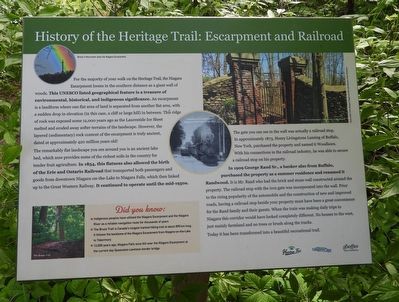
History of the Heritage Trail: Escarpment and Railroad
Photographed by Kevin Westell, June 5, 2026
1. History of the Heritage Trail: Escarpment and Railroad - Marker
The remarkably flat landscape you see around you is an ancient lake bed, which now provides some of the richest soils in the country for tender fruit agriculture. In 1854, this flatness also allowed the birth of the Erie and Ontario Railroad that transported both passengers and goods from downtown Niagara-on-the-Lake to Niagara Falls, which then linked up to the Great Western Railway. It continued to operate until the mid-1950s.
Did
this page online
- Indigenous peoples have utilized the Niagara Escarpment and the Niagara River as a reliable navigation route for thousands of years
- The Bruce Trail Canada's longest marked hiking trail at about 890 km long. It follows the backbone of the Niagara Escarpment from Niagara-on-the-Lake to Tobermory
- 12,000 years ago, Niagara Falls once fell over the Niagara Escarpment at the current day Queen-Lewiston border bridge
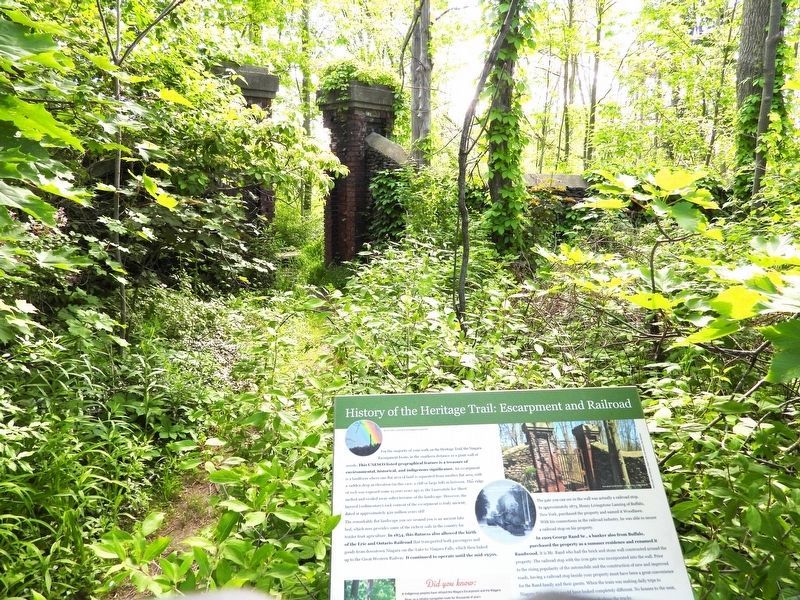
The gate you can see in the wall was actually a railroad stop In approximately 1873, Henry Livingstone Lansing of Buffalo, New York, purchased the property and named it Woodlawn. With his connections in the railroad industry, he was able to secure a railroad stop on his property.
In 1909 George Rand Sr., a banker also from Buffalo, purchased the property as a summer residence and renamed it Randwood. It is Mr. Rand who had the brick and stone wall constructed around the property. The railroad stop with the iron gate was incorporated into the wall. Prior to the rising popularity of the automobile and the construction of new and improved roads, having a railroad stop beside your property
Photographed by Kevin Westell, June 5, 2026
2. History of the Heritage Trail: Escarpment and Railroad - Marker in context
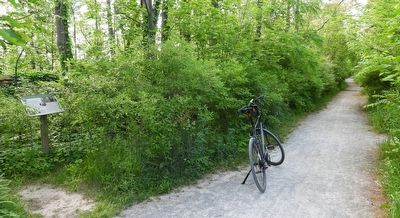
Photo faces south along the Upper Canada Rail Trail.
Topics. This historical marker is listed in these topic lists: Parks & Recreational Areas • Railroads & Streetcars. A significant historical year for this entry is 1854.
Location. 43° 14.456′ N, 79° 4.472′ W. Marker is in Niagara-on-the-Lake, Ontario, in Niagara Region. It is in Historic Old Town. It is on The Promenade, on the right when traveling west. The marker is along the Upper Canada Heritage Trail, 350 metres south of Charlotte St; and 120 metres north of the short access trail from The Promenade (between #39 and #41) to the rail trail. Touch for map. Marker is at or near this postal address: 39 The Promenade, Niagara-on-the-Lake ON L0S 1J0, Canada. Touch for directions.

Regionally, this marker is on the Golden Horseshoe and in Niagara Canada. It is also in Central Canada. Globally, it is
Photographed by Kevin Westell, June 5, 2026
3. The gate in Randwood's perimeter wall, near its rail platform
Photo faces east. This red-brick gate is immediately behind the marker. The stone wall continues in each direction, but (in my June photo, at least) is mostly concealed by the ambitious foliage.
Other nearby markers. At least 8 other markers are within walking distance of this marker: Nationally-Rare Trees in Niagara-on-the-Lake (about 180 meters away, measured in a direct line); Our Carolinian Forest Zone (approx. 0.3 kilometers away); Upper Canada Heritage Trail (approx. 0.3 kilometers away); a different marker also named Upper Canada Heritage Trail (approx. 0.4 kilometers away); Rare and Interesting Animals in Niagara-on-the-Lake (approx. 0.6 kilometers away); Our Western Home - British Home Children (approx. 0.6 kilometers away); The Solomon Moseby Affair 1837 (approx. 0.6 kilometers away); 1st Canadian Parachute Battalion / 1er Bataillon de parachutistes canadiens (approx. 0.6 kilometers away). Touch for a list and map of all markers in Niagara-on-the-Lake.
Credits. This page was last revised on June 6, 2026. It was originally submitted on June 6, 2026, by Kevin Westell of St. Catharines, Ontario. This page has been viewed 12 times since then. Photos: 1, 2, 3. submitted on June 6, 2026, by Kevin Westell of St. Catharines, Ontario.
