
Schaumburg in Cook County, Illinois — The American Midwest (Great Lakes)
Woodland Area

Photographed by Sean P. Flynn, June 6, 2026
1. Woodland Area Marker
Woodland Area:
The quality of trees in the woodland area was being degraded by the intrusion of non-native, invasive species. Buckthorn, Black Locust, Mulberry, Honeysuckle, Crown Vetch, and Purple Loosestrife were beginning to dominate the woodland, with older trees shading the ground to 1% light levels. As a result, native grasses and forbs, with their deep soil stabilizing root systems, could not survive, causing soil loss and severe erosion. Oaks and other nut-bearing trees that support wildlife do not reproduce well in dense shade.
When native plants are reduced, there is a reduction of native wildlife species as well, leading to a domino effect that degrades soil and water quality.
The role of fire in the landscape:
Before European settlers arrived in the 1830s, Illinois was a vast sea of tall waving prairie grasses and colorful wildflowers. The early settlers saw this "wide open space that stretched to the horizon without a single tree in sight." This dense prarie had roots reaching as far underground as 20 feet. The majority of living material, or biomass of the grasslands was beneath the surface of the
this page online
After the firestorm, the prairie would look black and lifeless, but the prairie plants' deep root systems would be undisturbed and ready to sprout new growth. The shallow rooted, invasive species brought by settlers could not survive the fire allowing the native plants to thrive.
Over time, and with further settlement, prairie fires were suppressed. This caused early sprouting, non-native plants to shade out native species and prairies began their rapid decline. Therefore, fire was essential to the health of the prairie. Not only did it suppress non-native plants, it also prevented the encroachment of trees and woody shrubs.
Restoration Efforts:
The Village of Schaumburg has adopted a Biodiversity Program and has been restoring native woodland species since 1999. Buckthorn and Honeysuckle have been cut and removed from the woodland, and non-native invasive plant species are being eliminated.
Restoration Goals:
•
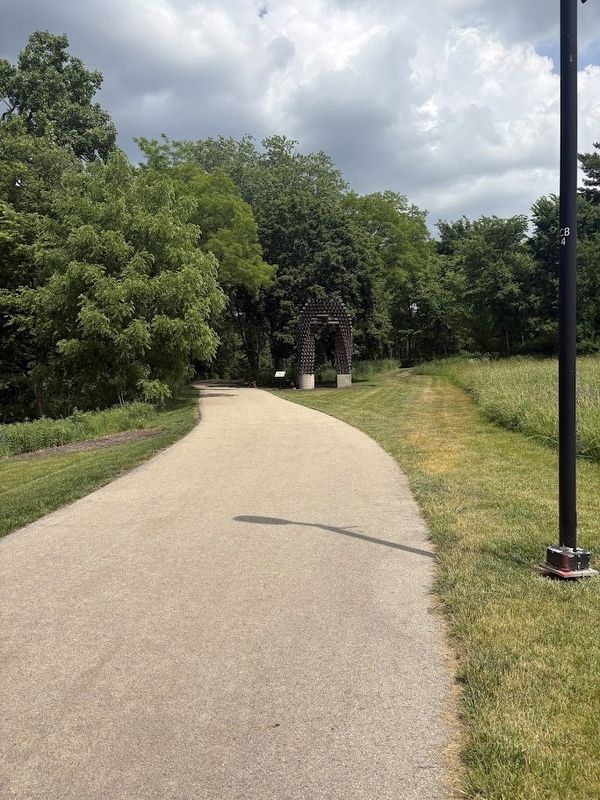
Photographed by Sean P. Flynn, June 6, 2026
2. Woodland Area Marker near the "Together" art installation
• Restock Native Plant Materials
• Maintain Healthy Natural Ecosystems
Erected by Village of Schaumburg.
Topics. This historical marker is listed in these topic lists: Environment • Horticulture & Forestry • Parks & Recreational Areas • Settlements & Settlers. A significant historical year for this entry is 1830.
Location. 42° 1.516′ N, 88° 3.929′ W. Marker is in Schaumburg, Illinois, in Cook County. It can be reached from Schaumburg Road (County Route A66) 0.3 miles west of Plum Grove Road, on the right when traveling east. The marker is in the 20-acre Schaumburg Sculpture Park, behind the Al Larson Prairie Center for the Arts. The sign is next to the art installation, "Together.". Touch for map. Marker is in this post office area: Schaumburg IL 60193, United States of America. Touch for directions.

Regionally, this marker is in Greater Chicago. It is also in the American Midwest and on the Great Lakes. Globally, it is in North America, the Western Hemisphere, the Western World, and the Anglosphere. Historically, it finds itself in what was once the Viceroyalty of New France, the territory of the Mississippian Culture, and the Northwest Territory.
Other nearby markers. At least 8 other markers are within walking distance of this marker: Thiruvalluvar (a few steps from this marker); Welcome to the Farm! (approx. 0.3 miles away); White Ash (approx. 0.3 miles away); Welcome to Spring Valley (approx. 0.3 miles away); Heritage Hot Dog Garden (approx. 0.4 miles away); American Elm (approx. 0.4 miles away); a different marker also named Welcome to Spring Valley (approx. 0.4 miles away); a different marker also named Welcome to the Farm! (approx. half a mile away). Touch for a list and map of all markers in Schaumburg.
Also see . . . Schaumburg Sculpture Park. (Submitted on June 8, 2026, by Sean P. Flynn of Oak Park, Illinois.)
Credits. This page was last revised on June 8, 2026. It was originally submitted on June 7, 2026, by Sean P. Flynn of Oak Park, Illinois. This page has been viewed 9 times since then. Photos: 1, 2. submitted on June 7, 2026, by Sean P. Flynn of Oak Park, Illinois.
