Somerford Township near Summerford in Madison County, Ohio — The American Midwest (Great Lakes)
Ohio Native Plants
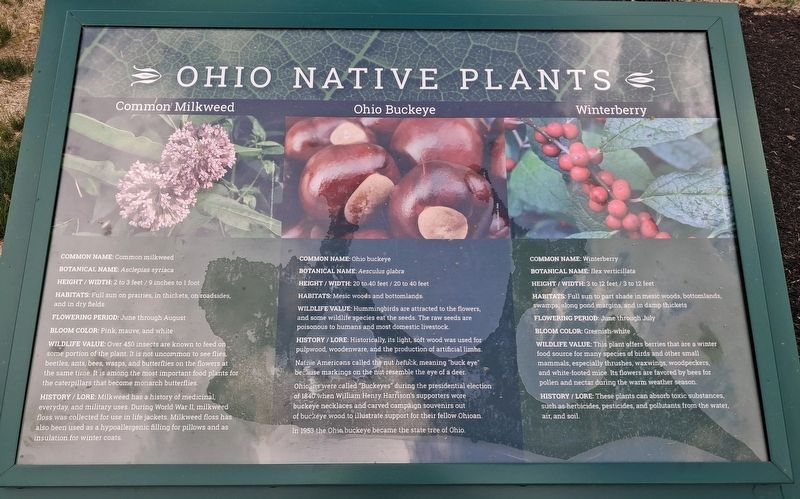
Photographed by William Fischer, Jr., June 6, 2026
1. Ohio Native Plants Marker
Common Milkweed
Common Name: Common milkweed
Botanical Name: Asclepias syriaca
Height/Width: 2 to 3 feet/9 inches to 1 foot
Habitats: Full sun on prairies, in thickets, on roadsides, and in dry fields
Flowering Period: June through August
Bloom Color: Pink, mauve, and white
Wildlife Value: Over 450 insects are known to feed on some portion of the plant. It is not uncommon to see flies, beetles, ants, bees, wasps, and butterflies on the flowers at the same time. It is among the most important food plants for the caterpillars that become monarch butterflies.
History/Lore: Milkweed has a history of medicinal, everyday, and military uses. During World War II, milkweed floss was collected for use in life jackets. Milkweed floss has also been used as a hypoallergenic filling for pillows and as insulation for winter coats.
Ohio Buckeye
Common Name: Ohio buckeye
Botanical Name: Aesculus glabra
Height/Width: 20 to 40 feet / 20 to 40 feet
Habitats: Mesic woods and bottomlands
Wildlife Value: Hummingbirds are attracted to the flowers, and some wildlife species eat the seeds. The raw seeds are poisonous to humansand most domestic livestock.
Click or scan to see
this page online
History/Lore: Historically, its light, soft wood was used for pulpwood, woodenware, and the production of artificial limbs.
Native Americans called the nut hetuck, meaning "buck eye" because markings on the nut resemble the eye of a deer.
Ohioans were called "Buckeyes" during the presidential election of 1840 when William Henry Harrison's supporters wore buckeye necklaces and carved campaign souvenirs out of buckeye wood to illustrate support for their fellow Ohioan.
In 1953 the Ohio buckeye became the state tree of Ohio.
Winterberry
Common Name: Winterberry
Botanical Name: Ilex verticillata
Height/Width: 3 to 12 feet / 3 to 12 feet
Habitats: Full sun to part shade in mesic woods, bottomlands, swamps, along pond margins, and in damp thickets
Flowering Period: June through July
Bloom Color: Greenish-white
Wildlife Value: This plant offers berries that are a winter food source for many species of birds and other small mammals, especially thrushes, waxwings, woodpeckers, and white-footed mice. Its flowers are favored by bees for pollen and nectar during the warm weather season.
History/Lore:These plants can absorb toxic substances, such as herbicides, pesticides, and pollutants from the water, air, and soil.Photographed by William Fischer, Jr., June 6, 20262. Ohio Native Plants MarkerMarker on left

Erected 2026 by Ohio Department of Transportation.
Topics. This historical marker is listed in these topic lists: Horticulture & Forestry • Indigenous Peoples and Communities • Science & Medicine.
Location. 39° 56.385′ N, 83° 31.944′ W. Marker is near Summerford, Ohio, in Madison County. It is in Somerford Township. It is on Interstate 70 at milepost 70, on the right when traveling east. Marker is on the grounds of the South Vienna Eastbound Rest Area. Touch for map. Marker is in this post office area: South Vienna OH 45369, United States of America. Touch for directions.

Regionally, this marker is in the Columbus Metropolitan Area. It is also in the American Midwest and in the Corn Belt. Globally, it is in North America, the Western Hemisphere, the Western World, and the Anglosphere. Historically, it finds itself in what was once the Haudenosaunee (Iroquois) Confederacy, the territory of the Mississippian Culture, and the Northwest Territory.
Other nearby markers. At least 8 other markers are within 5 miles of this marker, measured as the crow flies: Ohio Buckeye Tree (here, next to this marker); Ohio's Physiographic Regions (here, next to this marker); a different marker also named Ohio Native Plants (within shouting distance of this marker); Ohio World War I Red Poppy (within shouting distance of this marker); a different marker also named Ohio Native Plants (within shouting distance of this marker); Four Chaplains Memorial (approx. 1½ miles away); Somerford Veterans Memorial (approx. 1.6 miles away); The Molly Caren Agricultural Center (approx. 4½ miles away). Touch for a list and map of all markers in Summerford.
Credits. This page was last revised on June 8, 2026. It was originally submitted on June 8, 2026, by William Fischer, Jr. of Reynoldsburg, Ohio. This page has been viewed 10 times since then. Photos: 1, 2. submitted on June 8, 2026, by William Fischer, Jr. of Reynoldsburg, Ohio.
