Williamsburg, Virginia — The American South (Mid-Atlantic)
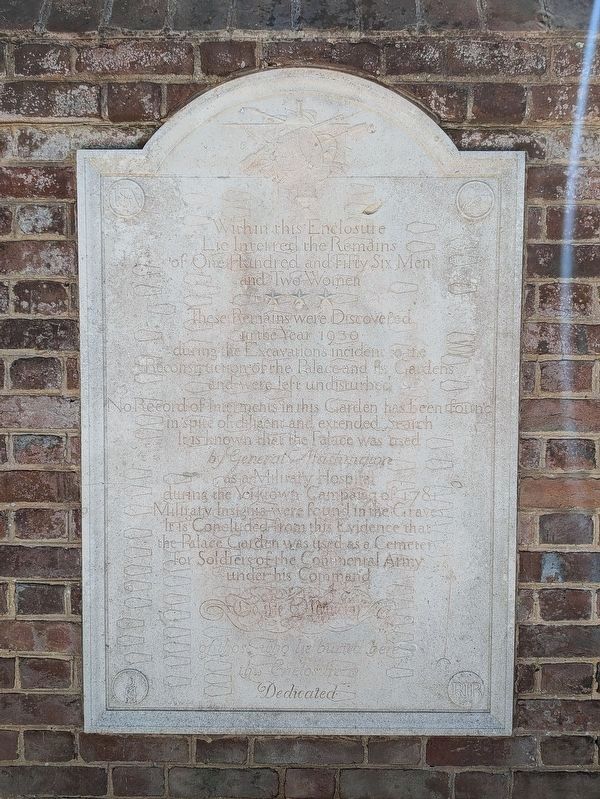
Within this Enclosure
Photographed by Evan Dwyer, April 21, 2026
1. Within this Enclosure Marker
Note burial shaft map of the cemetery on the background behind the text.
These remains were discovered in the year 1930 during the excavations incident to the reconstruction of the Palace and its Gardens and were left undisturbed
No record of interments in this Garden has been found in spite of diligent and extended search
It is known that the Palace was used by General G. Washington as a Military Hospital during the Yorktown Campaign of 1781
Military Insignia were found in the Graves
It is concluded from this evidence that the Palace Garden was used as a cemetery for soldiers of the Continental Army under his command
To the memory of those who lie buried here this enclosure is dedicated
Topics. This historical marker is listed in these topic lists: Cemeteries & Burial Sites • War, US Revolutionary. A significant historical year for this entry is 1930.
Location. 37° 16.475′ N, 76° 42.152′ W. Marker is in Williamsburg, Virginia. It can be reached from Palace Green Street 0.1 miles north of Scotland Street, on the left when traveling north. Marker is on the brick wall between the gardens
this page online

Regionally, this marker is on Virginia’s Peninsula, in Coastal Virginia, and in the Hampton Roads Metropolitan Area. It is also in the American South, specifically in the Upper South, in the Tidewater, and on the Eastern Seaboard. Globally, it is in the North Atlantic Region, North America, the Western Hemisphere, the Western World, and the Anglosphere. Historically, it finds itself in what was once the territory of the Mississippian Culture, one of the original Thirteen Colonies, one of the Confederate States of America, and the Antebellum South.
Other nearby markers. At least 8 other markers are within walking distance of this marker: Palace Gardens Cemetery (here, next to this marker); (Ice House) Mount (about 300 feet away, measured in a direct line); The Governor's Palace & Gardens
Photographed by Evan Dwyer, April 21, 2026
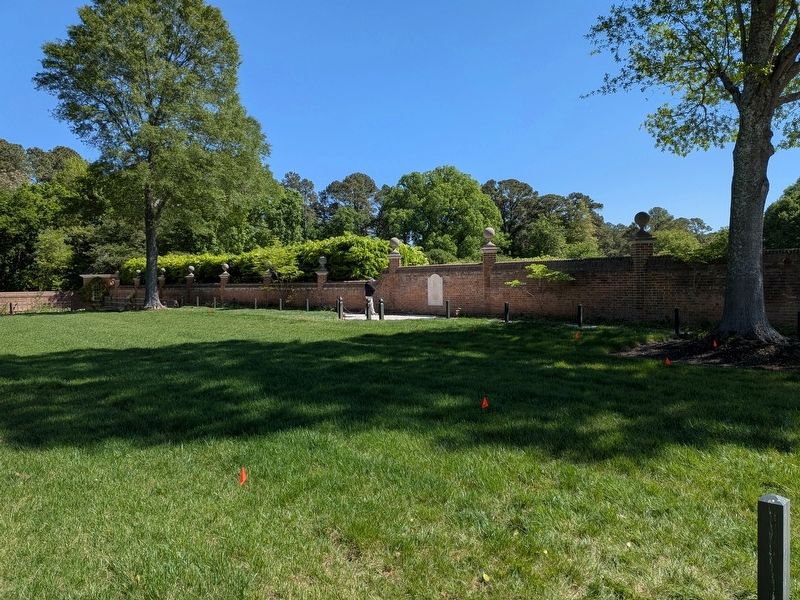
2. Within this Enclosure Marker
Marker, in context, is on the wall at right. The burial area is outlined with orange flags in the foreground and off to the left.
More about this marker. The marker also features an engraved layout of the burial shafts, each in the shape of a coffin, behind the text. The burials themselves are not independently marked, but occupy the restored green space immediately in front of the marker.
Regarding Within this Enclosure. Most of the identified remains are Frenchmen.
Photographed by Evan Dwyer, April 21, 2026
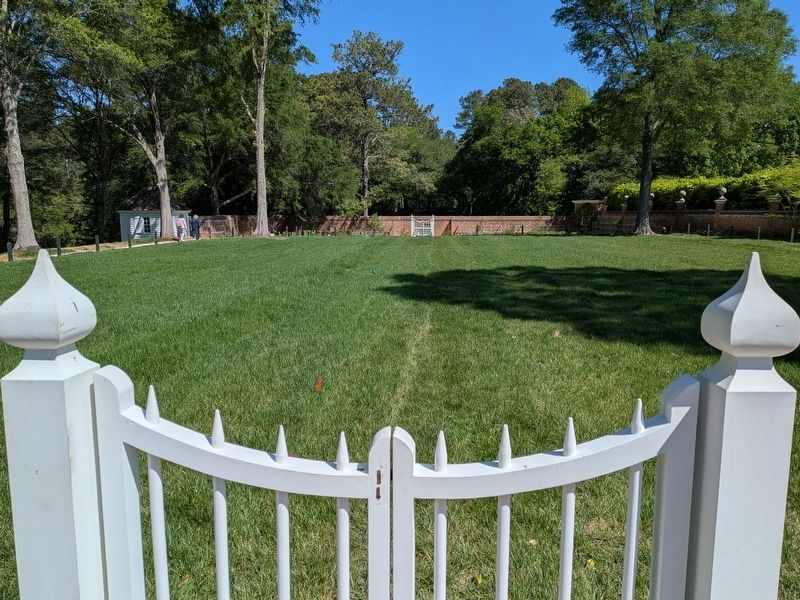
3. Revolutionary War Cemetery
View of the burial area facing north.
Photographed by Evan Dwyer, April 21, 2026
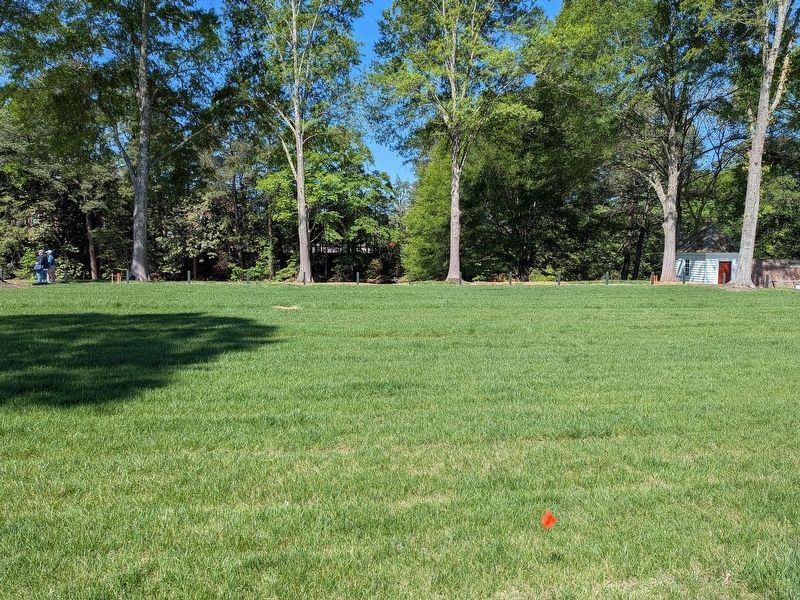
4. Cemetery View from Marker
This is the view of the burial area if the reader turns 180deg after reading the marker. The orange flags on the opposite side of the green mark the extend of the cemetery. As can be seen, the "enclosure" described on the marker is not actually an enclosure at all - the fence line stops at far right after wrapping around the northern part of the palace terraces. The canal is in the depression beyond.
Credits. This page was last revised on June 10, 2026. It was originally submitted on June 9, 2026, by Evan Dwyer of Richmond, Virginia. This page has been viewed 19 times since then. Photos: 1, 2, 3, 4. submitted on June 9, 2026, by Evan Dwyer of Richmond, Virginia. • Bernard Fisher was the editor who published this page.
