Kilgarvan in Cobh in County Cork, Munster, Ireland — Irish South-West ((Éire) North Atlantic Ocean)
Charlotte Grace O'Brien, 1845 – 1909
Advocate of the Irish Immigrant; Social Reformer; Author
Photographed by Ian Lefkowitz, May 15, 2026
1. Charlotte Grace O'Brien, 1845 – 1909 Marker
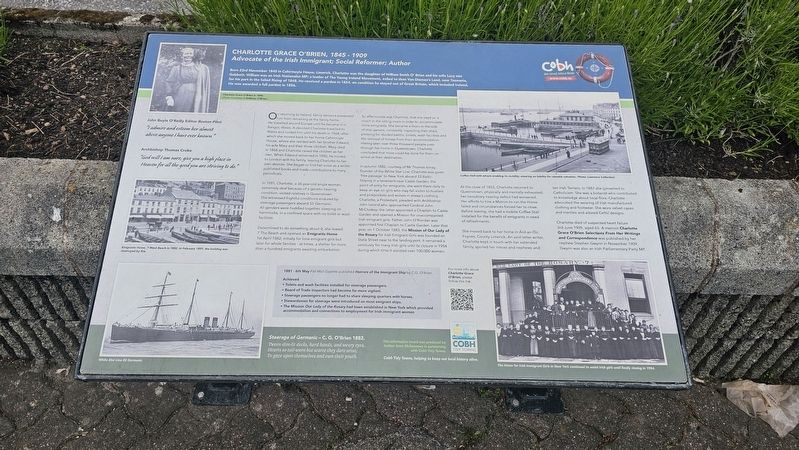
Born 23rd November 1845 in Cahirmoyle House, Limerick, Charlotte was the daughter of William Smith O’Brien and his wife Lucy née Gabbett. William was an Irish Nationalist MP, a landlord, a leader of The Young Ireland Movement, exiled to then Van Diemen’s Land, now Tasmania, for his part in the failed Rising of 1848. He received a pardon in 1854, on condition he stayed out of Great Britain, which included Ireland. He was awarded a full pardon in 1856.
On returning to Ireland, family tensions prevented him from remaining at the family home. He travelled around Europe until he became ill in Bangor, Wales. A devoted Charlotte travelled to Wales and nursed him until his death in 1864, after which she moved back to her home Cahirmoyle House, where she resided with her brother Edward, his wife Mary and their three children. Mary died in 1868 and Charlotte raised the children as her own. When Edward remarried in 1880, he moved to London with his family, leaving Charlotte to her own devices. She began to find her voice as a writer, published books and made contributions to many periodicals.
In 1881, Charlotte, a 36-year-old single
this page online
Determined to do something about it, she leased 7 The Beach and opened an Emigrants Home 1st April 1882, initially for lone emigrant girls but later for whole families — at times, a shelter for more than a hundred emigrants awaiting embarkation.
So affectionate was Charlotte, that she slept on a couch in the sitting room in order to accommodate more emigrants. She became a thorn in the side of gio owners, constantly regarding their faults, pressing for divided berths, toilet, wash facilities and the removal of horses from their accommodation. Having seen over three thousand people pass through her home in Queenstown, Charlotte concluded that more could be done for them on arrival at their destination.
In autumn 1882, courtesy of Mr Thomas Ismay, founder of the White Star Line, Charlotte was given free passage to New York aboard SS Baltic. Staying in
Photographed by Ian Lefkowitz, May 15, 2026
2. Charlotte Grace O'Brien Marker
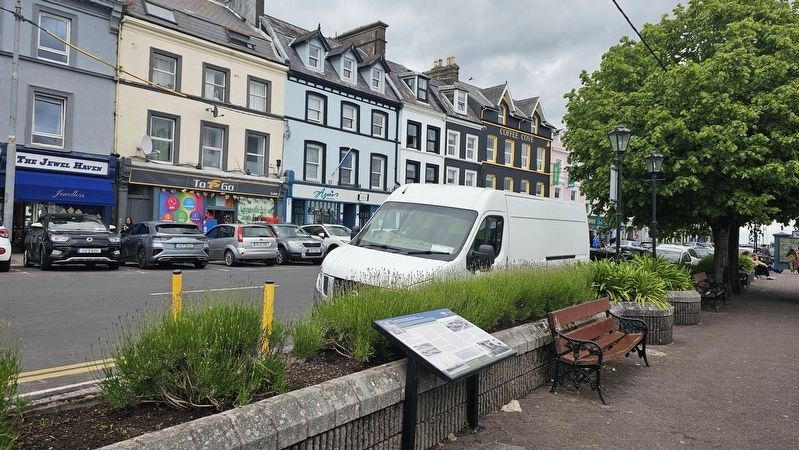
The marker is found along the southern end of West Beach.
At the close of 1883, Charlotte returned to Queenstown, physically and mentally exhausted, her hereditary hearing defect had worsened. Her efforts to hire a Matron to run the Home failed and circumstances forced her to close. Before leaving, she had a mobile Coffee Stall installed for the benefit of emigrants in need of refreshments.
She moved back to her home in Árd-an-Óir, Foynes, County Limerick. An avid letter writer, Charlotte kept in touch with her extended family, spoiled her nieces and nephews and ten Irish Terriers. In 1887 she converted to Catholicism. She was a botanist who contributed to knowledge about local flora. Charlotte advocated the wearing of Irish manufactured clothing and footwear. She wore velvet capes and mantles and adorned Celtic designs.
Charlotte died of suspected heart failure 3rd June 1909, aged 63. A memoir Charlotte Grace O’Brien Selections From Her Writings and Correspondence was published by her nephew Stephen Gwynn in November 1909. Gwynn was also an Irish Parliamentary Party MP.
1881 – 6th May Pall Mall Gazette published Horrors of the Immigrant Ship by C. G. O’Brien.
Achieved:
• Toilets and wash facilities installed for steerage passengers.
• Board of Trade inspectors had become far more vigilant.
• Steerage passengers no longer had to share sleeping quarters with horses.
• Stewardesses for steerage were introduced on most emigrant ships.
• The Mission Our Lady of the Rosary had been established in New York which provided accommodation and connections to employment for Irish immigrant women.
John Boyle O’Reilly Editor Boston Pilot:
“I admire and esteem her almost above anyone I have ever known.”
Archbishop Thomas Croke:
“God will I am sure, give you a high place in Heaven for all the good you are striving to do.”
Steerage of Germanic – C. G. O’Brien 1882.
Tween dim-lit decks, hard hands, and weary eyes,
Hearts so toil-worn but scarce they dare arise,
To gaze upon themselves and own their youth.
This information board was produced by Author Anne McCloskey in partnership with Cobh Tidy Towns.
Cobh Tidy Towns, helping to keep our local history alive.
(Captions)
Charlotte Grace O’Brien in 1894. Photo courtesy of Anthony O’Brien.
Emigrants Home, 7 West Beach in 1882. In February 1899, the building was destroyed by fire.
Coffee Stall with wheels enabling its mobility, assuring no liability for rateable valuation. (Photo: Lawrence Collection)
White Star Line SS Germanic.
The Home for Irish Immigrant Girls in New York continued to assist Irish girls until finally closing in 1954.
Erected by Cobh Tidy Towns.
Topics. This historical marker is listed in these topic lists: Arts, Letters, Music • Charity & Public Work • Immigration • Women. A significant historical date for this entry is May 6, 1881.
Location. 51° 51.018′ N, 8° 17.607′ W. Marker is in Cobh, Munster, in County Cork. It is in Kilgarvan. It can be reached from the intersection of West Beach and Kennedy Pier, on the left when traveling west. Touch for map. Marker is at or near this postal address: 29D West Beach, Cobh, Munster, Ireland. Touch for directions.

Regionally, it is on the Atlantic Ocean, in the North Atlantic Region, on the Atlantic Arc, in Europe, on the Island of Ireland, on the Celtic Fringe, in the European Union, in Atlantic Europe, on one of the British Isles, in the Western World, and in the Anglosphere.
Other nearby markers. At least 8 other markers are within walking distance of this marker: Radharc Inis Píc / Spike Island View (a few steps from this marker); Lusitania Centenary 2015 (within shouting distance of this marker); Father Theobald Mathew (within shouting distance of this marker); R.M.S. Titanic Memorial (within shouting distance of this marker); Cuimneachán Titanic / Titanic Memorial (within shouting distance of this marker); Cunard Line Offices (within shouting distance of this marker); Cóbh / Cobh (within shouting distance of this marker); Sonia O’Sullivan (within shouting distance of this marker). Touch for a list and map of all markers in Cobh.
Also see . . . O'Brien, Charlotte Grace (James H. Murphy, Dictionary of Irish Biography).
O’Brien’s principal cause was that of Irish emigrant women and the hazardous conditions under which they travelled to America – from the grim, overpriced boarding houses at Queenstown (Cobh) pre-departure, to the awful conditions onboard ships, to the dock slums and exploitation they arrived to. She vividly portrayed these dangers in her influential May 1881 article for the Pall Mall Gazette on the ‘Horrors of the immigrant ship’. She campaigned successfully on both sides of the Atlantic on these issues, and to the dismay of the shipping lines she established a boarding house at Queenstown (Cobh) and was able to give advice to thousands of emigrants on the best way to travel to America.(Submitted on June 13, 2026, by Ian Lefkowitz of New York, New York.)
Credits. This page was last revised on June 14, 2026. It was originally submitted on June 13, 2026, by Ian Lefkowitz of New York, New York. This page has been viewed 11 times since then. Photos: 1, 2. submitted on June 13, 2026, by Ian Lefkowitz of New York, New York. • Andrew Ruppenstein was the editor who published this page.
