Phoebus in Hampton, Virginia — The American South (Mid-Atlantic)
Hampton VAMC National Cemetery
Photographed by Brandon D Cross, January 30, 2019
1. Hampton VAMC National Cemetery Marker
National Soldiers Home
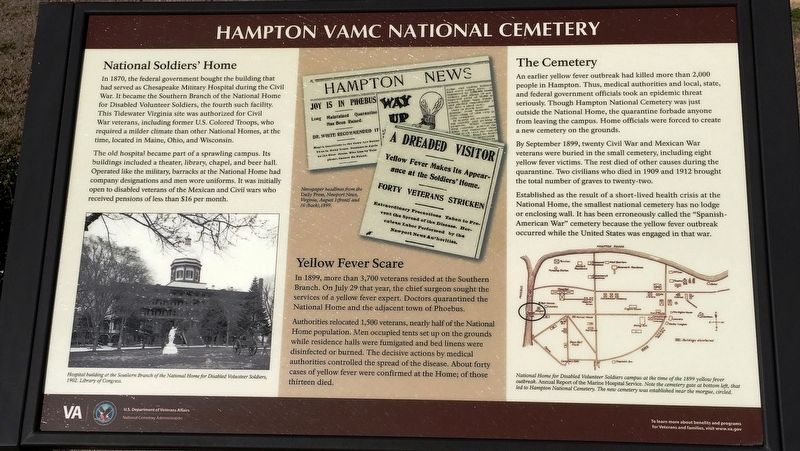
In 1870, the federal government bought the building that had served as Chesapeake Military Hospital during the Civil War. It became the Southern Branch of the National Home for Disabled Volunteer Soldiers, the fourth such facility. This Tidewater Virginia site was authorized for Civil War veterans, including former U.S. Colored Troops, who required a milder climate than other National Homes, at the time, located in Maine, Ohio, and Wisconsin.
The old hospital became part of a sprawling campus. Its buildings included a theater, library, chapel, and beer hall. Operated like the military, barracks at the National Home had company designations and men wore uniforms. It was initially open to disabled veterans of the Mexican and Civil wars who received pensions of less than $16 per month.
Yellow Fever Scare
In 1899, more than 3,700 veterans resided at the Southern Branch. On July 29 that year, the chief surgeon sought the services of a yellow fever expert. Doctors quarantined the National Home and the adjacent town of Phoebus.
Authorities relocated 1,500 veterans, nearly half of the National
this page online
The Cemetery
An earlier yellow fever outbreak had killed more than 2,000 people in Hampton. Thus, medical authorities and local, state, and federal government officials took an epidemic threat seriously. Though Hampton National Cemetery was just outside the National Home, the quarantine forbade anyone from leaving the campus. Home officials were forced to create a new cemetery on the grounds.
By September 1899, twenty Civil War and Mexican War veterans were buried in the small cemetery, including eight yellow fever victims. The rest died of other causes during the quarantine. Two civilians who died in 1909 and 1912 brought the total number of graves to twenty-two.
Established as the result of a short-lived health crisis at the National Home, the smallest national cemetery has no lodge or enclosing wall. It has been erroneously
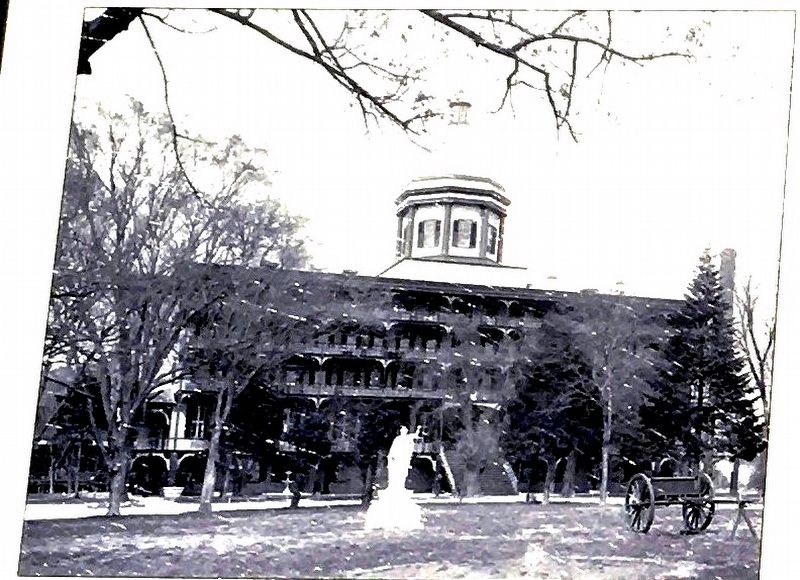
Library of Congress, circa January 30, 2019
2. Marker detail: Hospital Building at the Southern Branch for Disabled Volunteer Soldiers, 1902.
Erected by U.S Department of Veteran Affairs, National Cemetery Administration.
Topics and series. This historical marker is listed in these topic lists: Cemeteries & Burial Sites • Science & Medicine • War, Spanish-American. In addition, it is included in the National Cemeteries series list. A significant historical year for this entry is 1870.
Location. 37° 1.114′ N, 76° 19.866′ W. Marker is in Hampton, Virginia. It is in Phoebus. It is at the intersection of Harris Avenue and Emancipation Drive, on the right when traveling west on Harris Avenue. Touch for map. Marker is in this post office area: Hampton VA 23669, United States of America. Touch for directions.

Regionally, this marker is on Virginia’s Peninsula and in Coastal Virginia. It is also in the American South, specifically in the Upper South, in the Tidewater, and on the Eastern Seaboard. Globally, it is in the North Atlantic Region, North America, the Western Hemisphere, the Western World, and the Anglosphere.
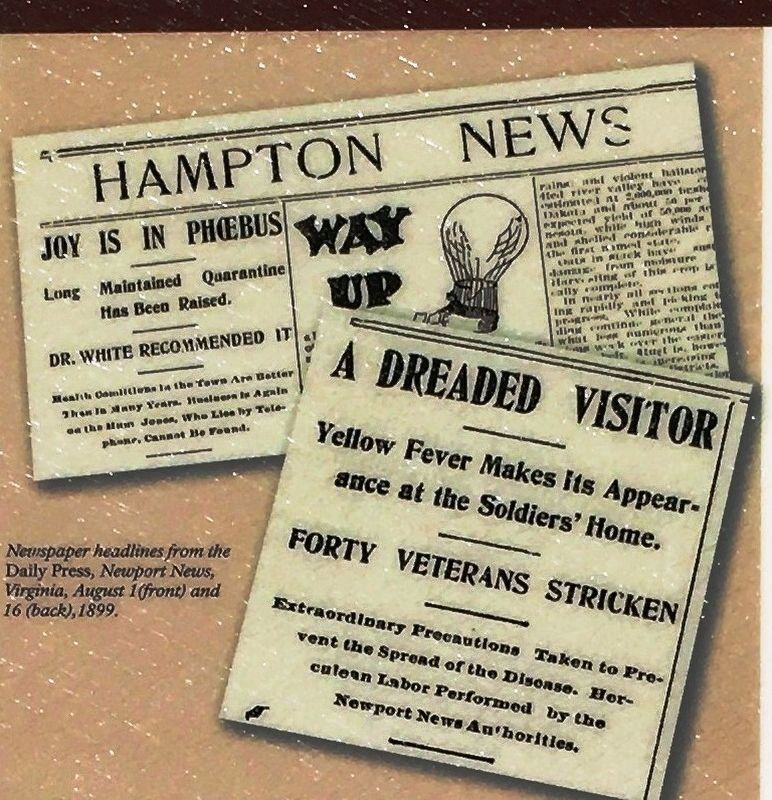
January 30, 2019
3. . Marker detail: Newspaper headlines from the Daily Press, August 1 (front) and 16 (back), 1899.
Other nearby markers. At least 8 other markers are within walking distance of this marker: USS Monitor (approx. 0.2 miles away); Union Soldiers Monument (approx. 0.2 miles away); Civil Rights (approx. ¼ mile away); Cemetery (approx. ¼ mile away); A National Cemetery System (approx. ¼ mile away); Hampton National Cemetery (approx. ¼ mile away); The Ultimate Sacrifice (approx. 0.3 miles away); a different marker also named Emancipation Oak (approx. 0.3 miles away). Touch for a list and map of all markers in Hampton.
Other markers no longer nearby. Emancipation Oak (was approx. 0.3 miles away but has been replaced with another marker now near it); a different marker also named Emancipation Oak (was approx. 0.3 miles away but has been replaced with another marker now near it).
More about this marker. This marker is specific to Hampton National Cemetery (VAMC), a small 22-interment hospital cemetery that is considered the smallest
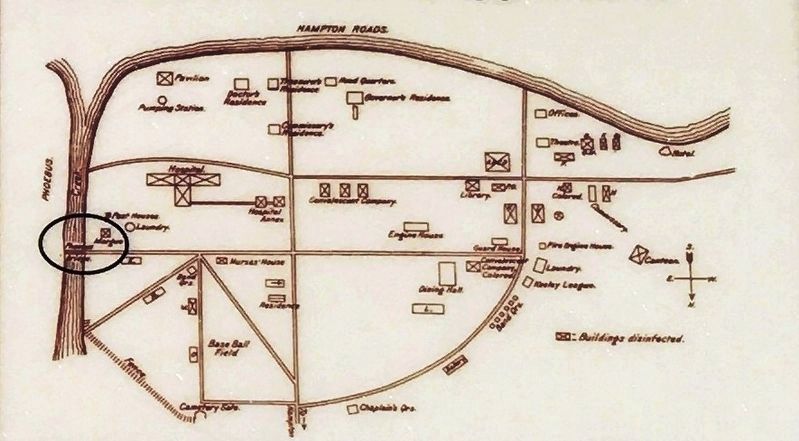
January 30, 2019
4. Marker detail: National Home for Disabled Volunteer Soldiers campus
Photo taken at the time of the 1899 yellow fever outbreak. Annual Report of the Marine Hospital Service. Note the cemetery gate at bottom left, that led to Hampton National Cemetery. The new cemetery was established near the morgue, circled.
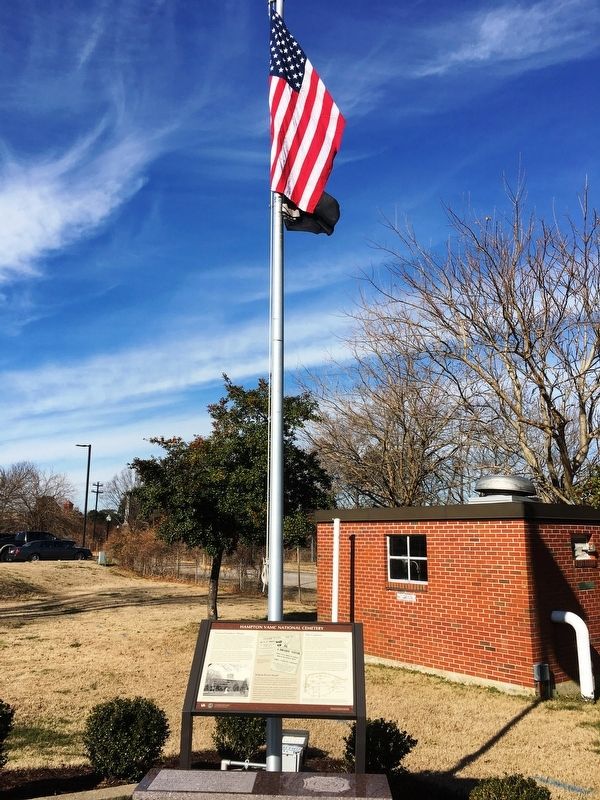
Photographed by Brandon D Cross, January 30, 2019
5. Hampton VAMC National Cemetery Marker
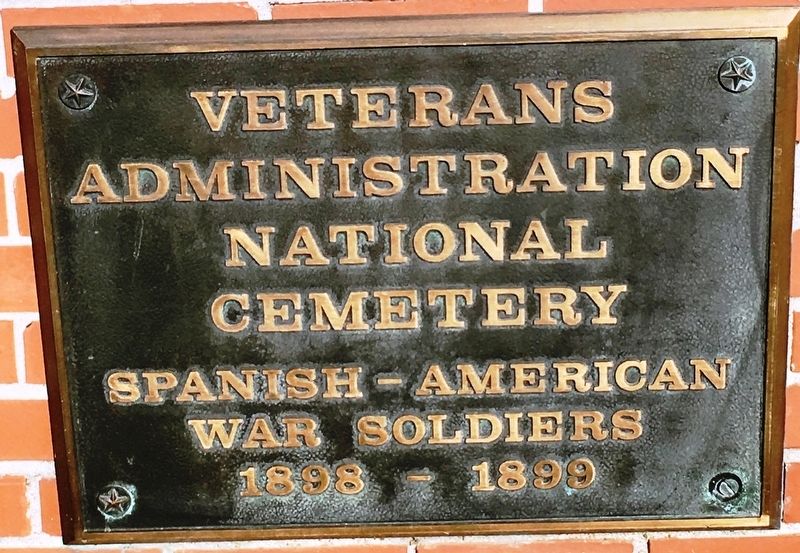
Photographed by Brandon D Cross, January 30, 2019
6. Veterans Administration National Cemetery
Spanish-American War Soldiers 1898-1899
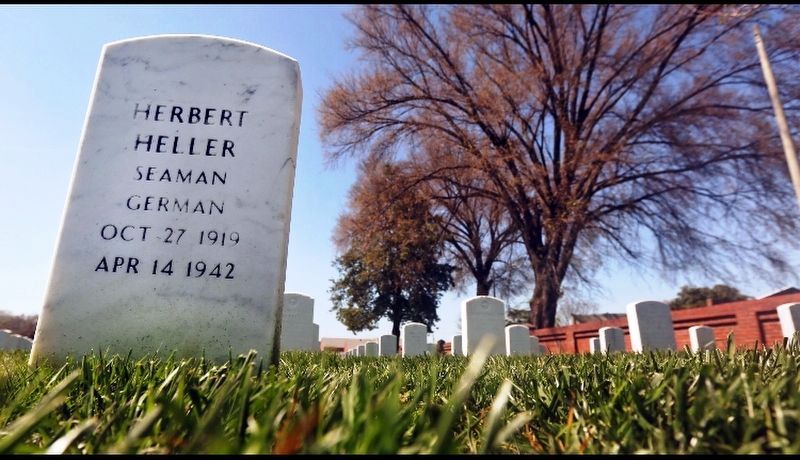
Courtesy The Daily Press
7. Germain Sailor Gravesite
One of 28 German sailors buried in the Hampton National Cemetery that were killed when the USS Roper sank the German U-boat,U-85, off Cape Hatteras in 1942.
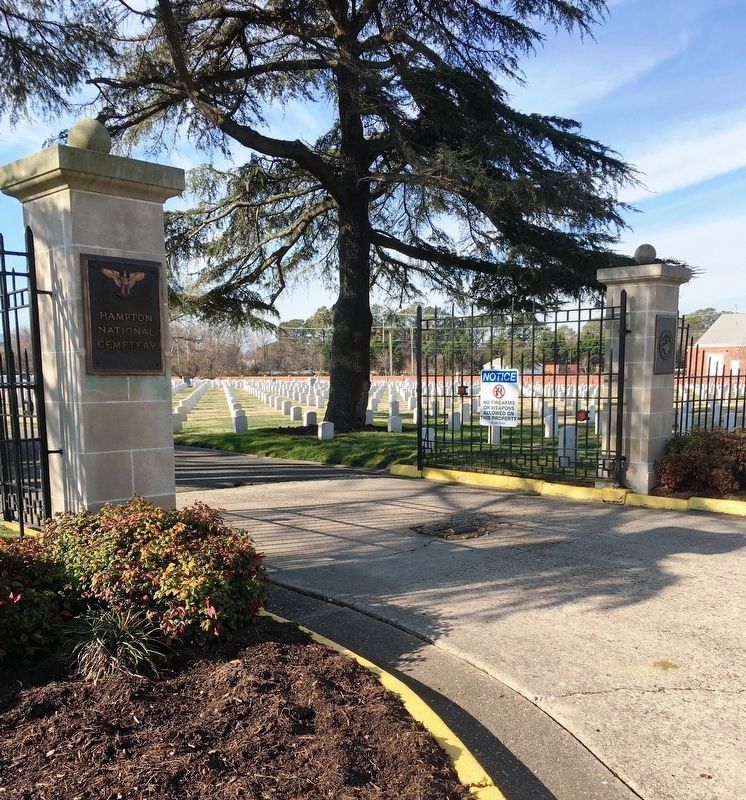
Photographed by Brandon D Cross, January 30, 2019
8. Hampton National Cemetery "Phoebus Section" gates
Photographed by Brandon D Cross, January 30, 2019
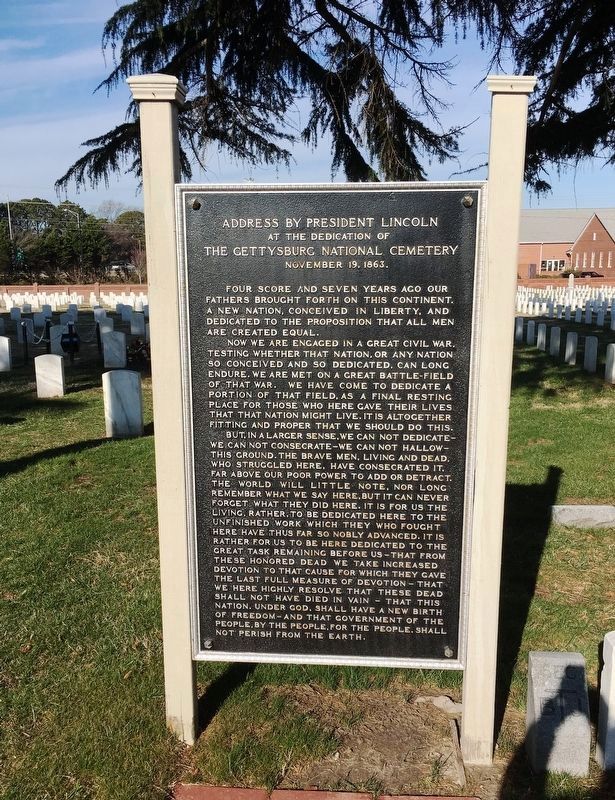
9. Gettysburg Address
Each US National Cemetery displays a Gettysburg Address tablet. This one is located in the Phoebus section of the Hampton National Cemetery.
Credits. This page was last revised on June 14, 2026. It was originally submitted on February 20, 2019, by Brandon D Cross of Flagler Beach, Florida. This page has been viewed 601 times since then and 50 times this year. Last updated on June 13, 2026, by Evan Dwyer of Richmond, Virginia. Photos: 1, 2, 3, 4, 5, 6. submitted on February 20, 2019, by Brandon D Cross of Flagler Beach, Florida. 7, 8. submitted on February 21, 2019, by Brandon D Cross of Flagler Beach, Florida. 9. submitted on February 22, 2019, by Brandon D Cross of Flagler Beach, Florida. • Bernard Fisher was the editor who published this page.
