Roxham
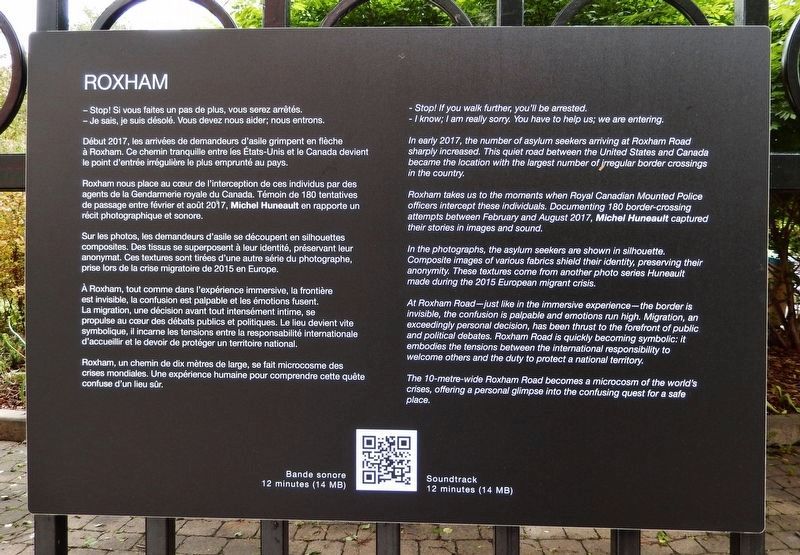

— Stop! Si vous faites un pas de plus, vous serez arrêtés.
— Je sais, je suis désolé. Vous devez nous aider; nous entrons.
Début 2017, les arrivées de demandeurs d'asile grimpent en flèche à Roxham. Ce chemin tranquille entre les États-Unis et le Canada devient le point d'entrée irrégulière le plus emprunté au pays.
Roxham nous place au cœur de l'interception de ces individus par des agents de la Gendarmerie royale du Canada. Témoin de 180 tentatives de passage entre février et août 2017, Michel Huneault en rapporte un récit photographique et sonore.
Sur les photos, les demandeurs d'asile se découpent en silhouettes composites. Des tissus se superposent à leur identité, préservant leur anonymat. Ces textures sont tirées d'une autre série du photographe, prise lors de la crise migratoire de 2015 en Europe.
À Roxham, tout comme dans l'expérience immersive, la frontière est invisible, la confusion est palpable et les émotions fusent. La migration, une décision avant tout intensément intime, se propulse au cœur des débats publics et politiques. Le lieu devient vite symbolique, il incarne les tensions entre
this page online
Roxham, un chemin de dix mètres de large, se fait microcosme des crises mondiales. Une expérience humaine pour comprendre cette quête confuse d'un lieu sûr.
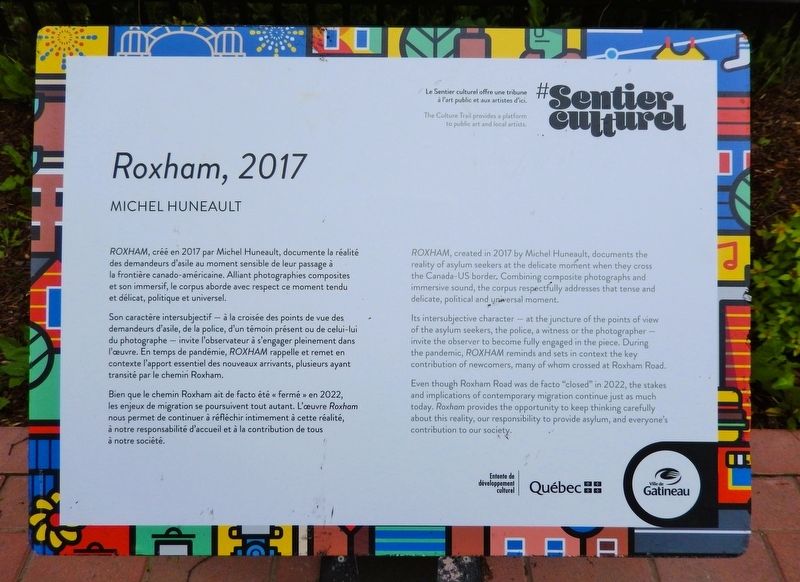
ROXHAM, créé en 2017 par Michel Huneault, documente la réalité des demandeurs d'asile au moment sensible de leur passage à la frontière canado-américaine. Alliant photographies composites et son immersif, le corpus aborde avec respect ce moment tendu et délicat, politique et universel.
Son caractère intersubjectif — à la croisée des points de vue des demandeurs d'asile, de la police, d'un témoin présent ou de celui-lui du photographe — invite l'observateur à s'engager pleinement dans l'œuvre. En temps de pandémie, ROXHAM rappelle et remet en contexte l'apport essentiel des nouveaux arrivants, plusieurs ayant transité par le chemin Roxham.
Bien que le chemin Roxham ait de facto été « fermé » en 2022, les enjeux de migration se poursuivent tout autant. L'œuvre Roxham nous permet de continuer à réfléchir intimement à cette réalité, à notre responsabilité d'accueil et à la contribution de
— Stop! If you walk further, you'll be arrested.
— I know; I am really sorry. You have to help us; we are entering.
In early 2017, the number of asylum seekers arriving at Roxham Road sharply increased. This quiet road between the United States and Canada became the location with the largest number of irregular border crossings in the country.
Roxham takes us to the moments when Royal Canadian Mounted Police officers intercept these individuals. Documenting 180 border-crossing attempts between February and August 2017, Michel Huneault captured their stories in images and sound.
In the photographs, the asylum seekers are shown in silhouette. Composite images of various fabrics shield their identity, preserving their anonymity. These textures come from another photo series Huneault made during the 2015 European migrant crisis.
At Roxham Road — just like in the immersive experience — the border is invisible; the confusion is palpable and emotions run high. Migration, an exceedingly personal decision, has been thrust to the forefront of public and political debates. Roxham Road is quickly becoming symbolic: it embodies the tensions between the international responsibility to welcome others and the duty to protect a national territory.
The 10-metre-wide Roxham Road becomes a microcosm of the world's crises, offering a personal glimpse into the confusing quest for a safe place.
ROXHAM, created in 2017 by Michel Huneault, documents the reality of asylum seekers at the delicate moment when they cross the Canada-US border. Combining composite photographs and immersive sound, the corpus respectfully addresses that tense and delicate, political and universal moment.
Its intersubjective character — at the juncture of the points of view of the asylum seekers, the police, a witness or the photographer — invite the observer to become fully engaged in the piece. During the pandemic, ROXHAM reminds and sets in context the key contribution of newcomers, many of whom crossed at Roxham Road.
Even though Roxham Road was de facto “closed” in 2022, the stakes and implications of contemporary migration continue just as much today. Roxham provides the opportunity to keep thinking carefully about this reality, our responsibility to provide asylum, and everyone's contribution to our society.
Erected by Ville de Gatineau, Québec, Entente de développement culturel.
Topics. This historical marker is listed in these topic lists: Immigration • Law Enforcement. A significant historical year for this entry is 2017.
Location. 45° 25.687′ N, 75° 43.092′ W. Marker is in Gatineau, Québec, in Outaouais. It is in District de Hull. It is on Rue Leduc just south of Rue Vaudreuil, on the right when traveling north. The marker is mounted on the wrought iron fence near the northwest corner of Du Carré-Vaudreuil Park. Touch for map. Marker is at or near this postal address: 50 Rue Vaudreuil, Gatineau QC J8X 2E3, Canada. Touch for directions.

Regionally, this marker is in the Ottawa Metropolitan Area and in the Outaouais & Eastern Townships. It is also in Central Canada. Globally, it is in North America, the Great North Woods, the Western Hemisphere, and the Western World. Historically, it finds itself in what was once a British colony, the Viceroyalty of New France, the Haudenosaunee (Iroquois) Confederacy, and Rupert’s Land.
Other nearby markers. At least 8 other markers are within walking distance of this marker: Hull, une ville ouvrière dans l'âme (about 120 meters away, measured in a direct line); Ce bâtiment est un haut lieu du syndicalisme Québécois (about 210 meters away); Une histoire marquée par les flammes (approx. 0.3 kilometers away); Maison Aubry (approx. 0.3 kilometers away); Une enclave du passé au cœur de la ville (approx. 0.3 kilometers away); Hull au début du XXe siècle (approx. 0.3 kilometers away); Bienvenue à Wrightstown (approx. 0.3 kilometers away); Le métier et les combats des allumettières (approx. 0.3 kilometers away). Touch for a list and map of all markers in Gatineau.
Also see . . . Roxham Road (Wikipedia).
Excerpt: Roxham Road is a 5-mile rural road from the former hamlet of Perry Mills in the town of Champlain, New York, United States, generally north to the vicinity of the former hamlet of Bogton, in the municipality of Saint-Bernard-de-Lacolle, Quebec, Canada. It has existed since the early 19th century, before the Canada–United States border was formally established along the 45th parallel north between the St. Lawrence and Connecticut rivers. For most of its length it is a rural two-lane blacktop road.(Submitted on June 14, 2026, by Cosmos Mariner of Cape Canaveral, Florida.)For most of its history, it was possible to freely cross the border through Roxham Road, since it largely carried local traffic. Canada established a small customs station just north of the border; the U.S. never followed suit, leaving Roxham an uncontrolled border crossing, even after Canada closed its customs station in the 1950s. That ended when Canadian authorities decided, in advance of the 1976 Summer Olympics in Montreal, to barricade all the uncontrolled land border crossings between Quebec and New York, as well as the neighboring U.S. state of Vermont. Since then, Roxham has officially been a dead end in both directions at the border. Beginning in 2017, more than 90 percent of those who irregularly entered Canada seeking asylum did so through Roxham Road, making it a metonym for the complications of Canada's immigration policies.
Credits. This page was last revised on June 14, 2026. It was originally submitted on June 14, 2026, by Cosmos Mariner of Cape Canaveral, Florida. This page has been viewed 14 times since then. Photos: 1, 2. submitted on June 14, 2026, by Cosmos Mariner of Cape Canaveral, Florida.
Editor’s want-list for this marker. wide view of the marker with surrounding context • Can you help?
