Le sentier récréatif du boulevard Fournier
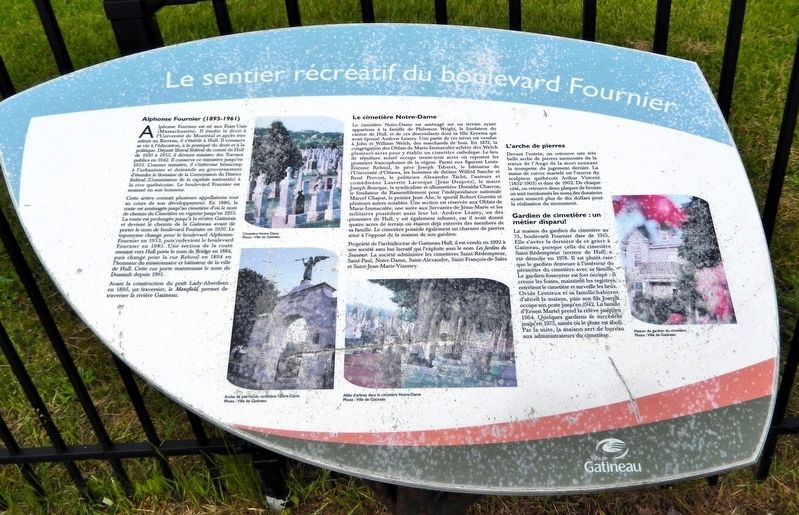

Alphonse Fournier est né aux États-Unis (Massachusetts). Il étudie le droit à l'Université de Montréal et après être admis au Barreau, il s'établit à Hull. Il consacre sa vie à l'éducation, à la pratique du droit et à la politique. Député libéral fédéral du comté de Hull de 1930 à 1953, il devient ministre des Travaux publics en 1942. Il conserve ce ministère jusqu'en 1953. Comme ministre, il s'intéresse beaucoup à l'urbanisme et demande au gouvernement d'étendre le domaine de la Commission du District fédéral (Commission de la capitale nationale) à la rive québécoise. Le boulevard Fournier est nommé en son honneur.
Cette artère connaît plusieurs appellations tout au cours de son développement. En 1886, la route est aménagée jusqu'au cimetière d'où le nom de chemin du Cimetière en vigueur jusqu'en 1923. La route est prolongée jusqu'à la rivière Gatineau et devient le chemin de la Gatineau avant de porter le nom de boulevard Fournier en 1950. Le toponyme change pour le boulevard Alphonse-Fournier en 1953, puis redevient le boulevard Fournier en 1985. Une section de la route menant vers
this page online
Avant la construction du pont Lady-Aberdeen en 1895, un traversier, le Mansfield, permet de traverser la rivière Gatineau.
Le cimetière Notre-Dame
Le cimetière Notre-Dame est aménagé sur un terrain ayant appartenu à la famille de Philemon Wright, le fondateur du canton de Hull, et de ces descendants dont sa fille Erexina qui avait épousé Andrew Leamy. Une partie de ces terres est vendue à John et William Welch, des marchands de bois. En 1872, la congrégation des Oblats de Marie-Iminaèulée achète des Welch plusieurs acres pour y établir un cimetière catholique. Le lieu de sépulture actuel occupe trente-trois acres où reposent les pionniers francophones de la région. Parmi eux figurent. Louis-Étienne Reboul, le père Joseph Tabaret, le bâtisseur de l'Université d'Ottawa, les hommes de théâtre Wilfrid Sanche et René Provost, le politicien Alexandre Taché, l'auteure et comédienne Laurette Larocque (Jean Despréz), le maire Joseph Bourque, la syndicaliste
Propriété de l'archidiocèse de Gatineau-Hull, il est vendu en 1992 à une société sans but lucratif qui l’exploite sous le nom Les Jardins du Souvenir. La société administre les cimetières Saint-Rédempteur, Saint-Paul, Notre-Dame, Saint-Alexandre, Saint-François-de-Sales et Saint Jean-Marie-Vianney.
L'arche de pierres
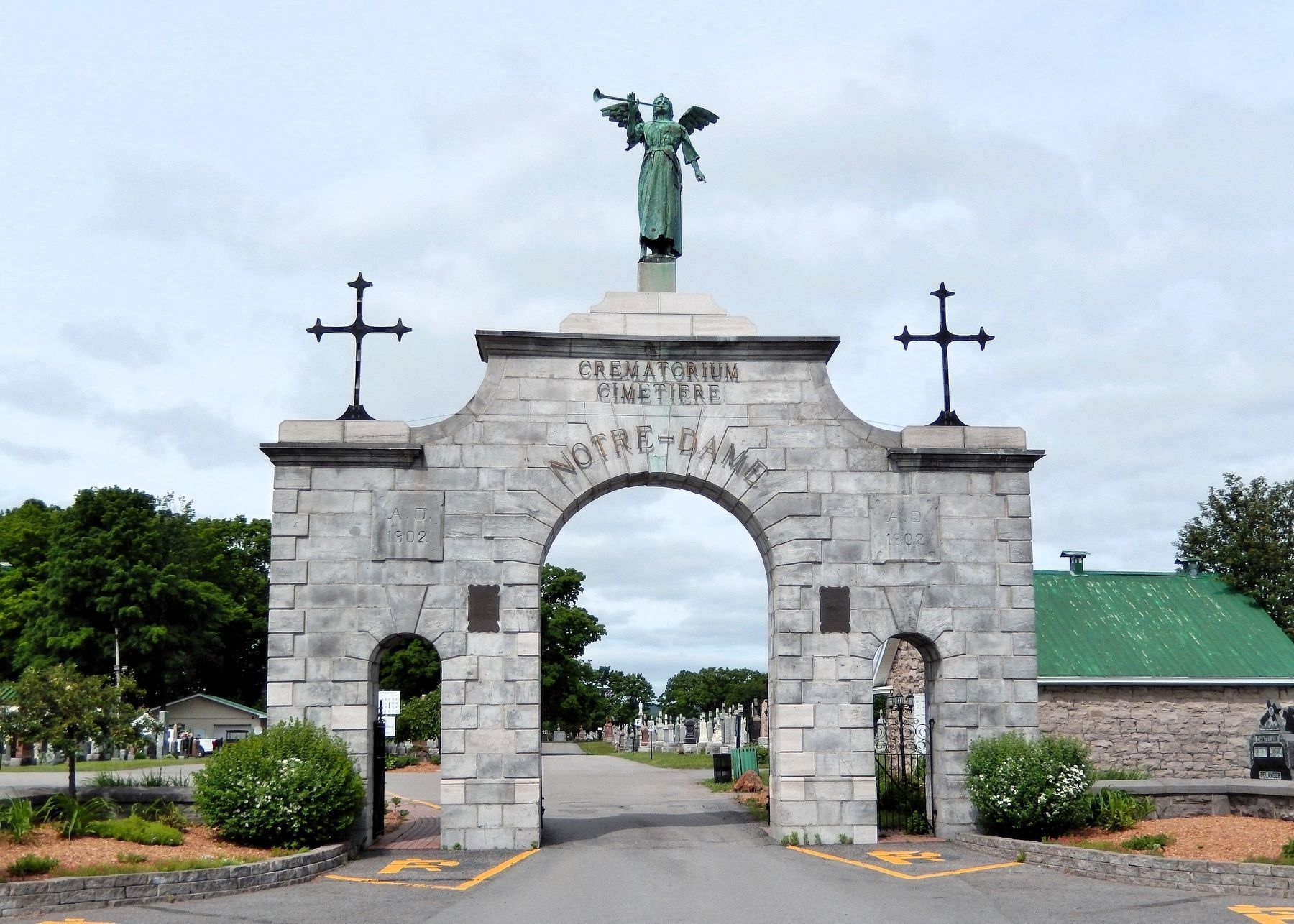
Devant l'entrée, on retrouve une très belle arche de pierres surmontée de la statue de l'Ange de la mort sonnant la trompette du jugement dernier. La statue de cuivre martelé est l'œuvre du sculpteur québécois Arthur Vincent (1852-1903) et date de
Gardien de cimetière : un métier disparu!
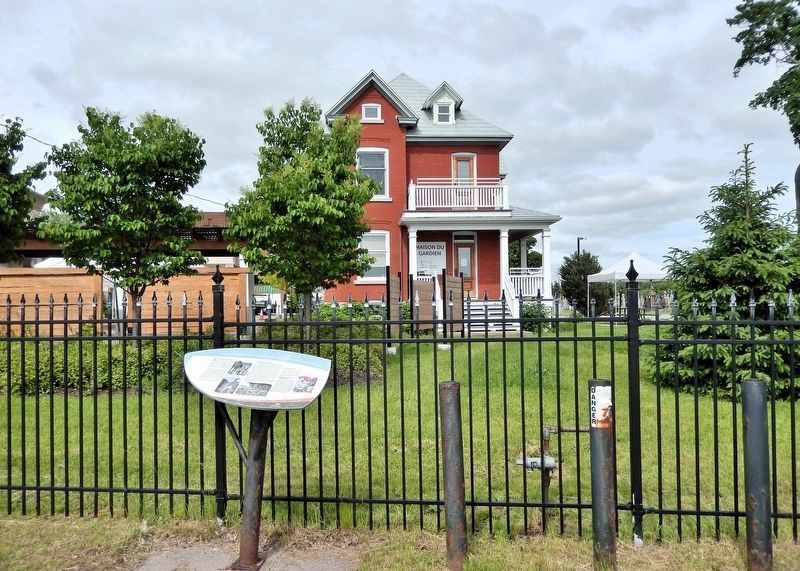
La maison du gardien du cimetière au 75, boulevard Fournier date de 1915. Elle s'avère la dernière de ce genre à Gatineau, puisque celle du cimetière Saint-Rédempteur (secteur de Hull) a' été démolie en 1978. Il est plutôt rare que le gardien demeure à l'intérieur du périmètre du cimetière avec famille. Le gardien-fossoyeur est fort occupé : il creuse les fosses, maintient les registres, entretient le cimetière et surveille les lieux. Ovide Lemieùx et sa famille habitent d'abord la maison, puis son fils Joseph occupe son poste jusqu’en 1942. La famille d'Ernest Martel prend la relève jusqu’en 1964. Quelques gardiens se succèdent jusqu’en 1975, année où le poste est aboli. Par la suite, la maison sert de bureau aux administrateurs du cimetière.
[légendes]
• Cimetière Notre-Dame
• Arche de pierres du cimetière Notre-Dame
• Allêe d’arbres dans le cimetière Notre-Dame
• Maison du gardien du cimetière
The recreational trail on Fournier Boulevard
Alphonse Fournier (1893-1961)
Alphonse Fournier was born in the United States (Massachusetts). He studied law at the University of Montreal and, after being admitted to the Bar, he settled in Hull. He dedicated his life to education, practicing law, and politics. He was the federal Liberal MP for the Hull riding from 1930 to 1953 and became Minister of Public Works in 1942. He held that ministry until 1953. As a minister, he was very interested in urban planning and asked the government to expand the domain of the Federal District Commission (National Capital Commission) to the Quebec side. Fournier Boulevard is named in his honor.
This main road has gone by several names throughout its development. In 1886, the road was built up to the cemetery, hence the name Cemetery Road, which was in use until 1923. The road was then extended to the Gatineau River and became Gatineau Road before being named Fournier Boulevard in 1950. The name changed to Alphonse-Fournier Boulevard in 1953, then back to Fournier Boulevard in 1985. A section of the road leading to Hull was called Bridge in 1884, then changed to Reboul Street in 1894 in honor of the missionary and city builder of Hull. This street has been named Dussault since 1961.
Before the Lady Aberdeen Bridge was built in 1895, a ferry, the Mansfield, allowed people to cross the Gatineau River.
Notre-Dame Cemetery
Notre-Dame Cemetery is set up on land that used to belong to the family of Philemon Wright, the founder of Hull Township, and his descendants, including his daughter Erexina, who had married Andrew Leamy. Part of this land was sold to John and William Welch, who were lumber merchants. In 1872, the Oblates of Mary Immaculate bought several acres from the Welches to establish a Catholic cemetery. The current burial site covers thirty-three acres, where the French-speaking pioneers of the region are laid to rest. Among them are Louis-Étienne Reboul, Father Joseph Tabaret, the builder of the University of Ottawa, theater figures Wilfrid Sanche and René Provost, politician Alexandre Taché, and author and actress Laurette Larocque (Jean Despréz), Mayor Joseph Bourque, the union activist and match factory worker Donalda Charron, the founder of the Rally for National Independence Marcel Chaput, the painter Jean Alie, the athlete Robert Guertin, and many other notable figures. One section is reserved for the Oblates of Mary Immaculate, another for the Servants of Jesus and Mary, and the military also has its own section. Andrew Leamy, one of the pioneers of Hull, is also buried there, as he had donated four acres of land where members of his family were already buried. The cemetery also has a stone ossuary located opposite the caretaker's house.
Owned by the Archdiocese of Gatineau-Hull, it was sold in 1992 to a nonprofit organization that operates it under the name Les Jardins du Souvenir. The organization manages the Saint-Rédempteur, Saint-Paul, Notre-Dame, Saint-Alexandre, Saint-François-de-Sales, and Saint Jean-Marie-Vianney cemeteries.
The Stone Arch
At the entrance, there's a beautiful stone arch topped with a statue of the Angel of Death blowing the trumpet of Judgment Day. The hammered copper statue is the work of Quebec sculptor Arthur Vincent (1852-1903) and dates back to 1902. On each side, there are two bronze plaques listing the names of donors who contributed more than ten dollars toward the creation of the monument.
Cemetery Caretaker: A Vanished Job!
The cemetery caretaker's house at 75 Fournier Boulevard dates back to 1915. It turns out to be the last of its kind in Gatineau, since the one at Saint-Rédempteur Cemetery (in the Hull area) was demolished in 1978. It's pretty rare for the caretaker to live inside the cemetery grounds with their family. The caretaker-gravedigger is quite busy: digging graves, keeping records, maintaining the cemetery, and watching over the place. Ovide Lemieux and his family were the first to live in the house, then his son Joseph held the position until 1942. Ernest Martel's family took over until 1964. A few caretakers followed until 1975, the year the position was abolished. After that, the house was used as an office for the cemetery administrators.
[captions]
• Notre-Dame Cemetery
• Stone arch of Notre-Dame Cemetery
• Tree-lined path in Notre-Dame Cemetery
• Cemetery caretaker's house
Erected by Ville de Gatineau.
Topics. This historical marker is listed in these topic lists: Architecture • Cemeteries & Burial Sites • Roads & Vehicles. A significant historical year for this entry is 1872.
Location. 45° 26.865′ N, 75° 42.756′ W. Marker is in Gatineau, Québec, in Outaouais. It is in District de Hull. It is on Boulevard Fournier 0.2 kilometers north of Rue Bériault, on the right when traveling south. Touch for map. Marker is at or near this postal address: 75 Boulevard Fournier, Gatineau QC J8X 3P5, Canada. Touch for directions.

Regionally, this marker is in the Ottawa Metropolitan Area and in the Outaouais & Eastern Townships. It is also in Central Canada. Globally, it is in North America, the Great North Woods, the Western Hemisphere, and the Western World. Historically, it finds itself in what was once a British colony, the Viceroyalty of New France, the Haudenosaunee (Iroquois) Confederacy, and Rupert’s Land.
Other nearby markers. At least 8 other markers are within walking distance of this marker: The International Peace Garden/Le Jardin International de la Paix (approx. 1.5 kilometers away in Ontario); Reflection/Réflexion (approx. 1.5 kilometers away in Ontario); WWII British Commonwealth/Empire Air Forces Honored Dead in Canada and the United States of America (approx. 1.5 kilometers away in Ontario); The Ottawa Memorial/Le Monument commémoratif d'Ottawa (approx. 1.5 kilometers away in Ontario); Iznik Tiles/Céramique d'Iznik (approx. 1.5 kilometers away in Ontario); The 25 Pounder, QF, Gun (approx. 1.5 kilometers away in Ontario); National Artillery Memorial/Monument national aux artilleurs (approx. 1.5 kilometers away in Ontario); Mackenzie-Papineau Battalion/Le bataillon Mackenzie-Papineau (approx. 1.5 kilometers away in Ontario).
Also see . . .
1. Alphonse Fournier PC QC (Wikipedia).
Excerpt: Born in Methuen, Massachusetts, he was first elected to the House of Commons of Canada representing the Quebec riding of Hull in the 1930 federal election. A Liberal, he was re-elected in 1935, 1940, 1945, and 1949. From 1942 to 1953, he was the Minister of Public Works. From 1948 to 1953, he was the Leader of the Government in the House of Commons and Liberal Party House Leader.(Submitted on June 14, 2026, by Cosmos Mariner of Cape Canaveral, Florida.)
2. Notre-Dame Cemetery (Les Jardins du Souvenir Funeral Home).
Excerpt : The entrance to the Notre-Dame Cemetery is quite impressive. It has a carved stone portal built in 1902 following the plans of Hull architect, Charles Brodeur. A statue of the Angel of Death sounding the last trumpet surmounts the portal. Made of hammered copper, the statue was made by Quebec sculptor Arthur Vincent. It appears that this statue was the last significant work of the artist.(Submitted on June 14, 2026, by Cosmos Mariner of Cape Canaveral, Florida.)Built in 1915, the Notre-Dame Cemetery caretakers’ house was first inhabited by Ovide Lemieux, Exhildat Jacques, his wife and their seven children. It then became the residence of the family of their son Joseph. Ernest Martel and his wife Alice Brault, who occupied the house along with their nine children until their departure in 1964. Other caretakers replaced the Martels until 1975 when the house was transformed into offices for the cemetery’s staff. In October 2006, the house was emptied and offices were then housed in a new building located where once was the garden. According to historian Manon Guitard, the heritage value of the building resides in the fact that it was the residence of caretakers and is unique in Gatineau. In fact, it is the sole caretaker house in the entire city. Its heritage value is attributed to the fact that it is located inside the perimeter of the cemetery, near the monumental entrance, thus granting it a significant value.
Credits. This page was last revised on June 15, 2026. It was originally submitted on June 14, 2026, by Cosmos Mariner of Cape Canaveral, Florida. This page has been viewed 17 times since then. Photos: 1, 2, 3. submitted on June 14, 2026, by Cosmos Mariner of Cape Canaveral, Florida.
