Wainfleet in Niagara Region, Ontario — Central Canada (North America)
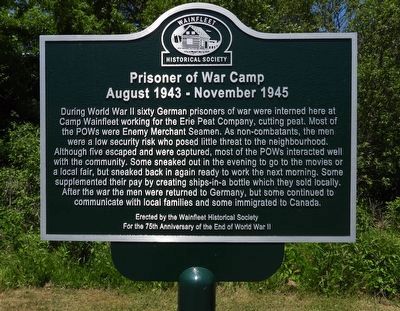
Prisoner of War Camp August 1943 - November 1945
Photographed by Kevin Westell, June 13, 2026
1. Prisoner of War Camp August 1943 - November 1945 - Marker
Erected by the Wainfleet Historical Society for the 75th Anniversary of the End of World War II
Erected 2022 by Wainfleet Historical Society.
Topics. This historical marker is listed in these topic lists: Immigration • Industry & Commerce • Law Enforcement • War, World II. A significant historical year for this entry is 1943.
Location. 42° 54.598′ N, 79° 17.758′ W. Marker is in Wainfleet,
this page online

Regionally, this marker is on the Golden Horseshoe and in Niagara Canada. It is also in Central Canada. Globally, it is in North America, on the Great Lakes, in the Western Hemisphere, in the Western World, and in the Anglosphere. Historically, it finds itself in what was once a British colony, the Viceroyalty of New France, the Haudenosaunee (Iroquois) Confederacy, and Rupert’s Land.
Other nearby markers. At least 8 other markers are within 5 kilometers of this marker, measured as the crow flies: Welcome to the Wainfleet Bog Conservation Area (here, next to this marker); Village of Humberstone Cenotaph (approx. 3.8 kilometers away); Augustine House (approx. 3.9 kilometers away); Humberstone Hall (approx. 4 kilometers away); The Ott House (approx. 4.1 kilometers away); Derek Point (approx. 4.1 kilometers
Photographed by Kevin Westell, June 13, 2026
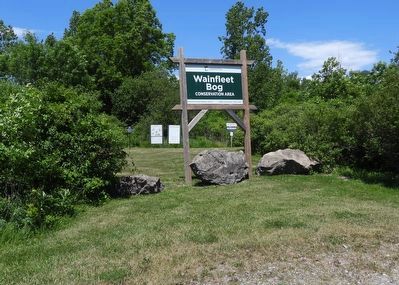
2. Prisoner of War Camp August 1943 - November 1945 - Marker in context
Photo faces north from Peat Bog Road, at its right turn into the parking lot for Wainfleet Bog Conservation Area. The plaque (distant centre left) is in line with panels describing the conservation area. The west end of the parking lot is 10 metres east of the eastern-most of these signs.
Regarding Prisoner of War Camp August 1943 - November 1945. #1. Wainfleet Bog is 1640 hectares (5.5 square miles). It consists of Wainfleet Bog Conservation Area on the west, that includes the former peat farm; and the smaller, wilder, boggier, undisturbed "Wainfleet Bog Conservation Reserve" (230 hectares - 0.9 square miles) to the north and east. Amenities are limited to parking and rudimentary trails.
#2. The Erie Peat Company operated from 1940 to 1983, briefly employing prison labour 1943-1945. A narrow-gauge (2 foot) railway operated on 3 miles of track, with 2 engines and 40 cars, to haul peat from the bog to the processing plant. It closed in 1983 after a fire.
#3. The dried out part of the bog (that was used for farming) catches fire some years - 1983, 1999, 2016, 2025.
Also see . . .
1. Wainfleet had a POW camp for German seamen from 1943 to 1945 (by insauga.com - January 19, 2023). (Submitted on June 15, 2026, by Kevin Westell of St. Catharines, Ontario.)
2. Wainfleet Bog Conservation Area (by Niagara Peninsula Conservation Authority).
The Wainfleet Bog Conservation Area is located within the Niagara Peninsula of Southern Ontario, (in the Township of Wainfleet and City of Port Colborne) and is part of the only bog wetland in the Niagara Peninsula. It is provincially, regionally and locally significant and the largest remaining bog within southern Ontario, providing habitat to a variety of unique plants and animals.(Submitted on June 15, 2026, by Kevin Westell of St. Catharines, Ontario.)
Credits. This page was last revised on June 15, 2026. It was originally submitted on June 15, 2026, by Kevin Westell of St. Catharines, Ontario. This page has been viewed 21 times since then. Photos: 1, 2. submitted on June 15, 2026, by Kevin Westell of St. Catharines, Ontario.
