Near Curlew in Ferry County, Washington — The American West (Northwest)
Ranald MacDonald
1824-1894

Photographed by Jimmy Emerson, June 15, 2017
1. Ranald MacDonald Marker
Adventurer, Seaman, and Miner
A native of the Pacific Northwest and admired for his bravery, intelligence, and friendly cooperation, Ranald MacDonald is honored by the Japanese as their first teacher of the English language and culture. His final resting place is near this site.
Early Years
Ranald was born February 3, 1824 at Fort George, a fur-trading post near the mouth of the Columbia River and present day Astoria, Oregon. He was the son of Archibald McDonald of the Hudson's Bay Company and Princess Raven of the Chinook tribe. Ranald's mother died shortly after his birth, and he was cared for by his mother's sister at a Chinook dwelling until his father married Jane Klyne.
Educated by his father at Fort Okanogan, Kamloops, and Langley, Ranald also attended Ball Academy at Fort Vancouver and Red River Academy in Winnipeg. At age 15, his father sent him to St. Thomas, Ontario to work in a bank and learn the profession. But Ranald longed for adventure and left banking and a civilized life to sail the "seven seas" and work on whaling ships.
First English Teacher in Japan
Ranald signed onto
this page online
Mining, Mineral Exploration, and Later Years
Ranald's adventures took him from Australia where he learned how to mine gold, to various regions in Canada where he participated in mining and mineral exploration.
In his later years, Ranald joined family members at Fort Colville, and built a cabin near the Columbia River. When his health began to fail, his niece, Jennie Nelson Lynch, brought him to her home near the confluence of Toroda Creek and
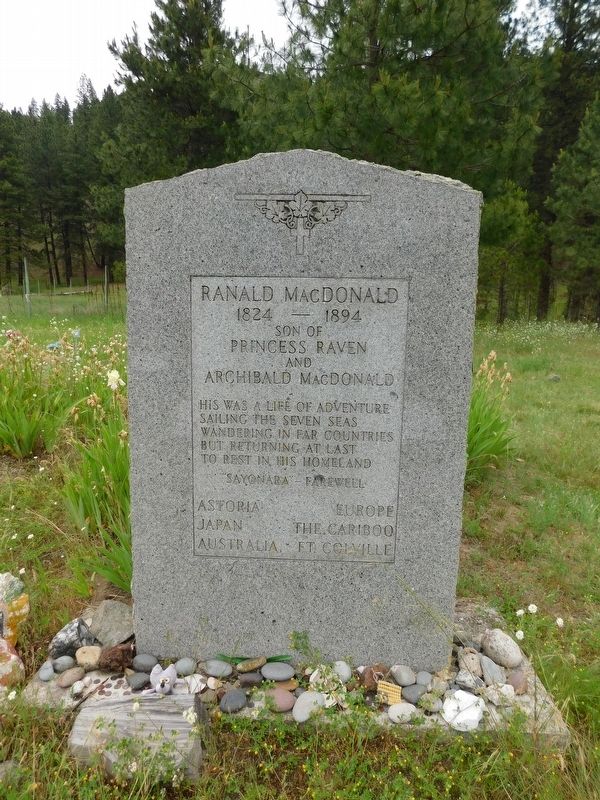
Photographed by Jimmy Emerson, June 15, 2017
2. Ranald MacDonald Grave
The historical mural at this site was painted by artist Charlene Payton Holt in 2000 and was restored by the artist in 2014.
This site was sponsored by the Ferry County Historical Society, the State of Washington, and the Friends of MacDonald
Sponsor: Ferry County Historical Society 15-2 Kean Street P.O. Box 287 Republic, WA 99166
Website: ferrycountyhs.org
This sign was created by Nathan Agent for his Eagle Scout project in the spring of 2015. Funding for this project was donated by the Ferry County Commissioners
Erected 2015 by Ferry County Historical Society, the State of Washington, and the Friends of MacDonald, Nathan Agent & Ferry County Commission.
Topics. This historical marker is listed in these topic lists: Education • Indigenous Peoples and Communities • Waterways & Vessels. A significant historical year for this entry is 1824.
Location. 48° 56.118′ N, 118° 45.27′ W. Marker is near Curlew, Washington, in Ferry County. It is on Kettle River Road 0.1 miles south of Custom Road, on the right when traveling north. Touch for map. Marker is at or near this postal address: 900 Kettle River Rd, Curlew WA 99118, United States of America. Touch for directions.

Regionally, this marker is in the Okanogan Highlands. It is also in the American Mountain West and in the Lewis & Clark Corridor. Globally, it is in North America, on the Pacific Rim, in the Western Hemisphere, in the Western World, and in the Anglosphere.
Other nearby markers. At least 6 other markers are within 18 kilometers of this marker, measured as the crow flies: Midway (approx. 5 miles away in Canada); Boundary Falls Smelter (approx. 12.2 kilometers away in Canada); Chief Joseph Tonasket (approx. 12.4 kilometers away); Bodie (approx. 15.3 kilometers away); Copper Street (approx. 16.8 kilometers away in Canada); Greenwood Smelter (approx. 16.8 kilometers away in Canada).
Another marker is no longer nearby. Kettle Valley Railroad (was approx. 8.8 kilometers away in Canada but has been replaced with another marker now near it).
Credits. This page was last revised on June 20, 2026. It was originally submitted on June 18, 2026, by Jimmy Emerson of Dalton, Georgia. This page has been viewed 17 times since then. Photos: 1, 2. submitted on June 18, 2026, by Jimmy Emerson of Dalton, Georgia. • James Hulse was the editor who published this page.
