Brownville in Nemaha County, Nebraska — The American Midwest (Upper Plains)
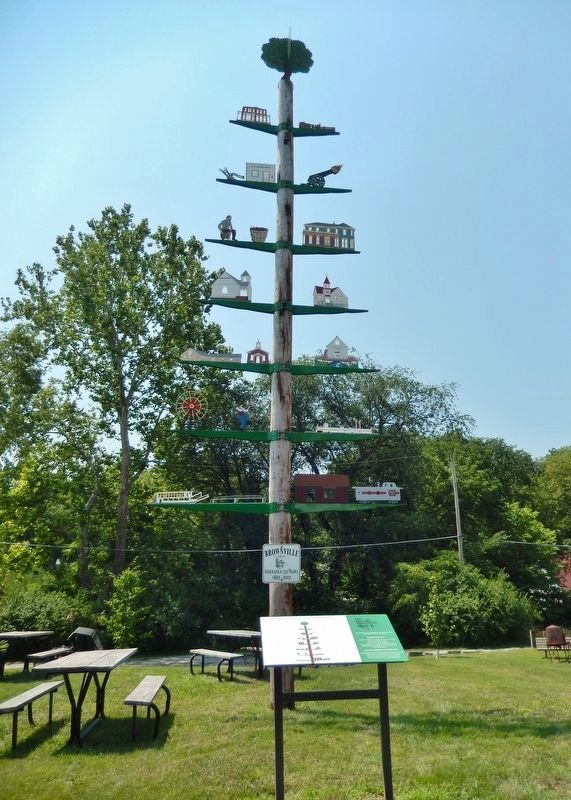
Brownville, Nebraska Historical Society Heritage Tree
Each symbol on the heritage tree represents life in Brownville

Photographed by Cosmos Mariner, July 3, 2021
1. Brownville, Nebraska Historical Society Heritage Tree Marker
Apple Tree — The rich heritage of Brownville began with Native Americans living in what became the Nebraska Territory. In 1854 Richard Brown arrived and soon a community was established near the Missouri River. The Loess soil was excellent for growing trees, fruits and grains. The Tree represents the vast fruits raised by early settlers.
Nemaha Valley Lodge #4 — Founded in 1858, the Masons have been using this historic building as a meeting hall since 1894, along with the Brownville Chapter Eastern Star #263. Brownville artist, sculpturist Tom Palmerton, used this building as his workshop and gallery.
Land Office and Plow — The Homestead Act of 1862 opened the Midwest prairie for agriculture where land was cleared, grain was milled and brought food, dairy products and fruit for merchandising. The first male and female claims were signed in Brownville at the Land Office.
Gov. Robert Furnas – Printing Press — Nebraska’s second Governor, Robert Furnas, had Brownville as home. This renaissance man brought agriculture to the forefront. His magazine, Nebraska Farmer, still graces farm family’s homes. Thousands of trees were planted
this page online
Brownville Concert Hall — The Peru Christian Church was moved to Brownville in 1989 and became the Concert Hall in 1990 where the art of music has entertained attendees with a diversity of musical performances.
Christian Church — In 1854, the same year Nebraska became a territory, the Elder Joel M. Wood arrived in town from Ohio. In 1855, he joined Richard Brown in establishing the Brownville Christian Church, one of the first religious organizations in Nebraska.
Methodist Church — (Methodist church was purchased from the Presbyterian Church in 1860.) The Brownville Methodist Church is a starkly beautiful brick building that has held continuous religious services since before the Civil War.
Festivals — The State Fair was held in 1870 and 1871 in Brownville. Festivals in every season have drawn visitors and tourists to its tree-lined streets. Music — Theater — Parades — Flea Markets — Fourth of July remain strong marks of the community.
Spirit of Brownville and MO River Bridge — The days of boat travel on the Missouri River brought the town's first settlers. The natural stone wharf made Brownville
Photographed by Cosmos Mariner, July 3, 2021
2. Brownville, Nebraska Historical Society Heritage Tree Marker
Looking south from Main Street across Brownville City Park.
Brownville School — The school nurtured caring and responsible youth for years in Brownville, joining the Auburn Public School District in 2005. The building is now a part of the Brownville Book town. Brownville is home to the Nebraska State Education Association. The first school building (frame) was erected in 1856 and was afterward used as a dwelling house. Brownville was organized as a school district in 1856.
Cannon — The Brownville Civil War Cannon has announced most significant events in Brownville with cannon blasts. This artifact and Civil War memorabilia is on display at the Wheel Museum, 219 Main Street.
Brown/Carson House — The founder of Brownville, Richard Brown, erected a brick home at 2nd and Main Street. John Carson, early Nebraska banker, brought family furnishings from St. Louis up the Missouri River to Brownville and built two framed additions to the 1860 house. This historic
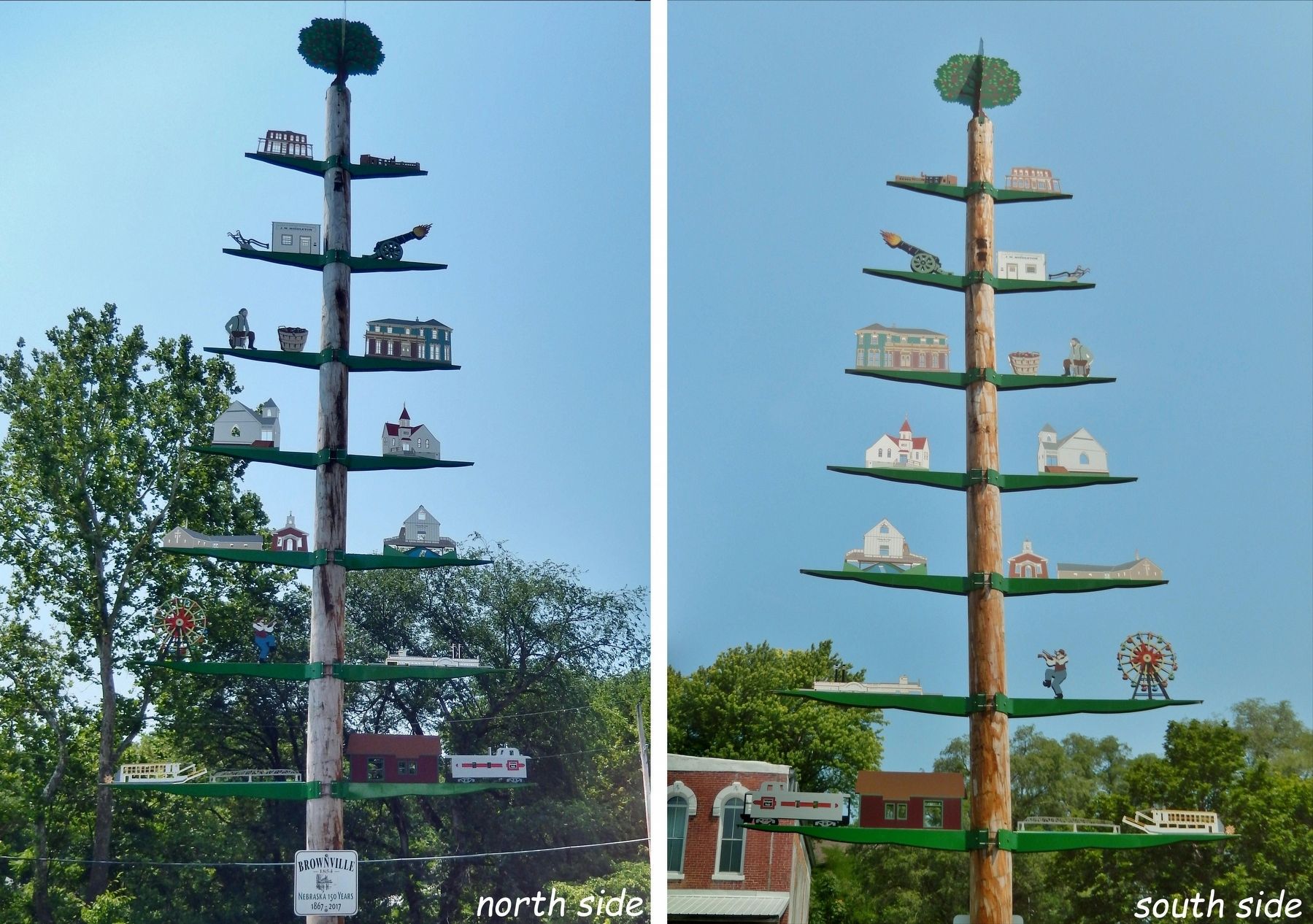
Photographed by Cosmos Mariner, July 3, 2021
3. Brownville Heritage Tree
Brownville Village Theater — This 1903 church building originally was used as a place of worship by the Christian Church. In 1966 the building became home to Nebraska's oldest repertory theater. Midwest college students audition each year to provide their attendees five different shows.
Whiskey Run Creek Winery — Beer was brewed at the Brownville Brewery in 1866 by the Conrad Schreiner family. The brewery closed during Prohibition days and was reopened in 2002 as the Whiskey Run Creek Winery in this vintage wooden peg barn. Grapes have been a staple of the area for years.
Meriwether Lewis Dredge Museum — This side-wheel steam paddle dredge was operated by the U.S. Army Corp of Engineers to help channel the Missouri River. It was launched on December 12, 1931. This National Historic Landmark permits visitors to learn about the vessel and provides Missouri River history. It came to Brownville and was dry-berthed in 1976.
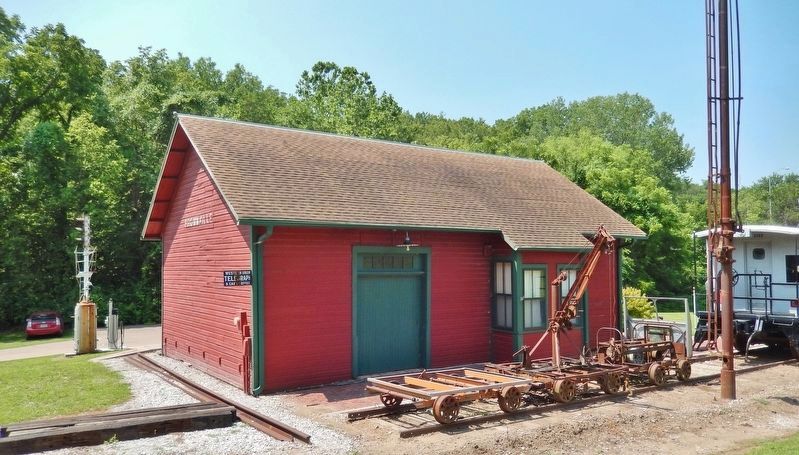
Depot & Caboose — The dream of Brownville was to be a stop on the Transcontinental railway. That dream did not happen. The railroad did not arrive until 1875. The
Photographed by Cosmos Mariner, July 3, 2021
4. Brownville Depot & Railroad History Museum
The 1875 railroad depot is located 3 blocks southeast of Brownville City Park, on South 1st Street.
Dedication on right side of marker (not pictured here due to glare):
Brownville Historical Society Heritage Tree installed October 14, 2017. Tributes to: Ariens Company, Auburn, Construction; Matt Koeneke, Designer; Terry Van Gundy, Paint Artist; Auburn Board of Public Works, Installation; Brownville Historical Society; Merz Ink, Signage. With appreciation to: Brownville Historical Society; Brownville Community Forum; Eastern Star #263, Brownville.
Erected 2017 by Brownville Historical Society.
Topics. This historical marker is listed in these topic lists: Agriculture • Religion & Religious Structures • Settlements & Settlers • Waterways & Vessels. A significant historical year for this entry is 1854.
Location. 40° 23.841′ N, 95° 39.433′ W. Marker is in Brownville, Nebraska, in Nemaha County. It is on Main Street just west of South 2nd Street, on the left when traveling west. The marker and Heritage Tree are located beside the sidewalk on the north side of Brownville City Park. Touch for map. Marker is at or near this postal address: 213 Main Street, Brownville NE 68321, United States of America. Touch for directions.

Regionally, this marker is in Eastern Nebraska. It is also in the American Midwest, in the Lewis & Clark Corridor, in the Corn Belt, and on the prairies. Globally, it is in North America, the Western Hemisphere, the Western World, and the Anglosphere. Historically, it finds itself in what was once the Louisiana Purchase.
Other nearby markers. At least 8 other markers are within walking distance of this marker: A different marker also named Brownville (here, next to this marker); Co. C. 1st Reg. of Nebraska (a few steps from this marker); Late 1800's Road Grader (a few steps from this marker); 1854 Didier Log Cabin (a few steps from this marker); Muir House (about 400 feet away, measured in a direct line); The Large One-bottom Plow (about 600 feet away); The Nebraska State Teachers' Association (approx. 0.2 miles away); The Nebraska House (approx. 0.2 miles away). Touch for a list and map of all markers in Brownville.
Also see . . . Heritage Tree (Brownville Historical Society).
Excerpt: In 2017, Nebraska celebrated the Sesquicentennial of our state. To highlight this anniversary, the Brownville Historical Society chose the HERITAGE TREE as a part of the State’s celebration. This tree represents several symbols of Brownville’s rich history, from a riverboat to the Railroad, the Theater to the Concert Hall, the Civil War cannon to the Winery.(Submitted on June 21, 2026, by Cosmos Mariner of Cape Canaveral, Florida.)Located in downtown Brownville, the Tree is modeled after similar civil monuments in Southern Germany called Stammbaums. This wood and steel structure stands 29 feet tall above ground.
The significant heritage of Brownville began in 1854. Early settlers led by former Governor Robert Furnas, planted thousands of trees in the Loess soil. The apple tree at the top of the HERITAGE TREE represents this early Nebraska effort.
Credits. This page was last revised on June 21, 2026. It was originally submitted on June 18, 2026, by Cosmos Mariner of Cape Canaveral, Florida. This page has been viewed 24 times since then. Photos: 1, 2, 3. submitted on June 20, 2026, by Cosmos Mariner of Cape Canaveral, Florida. 4. submitted on June 21, 2026, by Cosmos Mariner of Cape Canaveral, Florida.
