New Paltz in Ulster County, New York — The American Northeast (Mid-Atlantic)
The First Black Residents of New Paltz - Jack and Betty
Photographed by Devry Becker Jones (CC0), June 19, 2026
1. The First Black Residents of New Paltz - Jack and Betty Marker
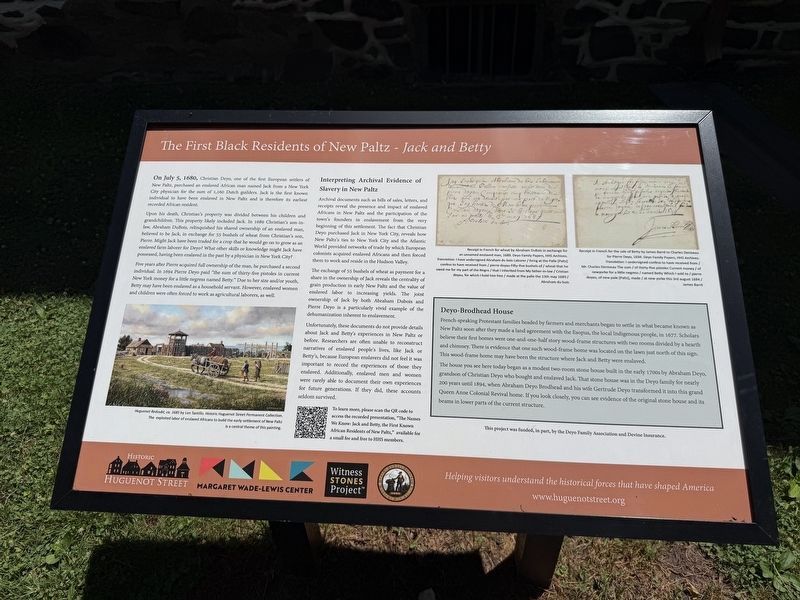
On July 5, 1680, Christian Deyo, one of the first European settlers of New Paltz, purchased an enslaved African man named Jack from a New York City physician for the sum of 1,160 Dutch guilders. Jack is the first known individual to have been enslaved in New Paltz and is therefore its earliest recorded African resident.
Upon his death, Christian's property was divided between his children and grandchildren. This property likely included Jack. In 1689 Christian's son-in-law, Abraham DuBois, relinquished his shared ownership of an enslaved man, believed to be Jack, in exchange for 55 bushels of wheat from Christian's son, Pierre. Might Jack have been traded for a crop he would go on to grow as an enslaved farm laborer for Deyo? What other skills or knowledge might Jack have possessed, having been enslaved in the past by a physician in New York City?
Five years after Pierre acquired full ownership of the man, he purchased a second individual. In 1694 Pierre Deyo paid "the sum of thirty-five pistoles in current New York money for a little negress named Betty." Due to her size and/or youth, Betty may have been enslaved
this page online
Interpreting Archival Evidence of Slavery in New Paltz
Archival documents such as bills of sales, letters, and receipts reveal the presence and impact of enslaved Africans in New Paltz and the participation of the town's founders in enslavement from the very beginning of this settlement. The fact that Christian Deyo purchased Jack in New York City, reveals how New Paltz's ties to New York City and the Atlantic World provided networks of trade by which European colonists acquired enslaved Africans and then forced them to work and reside in the Hudson Valley.
The exchange of 55 bushels of wheat as payment for a share in the ownership of Jack reveals the centrality of grain production in early New Paltz and the value of enslaved labor to increasing yields. The joint ownership of Jack by both Abraham Dubois and Pierre Deyo is a particularly vivid example of the dehumanization inherent to enslavement.
Unfortunately, these documents do not provide details about Jack and Betty's experiences in New Paltz or before.
[Sidebar:]
Deyo-Brodhead House
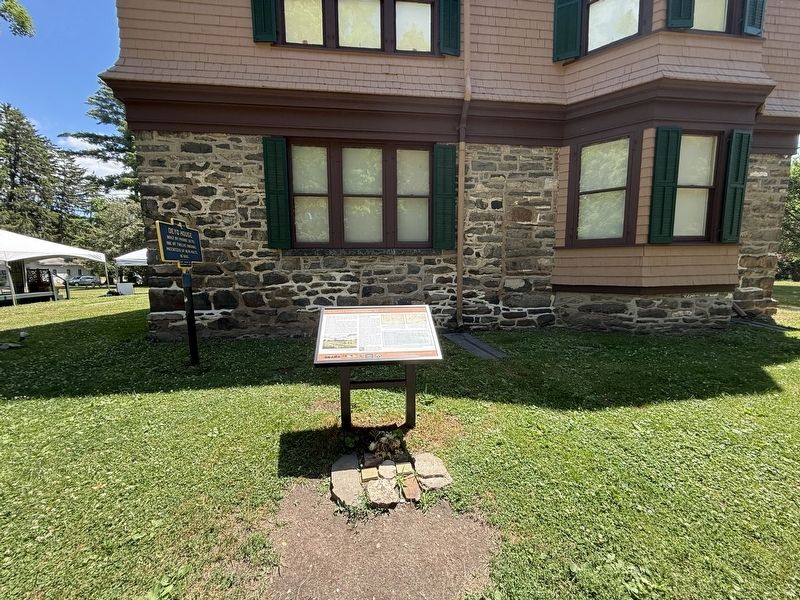
French-speaking Protestant families headed by farmers and merchants began to settle in what became known as New Paltz soon after they made a land agreement with the Esopus, the local Indigenous people, in 1677. Scholars believe their first homes were one-and-one-half story wood-frame structures with two rooms divided by a hearth and chimney. There is evidence that one such wood-frame home was located on the lawn just north of this sign. This wood-frame home may have been the structure where Jack and Betty were enslaved.
The house you see here today began as a modest two-room stone house built in the early 1700s by Abraham Deyo, grandson of Christian Deyo who bought and enslaved Jack. That stone house was in the Deyo family for nearly 200 years until 1894, when Abraham Deyo Brodhead and his wife Gertrude Deyo transformed it into this grand Queen Anne Colonial Revival home. If you look closely, you can see evidence of the original stone house and its beams in lower parts of the current structure.
[Captions:]
Huguenot Redoubt, ca. 1685 by Len Tantillo. Historic Huguenot Street Permanent Collection.
The exploited labor of enslaved Africans to build the early settlement of New Paltz is a central theme of this painting.
Receipt in French for wheat by Abraham DuBois in exchange for and unnamed enslaved man, 1689. Deyo Family Papers, HHS Archives.
Translation: I have undersigned Abraham du bois Laborer / living in the Palle [Paltz] confess to have received from / pierre doyau Fifty-five bushels of / wheat that he owed me for my part of the Negro / that I inherited from My father-in-law / Cristian doyau, for which I hold him free / made at the palle the 13th may 1689 / Abraham du bois
Receipt in French for the sale of Betty by James Barré to Charles Deniseau for Pierre Deyo, 1694. Deyo Family Papers, HHS Archives.
Translation: I undersigned confess to have received from / Mr. charles Deniseau The sum / of thirty-five pistoles Current money / of newyorke for a little negress / named Betty Which I sold to / pierre doyau, of new pale [Paltz], made / at new yorke this 3rd august 1694 / James Barré
Erected by Historic Huguenot Street; Margaret Wade-Lewis Center; Witness Stones Project; Ulster County, New York.
Topics. This historical marker is listed in these topic lists: African Americans • Agriculture • Colonial Era • Industry & Commerce. A significant historical date for this entry is July 5, 1680.
Location. 41° 45.073′ N, 74° 5.285′ W. Marker is in New Paltz, New York, in Ulster County. It is on Huguenot Street south of Broadhead Avenue, on the left when traveling south. Touch for map. Marker is at or near this postal address: 74 Huguenot St, New Paltz NY 12561, United States of America. Touch for directions.

Regionally, this marker is in Upstate New York and in the Hudson Valley. It is also in the American Northeast, in the Mid-Atlantic, and on the Eastern Seaboard. Globally, it is in the North Atlantic Region, North America, the Western Hemisphere, the Western World, and the Anglosphere. Historically, it finds itself in what was once New Netherland and also one of the original Thirteen Colonies.
Other nearby markers. At least 8 other markers are within walking distance of this marker: Jack (here, next to this marker); Betty (here, next to this marker); Deyo House (a few steps from this marker); Dubois House (within shouting distance of this marker); Jean Hasbrouck (within shouting distance of this marker); New Paltz Patentees (within shouting distance of this marker); New Paltz (within shouting distance of this marker); Walloon Church (within shouting distance of this marker). Touch for a list and map of all markers in New Paltz.
Additional keywords. human trafficking; trade; enslaved labor
Credits. This page was last revised on June 22, 2026. It was originally submitted on June 22, 2026, by Devry Becker Jones of Washington, District of Columbia. This page has been viewed 12 times since then. Photos: 1, 2. submitted on June 22, 2026, by Devry Becker Jones of Washington, District of Columbia.
