Central Business District in Melbourne, Victoria, Australia — Oceania
Site History - Old Melbourne Gaol
| — | Old Melbourne Gaol | — |
Photographed by Dean Barton-Ancliffe, June 16, 2026
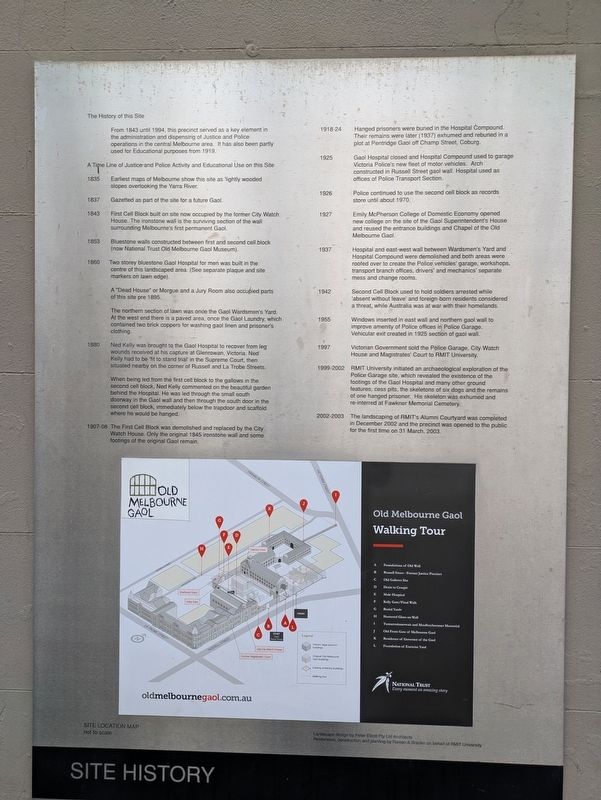
1. Site History - Old Melbourne Gaol Marker
From 1843 1994, this precinct served as a key element in the administration and dispensing of Justice and Police operations in the central Melbourne area. It has also been partly used for Educational purposes from 1919.
A Time Line of Justice and Police Activity and Educational Use on this Site
1835 Earliest maps of Melbourne show this site as lightly wooded slopes overlooking the Yarra River.
1837 Gazetted a part of the site for a future Gaol.
1843 First Cell Block built on site now occupied by the former City Watch House. The ironstone was is the surviving section of the wall surrounding Melbourne's first permanent Gaol.
1853 Bluestone walls constructed between first and second cell block (now National Trust Old Melbourne Gaol Museum).
1860 Two storey bluestone Gaol Hospital for men was built in the centre of this landscaped area (See separate plaque and site markers on lawn edge).
A "Dead House" or Morgue and a Jury Room also occupied parts of this site pre 1895.
The northern section of lawn was once the Gaol Wardsmen's Yard. At the west end there is a paved
this page online
1900 Ned Kelly was brought so the Gaol Hospital to recover from leg wounds received at his capture at Glenrowan, Victoria. Ned Kelly had to be 'fit to stand trail' in the Supreme Court, then situated nearby on the corner of Russell and La Trobe Streets.
When being led from the first cell block to the gallows in the second cell block, Ned Kelly commented on the beautiful garden behind the Hospital. He was led through the small south doorway in the Gaol wall and then through the south door in the second cell block, immediately below the trapdoor and scaffold where he would be hanged.
1907-08 The First Cell Block was demolished and replaced by the City Watch House. Only the original 1845 ironstone wall and some footings of the original Gaol remain.
1918-24 Hanged prisoners were buried in the Hospital Compound. Their remains were later (1937) exhumed and reburied in a plot at Pentridge Gaol off Champ Street, Coburg.
1925 Gaol Hospital closed and Hospital Compound used to garage Victoria Police's new fleet
Photographed by Dean Barton-Ancliffe, June 16, 2026
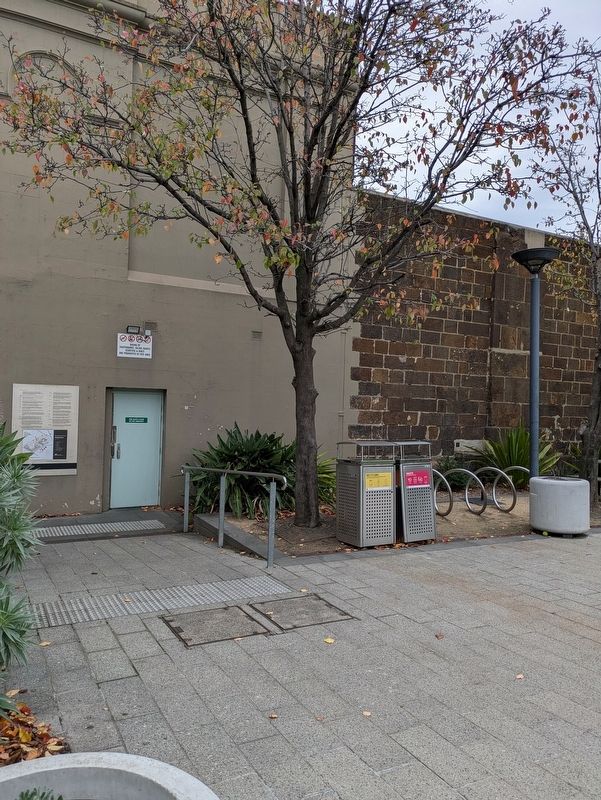
2. Site History Marker in the Courtyard
1926 Police continued to use the second cell block as records store until about 1970.
1927 Emily McPherson College of Domestic Economy opened new college on the site of the Gaol Superintendent's House and reused the entrance buildings and Chapel of the Old Melbourne Gaol.
1937 Hospital and east-west wall between Wardsmen's Yard and Hospital Compound were demolished and both areas were roofed over to create the Police vehicles garage, workshops, transport branch offices, drivers' and mechanics' separate mess and change rooms.
1942 Second Cell Block used to hold soldiers arrested while 'absent without leave' and foreign born residents considered a threat, while Australia was at war with their homelands.
1955 Windows inserted in east wall and northern gaol wall to improve amenity of Police offices in Police Garage. Vehicular exit created in 1925 section of gaol wall.
1997 Victorian Government sold the Police Garage, City Watch House and Magistrates Court to RMIT University.
1999-2002 RMIT University initiated an archaeological exploration of the Police Garage site, which revealed the existence of the footings of the Gaol Hospital and many other ground features, cess pits, the skeletons of six dogs and the remains of one hanged prisoner. His skeleton was exhumed and re-interred at Fawkner Memorial Cemetery.
2002-2003 The landscaping of RMIT's Alumni Courtyard was completed in December 2002 and the precinct was opened to the public for the first time on 31 March, 2003.
Erected by National Trust.
Topics. This historical marker is listed in these topic lists: Architecture • Colonial Era • Education • Law Enforcement. A significant historical year for this entry is 1843.
Location. 37° 48.486′ S, 144° 57.941′ E. Marker is in Melbourne, Victoria. It is in the Central Business District. It can be reached from Russell Street 0.1 kilometers south of MacKenzie Street. Touch for map. Marker is at or near this postal address: 357 Russell Street, Melbourne VIC 3000, Australia. Touch for directions.

Regionally, it is in Oceania, in Australasia, in the Pacific Ocean, in South Pacific, on the Pacific Rim, in the Western World, and in the Anglosphere. Historically, it finds itself in what was once a British colony.
Other nearby markers. At least 8 other markers are within walking distance of this marker: Gaol Arched Entrance (a few steps from this marker); Bluestone Gaol Wall (within shouting distance of this marker); Gaol Bluestone (within shouting distance of this marker); Old Melbourne Gaol Trust Marker (within shouting distance of this marker); The Melbourne Gaol Men's Hospital (within shouting distance of this marker); Ironstone Walls and Footings (within shouting distance of this marker); The Kelly Gate (within shouting distance of this marker); Western Gaol Wall Archway (within shouting distance of this marker). Touch for a list and map of all markers in Melbourne.
Also see . . . Old Melbourne Gaol. Wikipedia
The Old Melbourne Gaol is a former jail and current museum on Russell Street, in Melbourne, Victoria, Australia. It consists of a bluestone building and courtyard, and is located next to the old City Police Watch House and City Courts buildings, and opposite the Russell Street Police Headquarters. It was first constructed starting in 1839, and during its operation as a prison between 1845 and 1924, it held and executed some of Australia's most notorious criminals, including bushranger Ned Kelly and serial killer Frederick Bailey Deeming. In total, 133 people were executed by hanging. Though it was used briefly during World War II, it formally ceased operating as a prison in 1924, with parts of the jail being incorporated into the RMIT University, and the rest becoming a museum.(Submitted on June 23, 2026, by Dean Barton-Ancliffe of Rowville, Victoria.)
The three-storey museum displays information and memorabilia of the prisoners and staff, including death masks of the executed criminals. At one time the museum displayed what was believed at the time to be Ned Kelly's skull, before it was stolen in 1978, as well as the pencil used by wrongly convicted Colin Campbell Ross to protest his innocence in writing, before being executed.
Credits. This page was last revised on June 24, 2026. It was originally submitted on June 23, 2026, by Dean Barton-Ancliffe of Rowville, Victoria. This page has been viewed 31 times since then. Photos: 1, 2. submitted on June 23, 2026, by Dean Barton-Ancliffe of Rowville, Victoria. • Andrew Ruppenstein was the editor who published this page.
