Central Business District in Melbourne, Victoria, Australia — Oceania
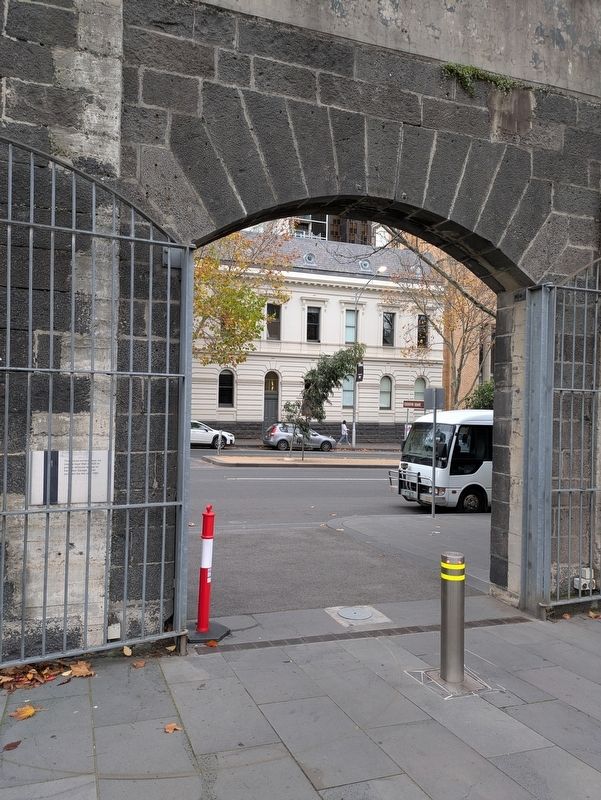
Gaol Arched Entrance
| — | Old Melbourne Gaol | — |

Photographed by Dean Barton-Ancliffe, June 16, 2026
1. Gaol Arched Entrance Marker
Erected by RMIT University. (Marker Number 1.)
Topics. This historical marker is listed in these topic lists: Colonial Era • Law Enforcement. A significant historical year for this entry is 1925.
Location. 37° 48.479′ S, 144° 57.942′ E. Marker is in Melbourne, Victoria. It is in the Central Business District. It can be reached from Russell Street 0.1 kilometers south of MacKenzie Street. Touch for map. Marker is at or near this postal address: 357 Russell Street, Melbourne VIC 3000, Australia. Touch for directions.

Regionally, it is in Oceania, in Australasia, in the Pacific Ocean, in South Pacific, on the Pacific Rim, in the Western World, and in the Anglosphere. Historically, it finds itself in what was once a British colony.
Other nearby markers. At least 8 other markers are within walking distance of this marker: Site History - Old Melbourne Gaol (a few steps from this marker); Bluestone Gaol Wall (a few steps from this marker); Old Melbourne Gaol Trust Marker
this page online
Also see . . . Old Melbourne Gaol. Wikipedia
The Old Melbourne Gaol is a former jail and current museum on Russell Street, in Melbourne, Victoria, Australia. It consists of a bluestone building and courtyard, and is located next to the old City Police Watch House and City Courts buildings, and opposite the Russell Street Police Headquarters. It was first constructed starting in 1839, and during its operation as a prison between 1845 and 1924, it held and executed some of Australia's most notorious criminals, including bushranger Ned Kelly and serial killer Frederick Bailey Deeming. In total, 133 people were executed by hanging. Though it was used briefly during World War II, it formally ceased operating as a prison in(Submitted on June 24, 2026, by Dean Barton-Ancliffe of Rowville, Victoria.)1924, with parts of the jail being incorporated into the RMIT University, and the rest becoming a museum.Photographed by Dean Barton-Ancliffe, June 16, 20262. Gaol Arched Entrance Marker near Arch facing into Russell Street
Credits. This page was last revised on June 27, 2026. It was originally submitted on June 24, 2026, by Dean Barton-Ancliffe of Rowville, Victoria. This page has been viewed 10 times since then. Photos: 1, 2. submitted on June 24, 2026, by Dean Barton-Ancliffe of Rowville, Victoria. • Andrew Ruppenstein was the editor who published this page.
