Waterbury in Naugatuck Valley Region, Connecticut — The American Northeast (New England)
Cool Waters, 2012
Joanne and Bruce Hunter
Mosaic in Porcelain Tile
| — | 30' x 30' | — |
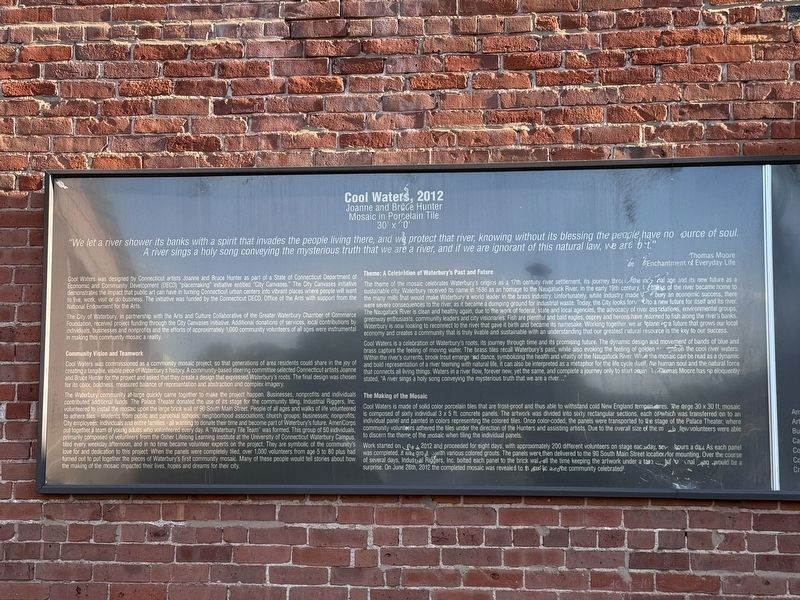
“We let a river shower its banks with a spirit that invades the people living there, and we protect that river, knowing without its blessing the people have no source of soul. A river sings a holy song conveying the mysterious truth that we are a river, and if we are ignorant of this natural law, we are but.”
—Thomas Moore
The Enchantment of Everyday Life
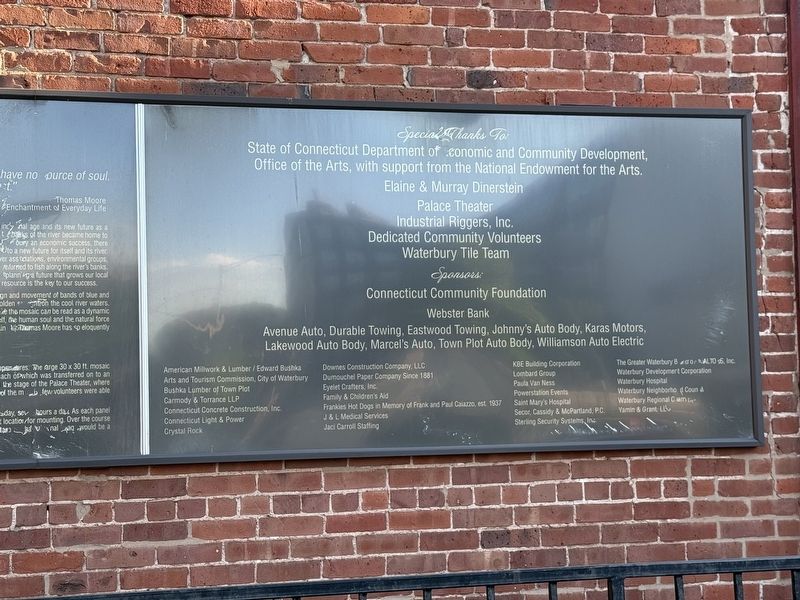
Cool Waters was designed by Connecticut artists Joanne and Bruce Hunter as part of a State of Connecticut Department of Economic and Community Development (DECD) “placemaking” initiative entitled “City Canvases.” The City Canvases initiative encourages communities to transform public art into dynamic and inviting places where people live, work, visit or do business. The initiative was funded by the Connecticut DECD, Office of the Arts with support from the National Endowment for the Arts.
The City of Waterbury, in partnership with the Arts and Culture Collaborative of the Greater Waterbury Chamber of Commerce Foundation, received project funding through the City Canvases initiative. Additional donations of services, local contributions of individuals, businesses
this page online
Community Vision and Teamwork
Cool Waters was commissioned as a community mosaic project, so that generations of area residents could share in the joy of creating a tangible, visible piece of Waterbury’s history. A community-based steering committee selected Connecticut artists Joanne and Bruce Hunter for the project and asked that they create a design that expressed Waterbury’s roots. The final design was chosen for its color, boldness, message balance of representation and abstraction and complex imagery.
The Waterbury community at large quickly came together to make this project happen. Businesses, nonprofits and individuals contributed additional funds. The Palace Theater donated the use of its stage for the community tiling. Industrial Riggers, Inc. volunteered to install the mosaic upon the large brick wall of 90 South Main Street. People of all ages and walks of life volunteered to adhere tiles—students from public and parochial schools, neighborhood associations, church groups,
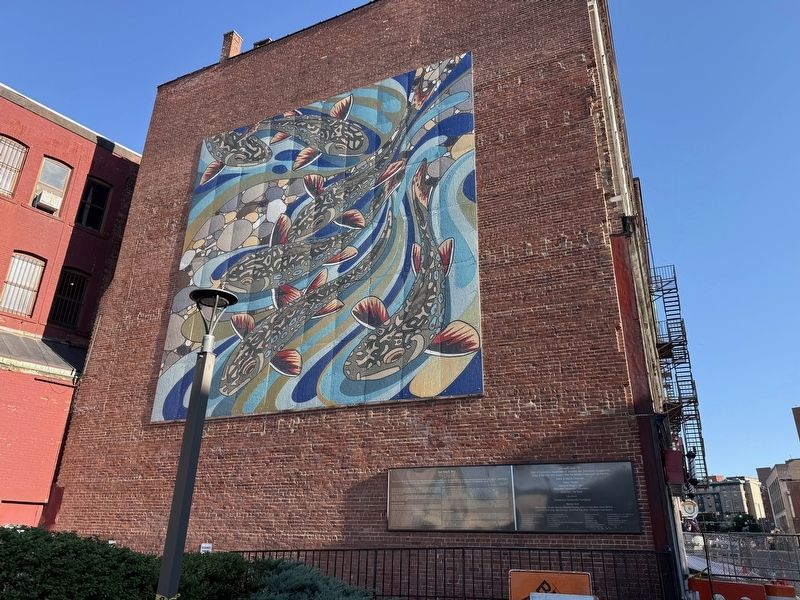
Theme: A Celebration of Waterbury’s Past and Future
The theme of the mosaic celebrates Waterbury’s origins as a 17th century river settlement, its journey through the industrial age and its new future as a sustainable city. Waterbury received its name in 1686
Cool Waters is a celebration of Waterbury’s roots, its journey through time and its promising future. The dynamic design and movement of bands of blue and brass capture the feeling of moving water. The brass tiles recall Waterbury’s past, while also evoking the flow of golden molten metal. Within the river’s currents, brook trout merge and dance, symbolizing the health and vitality of the Naugatuck River. While the mosaic can be read as a dynamic and bold representation of a river teeming with natural life, it can also be interpreted as a metaphor for the life cycle itself, the human soul and the natural force that connects all living things. Waters in a river flow, forever new, yet the same, and complete a journey only to start again. As Thomas Moore has so eloquently stated, “A river sings a holy song conveying the mysterious truth that we are a river…”
The Making of the Mosaic
Cool Waters is made of solid color porcelain tiles that are frost-proof and thus able to withstand cold New England temperatures. The large 30 x 10 ft mosaic is composed of sixty individual 3 x 5 ft. concrete panels. The artwork was divided into sixty rectangular sections, each of which was transferred onto an individual panel and painted in colors representing the colored tiles. Once color-coded, the panels were transported to the stage of the Palace Theater, where community volunteers adhered the tiles under the direction of the Hunters and assisting artists. Due to the overall size of the mosaic, volunteers were able to discern the theme of the mosaic while tiling the individual panels.
Work started on June 6, 1021 and proceeded for eight days, with approximately 200 different volunteers on stage each day, seven hours a day. As each panel was completed, it was grouted with various colored grouts. The panes where then delivered to the 90 South Main Street location for mounting. Over the course of several days, Industrial Riggers, Inc., bolted each panel to the brick wall, all the time keeping the artwork under a tarp so the original design would be a surprise. On June 26th, 2012 the completed mosaic was revealed to the pubic and the community celebrated!
Topics. This historical marker is listed in these topic lists: Arts, Letters, Music • Environment • Industry & Commerce • Waterways & Vessels. A significant historical date for this entry is June 6, 1686.
Location. 41° 33.255′ N, 73° 2.424′ W. Marker is in Waterbury in Naugatuck Valley Region, Connecticut. It is on South Main Street north of Scovill Street, on the left when traveling north. Touch for map. Marker is at or near this postal address: 106 S Main St, Waterbury CT 06702, United States of America. Touch for directions.

Regionally, this marker is in the Connecticut River Valley, on the Connecticut Shoreline, and in Greater New Haven. It is also in the American Northeast and in New England. Globally, it is in North America, the Western Hemisphere, the Western World, and the Anglosphere. Historically, it finds itself in what was once New Haven County and also one of the original Thirteen Colonies.
Other nearby markers. At least 8 other markers are within walking distance of this marker: Fortified House lf Ensign Stanley (approx. 0.2 miles away); Waterbury (approx. 0.2 miles away); John Fitzgerald Kennedy (approx. 0.2 miles away); UNICO National (approx. 0.2 miles away); Cristoforo Colombo (approx. 0.2 miles away); POW/MIA Soldiers from Waterbury (approx. 0.2 miles away); Enoch Hibbard House (approx. 0.2 miles away); Waterbury Veteran’s Monument (approx. 0.2 miles away). Touch for a list and map of all markers in Waterbury.
Credits. This page was last revised on June 28, 2026. It was originally submitted on June 28, 2026, by Devry Becker Jones of Washington, District of Columbia. This page has been viewed 12 times since then. Photos: 1, 2, 3. submitted on June 28, 2026, by Devry Becker Jones of Washington, District of Columbia.
