Carlton in Melbourne, Victoria, Australia — Oceania
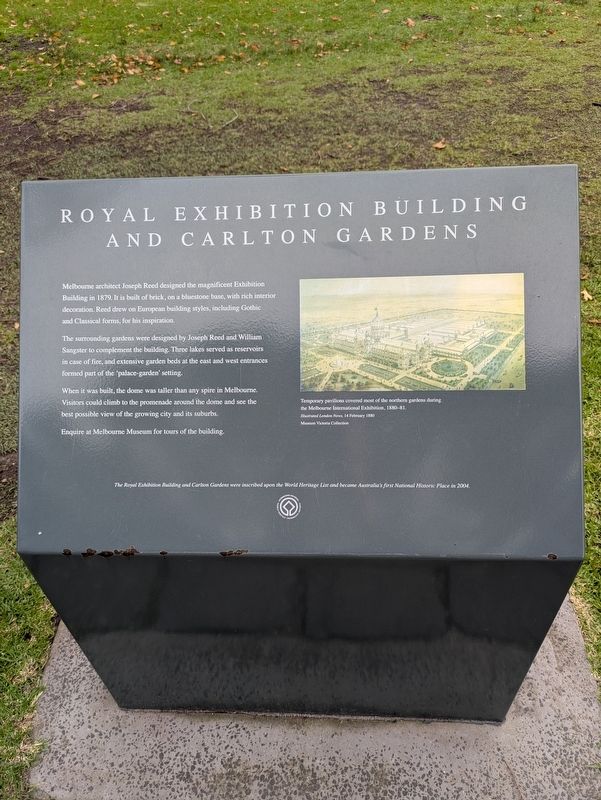
Royal Exhibition Building and Carlton Gardens
Photographed by Dean Barton-Ancliffe, June 16, 2026
1. Royal Exhibition Building and Carlton Gardens Marker
The surrounding gardens were designed by Joseph Reed and William Sangster to complement the building. Three lakes served as reservoirs in case of fire, and extensive garden beds at the east and west entrances formed part of the 'palace-garden' setting.
When it was built, the dome was taller than any spire in Melbourne. Visitors could climb to the promenade around the dome and see the best possible view of the growing city and its suburbs.
Enquire at Melbourne Museum for tours of the building.
(Picture Caption)Temporary pavilions covered most of the northern gardens during the Melbourne International Exhibition, 1880-81.
Illustrated London News, 14 February 1880
Museum Victoria Collection The Royal Exhibition Building and Carton Gardens were inscribed upon the World Heritage List and became Australia's first National Historic Place in 2004.
Erected by World
this page online
Topics. This historical marker is listed in these topic lists: Architecture • Colonial Era • Horticulture & Forestry • Parks & Recreational Areas. A significant historical year for this entry is 1879.
Location. 37° 48.308′ S, 144° 58.397′ E. Marker is in Carlton, Victoria, in Melbourne. It is at the intersection of Nicholson Street and Gertrude Street, on the left when traveling north on Nicholson Street. Touch for map. Marker is at or near this postal address: 9 Nicholson Street, Carlton VIC 3053, Australia. Touch for directions.

Regionally, it is in Oceania, in Australasia, in the Pacific Ocean, in South Pacific, on the Pacific Rim, in the Western World, and in the Anglosphere. Historically, it finds itself in what was once a British colony.
Other nearby markers. At least 8 other markers are within walking distance of this marker: Exhibition Building Foundation Stone Centenary (within shouting distance of this marker); Exhibition Building receives Royal Title (within shouting distance of this marker); Colonial Mutual Life Building (within shouting distance of this marker); Exhibition Building Great Hall

Photographed by Dean Barton-Ancliffe, June 16, 2026
2. Royal Exhibition Building and Carlton Gardens Marker
Also see . . . Royal Exhibition Building. National Film and Sound Archive - Also contains a video regarding the Royal Exhibition Building
During the 19th century, Melbourne’s Royal Exhibition Building was an architectural masterpiece which showcased Australia’s arrival on the world stage as an economic powerhouse.(Submitted on June 28, 2026, by Dean Barton-Ancliffe of Rowville, Victoria.)
It was 1888, the golden age of exhibitions, and Victoria, initially fuelled by the gold rush, boasted the largest exhibition building in the world with its annexes combining to cover 14 hectares.
The National and World Heritage-listed Royal Exhibition Building was used for the opening of the first Australian Federal Parliament in 1901, and subsequently served as a hospital, an army training centre and a wrestling venue during the 1956 Olympics.
Credits. This page was last revised on July 2, 2026. It was originally submitted on June 28, 2026, by Dean Barton-Ancliffe of Rowville, Victoria. This page has been viewed 18 times since then. Photos: 1, 2. submitted on June 28, 2026, by Dean Barton-Ancliffe of Rowville, Victoria. • Andrew Ruppenstein was the editor who published this page.
