Whittier near Frederick in Frederick County, Maryland — The American Northeast (Mid-Atlantic)
Rocky Springs Clash
"Skirmished with the rebel cavalry... near Rocky Springs Schoolhouse"
| — | Early's 1864 Attack on Washington | — |
Photographed by Alvaro E. Duran, June 21, 2026
1. Early's 1864 Attack on Washington Marker
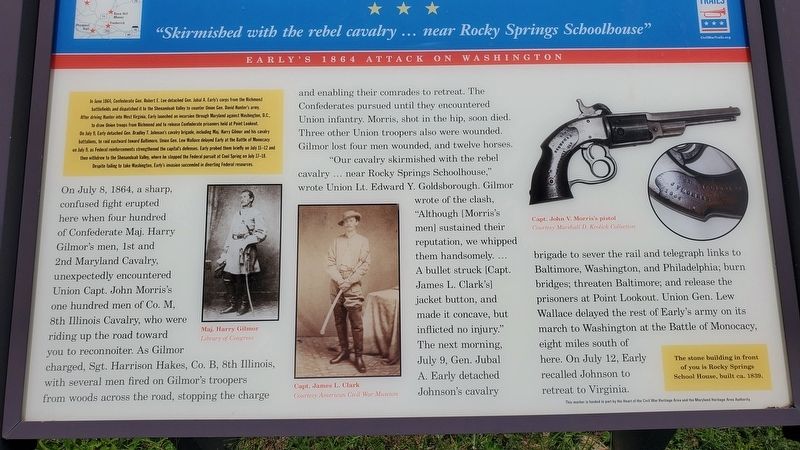
In June 1864, Confederate Gen. Robert E. Lee detached Gen. Jubal A. Early's corps from the Richmond battlefields and dispatched it to the Shenandoah Valley to counter Union Gen. David Hunter's army. After driving Hunter into West Virginia, Early launched an incursion through Maryland against Washington, D.C., to draw Union troops from Richmond and to release Confederate prisoners held at Point Lookout. On July 9, Early detached Gen. Bradley T. Johnson's cavalry brigade, including Maj. Harry Gilmor and his cavalry battalions, to raid eastward toward Baltimore. Union Gen. Lew Wallace delayed Early at the Battle of Monocacy on July 9, as Federal reinforcements strengthened the capital's defenses. Early probed them briefly on July 11-12 and then withdrew to the Shenandoah Valley, where he stopped the Federal pursuit at Cool Spring on July 17-18. Despite failing to take Washington, Early's invasion succeeded in diverting Federal resources.On July 8, 1864, a sharp, confused fight erupted here when four hundred of Confederate Maj. Harry Gilmor's men, 1st and 2nd Maryland Cavalry, unexpectedly encountered Union Capt. John Morris's
this page online
"Our cavalry skirmished with the rebel cavalry ... near Rocky Springs Schoolhouse," wrote Union Lt. Edward Y. Goldsborough. Gilmor wrote of the clash, "Although [Morris's men] sustained their reputation, we whipped them handsomely. A bullet struck [Capt. James L. Clark's] jacket button, and made it concave, but inflicted no injury." The next morning, July 9, Gen. Jubal A. Early detached Johnson's cavalry brigade to sever the rail and telegraph links to Baltimore, Washington, and Philadelphia; burn bridges; threaten Baltimore; and release the prisoners at Point Lookout. Union Gen. Lew Wallace delayed the rest of Early's army on its march to Washington
Photographed by Alvaro E. Duran, June 21, 2026
2. Early's 1864 Attack on Washington Marker
wide-shot
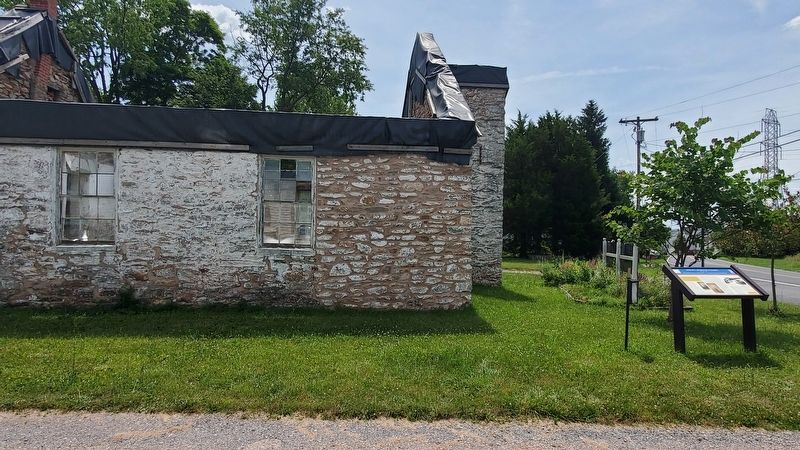
The stone building in front of you is Rocky Springs School House, built ca. 1839.
(captions)
Maj. Harry Gilmor Libray of Congress
Capt. James L. Clark Courtesy American Civil War Museum
Capt. John V. Morris's pistolames L. Clark Courtesy Marshall D. Krolick Collection
Erected by Maryland Civil War Trails.
Topics and series. This historical marker is listed in this topic list: War, US Civil. In addition, it is included in the Maryland Civil War Trails series list. A significant historical date for this entry is July 8, 1864.
Location. 39° 26.976′ N, 77° 27.265′ W. Marker is near Frederick, Maryland, in Frederick County. It is in Whittier. It is on Rocky Springs Road north of Kemp Lane, on the right when traveling north. Touch for map. Marker is at or near this postal address: 7815 Rocky Springs Rd, Frederick MD 21702, United States of America. Touch for directions.

Regionally, this marker is in the Washington Metropolitan Area and in Central Maryland. It is also in the American Mid-Atlantic. Globally, it is in North America, the Western Hemisphere, the Western World, and the Anglosphere. Historically, it finds itself in what was once one of the original Thirteen Colonies and also the Antebellum South.
Other nearby markers. At least 8 other markers are within 3 miles of this marker, measured as the crow flies: Rocky Springs School House (a few steps from this marker); General Edward Braddock (approx. 2.1 miles away); The Catoctin Mountain Range (approx. 2.3 miles away); Schifferstadt Architectural Museum (approx. 2.3 miles away); Schifferstadt (approx. 2.3 miles away); Maj. Gen. Edward Braddock (approx. 2.4 miles away); The Land We Call Home (approx. 2.4 miles away); Battle of Frederick (approx. 2½ miles away). Touch for a list and map of all markers in Frederick.
Credits. This page was last revised on June 29, 2026. It was originally submitted on June 29, 2026, by Alvaro E. Duran of Reisterstown, Maryland. This page has been viewed 23 times since then. Photos: 1, 2. submitted on June 29, 2026, by Alvaro E. Duran of Reisterstown, Maryland. • Bernard Fisher was the editor who published this page.
Editor’s want-list for this marker. A photo of the entire marker including the main title • Can you help?
