Rochester in Beaver County, Pennsylvania — The American Northeast (Mid-Atlantic)
Stepping into Historic Rochester
Town of Rochester

Photographed by Bradley Owen, June 20, 2026
1. Stepping into Historic Rochester Marker
One generation makes history, another records it. Emerson said, "We are the sum of all our yesterdays." In order to appreciate fully and recognize the blessings and opportunities of the present age, it is necessary to understand the problems and tribulations of those who have come and gone.
1840
The Borough of Rochester is nicely situated on the northern-most point of the Ohio River where it meets the confluence of the Beaver River, and it sits nearly 26 miles Northwest of Pittsburgh. Blessed with an abundance of natural resources, and an ideal location between two rivers, the advantages of this site have been recognized throughout its history.
The story of Rochester began in the years prior to the Revolutionary War when this place was once the location of a village populated by the famous Chief Logan and his Mingo followers. It was known as "Logan's Town" or "Mingo Town." Logan's Town was founded in 1770 and ended about 1774 when Logan and his followers relocated to the mouth of Yellow Creek in present-day Ohio.
Following the opening of the northern side of the Ohio River for settlement in 1785, European settlers,
this page online
An 1804 Act of the Pennsylvania Legislature removed seventy-nine out lots located on the eastern side of the Beaver River from the Borough of Beaver. This detached area would later form the basis of Rochester Township and later Rochester Borough.
The name Rochester was given to the village around 1837 by Mitchell Hammond, a local grocery merchant, but it was not used officially until Rochester Township was formed in 1840.
The borough was incorporated on March 20, 1849, from Rochester Township. It was already an important shipping center thanks to its river location and the Pittsburgh
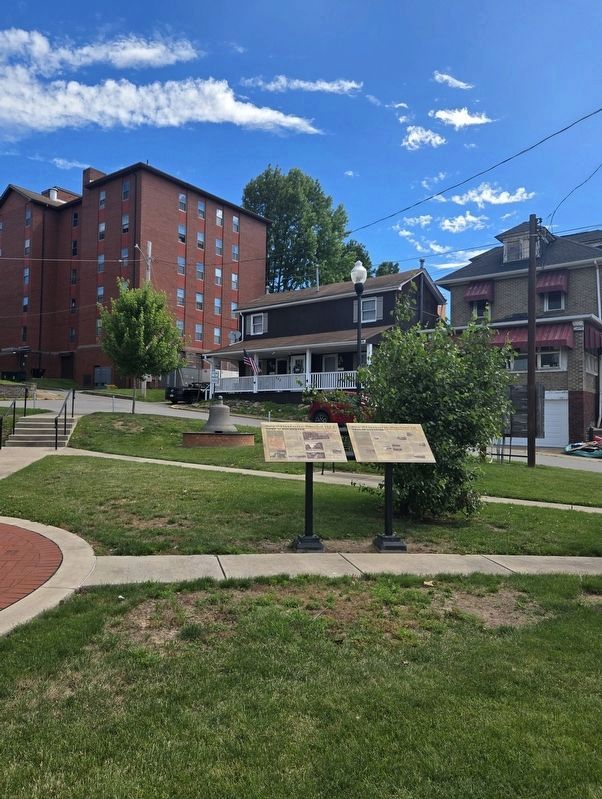
Photographed by Bradley Owen, June 20, 2026
2. Stepping into Historic Rochester Marker
Marker is on the left.
It is the hope of the Committee that the viewer will peruse and enjoy this history of "Our Yesterdays."
Erected by Rochester Area Heritage Society.
Topics. This historical marker is listed in these topic lists: Indigenous Peoples and Communities • Railroads & Streetcars • Settlements & Settlers • Waterways & Vessels. A significant historical year for this entry is 1770.
Location. 40° 42.123′ N, 80° 17.11′ W. Marker is in Rochester, Pennsylvania, in Beaver County. It is at the intersection of North Park Street and Brighton Avenue (Pennsylvania Route 18), on the right when traveling east on North Park Street. Touch for map. Marker is at or near this postal address: 50 North Park Street, Rochester PA 15074, United States of America. Touch for directions.

Regionally, this marker is in Greater Pittsburgh. It is also in the American Northeast, in the Mid-Atlantic, and in the Ohio River Valley. Globally, it is in North America, the Western Hemisphere, the Western World, and the Anglosphere. Historically, it finds itself in what was once the Haudenosaunee (Iroquois) Confederacy and also one of the original Thirteen Colonies.
Other nearby markers. At least 8 other markers are within walking distance of this marker: A different marker also named Stepping into Historic Rochester (here, next to this marker); a different marker also named Stepping into Historic Rochester (here, next to this marker); a different marker also named Stepping into Historic Rochester (here, next to this marker); a different marker also named Stepping into Historic Rochester (a few steps from this marker); History of the Rochester Fire Department (a few steps from this marker); a different marker also named Stepping into Historic Rochester (a few steps from this marker); a different marker also named Stepping into Historic Rochester (a few steps from this marker); a different marker also named Stepping into Historic Rochester (a few steps from this marker). Touch for a list and map of all markers in Rochester.
Credits. This page was last revised on July 1, 2026. It was originally submitted on June 30, 2026, by Bradley Owen of Morgantown, West Virginia. This page has been viewed 14 times since then. Photos: 1. submitted on June 30, 2026, by Bradley Owen of Morgantown, West Virginia. 2. submitted on July 1, 2026, by Bradley Owen of Morgantown, West Virginia.
