Pine Creek Valley — A Story of Transformations
Pennsylvania Wilds
| — | Pine Creek Rail Trail | — |
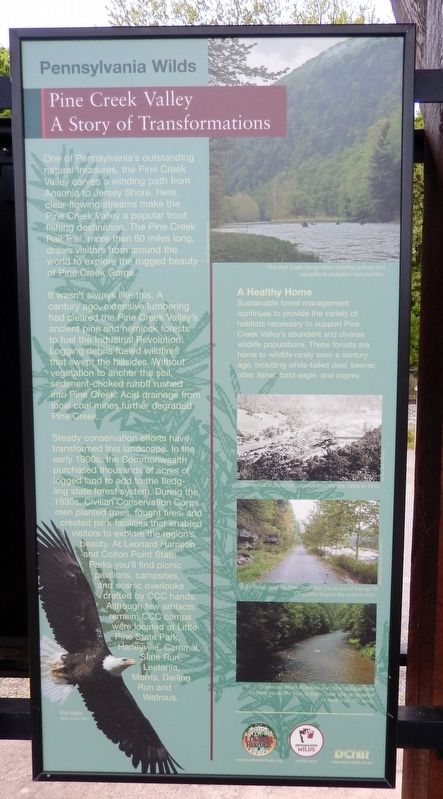
One of Pennsylvania’s outstanding natural treasures, the Pine Creek Valley carves a winding path from Ansonia to Jersey Shore. Here, clear-flowing streams make the Pine Creek Valley a popular trout fishing destination. The Pine Creek Rail Trail, more than 60 miles long, draws visitors from around the world to explore the rugged beauty of Pine Creek Gorge.
It wasn't always like this. A century ago, extensive lumbering had cleared the Pine Creek Valley's ancient pine and hemlock forests to fuel the Industrial Revolution. Logging debris fueled wildfires that swept the hillsides. Without vegetation to anchor the soil, sediment-choked runoff rushed into Pine Creek. Acid drainage from local coal mines further degraded Pine Creek.
Steady conservation efforts have transformed this landscape. In the early 1900s, the Commonwealth purchased thousands of acres of logged land to add to the fledgling state forest system. During the 1930s, Civilian Conservation Corps men planted trees, fought fires, and created park facilities that enabled visitors to explore the region’s beauty. At Leonard Harrison and Colton Point State Parks you’ll find picnic pavilions, campsites, and scenic overlooks crafted by CCC hands. Although few artifacts remain, CCC camps were located at Little Pine State Park, Haneyville, Cammal, Slate Run, Leetonia, Morris, Darling Run and Watrous.
A Healthy Home
Sustainable forest management continues to provide the variety of habitats necessary to support Pint Creek Valley’s abundant and diverse wildlife populations. These forests are home to wildlife rarely seen a century ago, including white-tailed deer, beaver, otter, fisher, bald eagle, and osprey.
[photo captions]
• The Pine Creek Gorge offers stunning scenery and exceptional recreation opportunities.
• The sawmill at Slate Run operated from the late 1880s
this page online
• USA Today rated the Pine Creek Rail Trail as one of the top 10 Great Bike Tours in the world in 2001.
• Grassroots efforts to reduce acid mine drainage have brought aquatic life back to Babb Creek after an absence of more than 100 years.
Erected by Lumber Heritage Region of Pennsylvania, Pennsylvania Department of Conservation and Natural Resources, and Pennsylvania Wilds.
Topics and series. This historical marker is listed in these topic lists: Animals • Environment • Industry & Commerce • Parks & Recreational Areas. In addition, it is included in the Civilian Conservation Corps (CCC) series list.
Location. 41° 12.096′ N, 77° 16.818′ W. Marker is in Jersey Shore, Pennsylvania, in Lycoming County. It can be reached from the intersection of Railroad Street and Humes Street, on the left when traveling west. The marker is at the Pine Creek Rail Trail Trailhead. Touch for map. Marker is in this post office area: Jersey Shore PA 17740, United States of America. Touch for directions.

Regionally, this marker is in the Pennsylvania Wilds and in the Susquehanna

Other nearby markers. At least 8 other markers are within walking distance of this marker: Discover the Lumber Heritage Region (here, next to this marker); Fair Play in the Wild West (here, next to this marker); Continuing Commitment (here, next to this marker); Restoration and Renewal (here, next to this marker); Altered States (here, next to this marker); In the Beginning (here, next to this marker); Jersey Shore Cemetery War Memorial (approx. 0.7 miles away); Pine Creek Presbyterian Church (approx. 0.8 miles away). Touch for a list and map of all markers in Jersey Shore.
Also see . . . Civilian Conservation Corps (CCC) Camps on the Pine Creek Watershed.
Excerpt: During the Civilian Conservation Corps era, 1933-1942, there were 11 camps on the Pine Creek Watershed, each with the ‘S’ designation indicating PA Department of Forests and Water camps. The Army provided the necessities for the camps — shelter, clothing, food, medical supplies and equipment. Forests and Water, now the Department of Conservation and Natural Resources, planned the work projects and supervised the CCC boys in the completion of these projects — which included tree planting, building fire towers and fire trails, forest fire fighting, erecting stone and wooden walls and steps, constructing roads and trails, and developing fish hatcheries and state parks.(Submitted on July 1, 2026, by Cosmos Mariner of Cape Canaveral, Florida.)The Lyman Run Camp CCC project developed many of the roads and trails in that area, which started Lyman Run State Park and developed Cherry Springs State Park.
There were five CCC camps on the Tioga State Forest land. The work of the Asaph Camp included the erection of a fire tower, the standard CCC projects, and the development of a fish hatchery. The boys of this camp developed the two Pennsylvania Grand Canyon State Parks: Leonard Harrison and Colton Point.
The Watrous Camp built the Thompson Hollow Road that made Colton Point State Park accessible from the west and built numerous roads in conjunction with the Leetonia camp. Several buildings, accessible by elaborate wooden steps, were erected on the hillside on a former logging railroad grade with vistas cut along their roads.
The Leetonia Camp was located in a former logging town.
The Dixie Run camp was located between Morris and Blackwell where CCC boys built roads and trails in the lower Pine Creek Gorge. The CCC boys often threw mini Kellogg’s cereal boxes to the Blackwell kids on their way to their work projects.
The Slate Run Camp was located along the Francis Branch of the Slate Run stream and had a medical facility called the “Walter Reed Junior Hospital.”
The Cammal Camp, like Darling Run, was also located on the wrong side of the creek. After several bridges were wiped out by ice jams and high water, the camp was moved to Maryland.
The Tiadaghton Camp had several names during its history: Waterville, Haneyville, and finally Tiadaghton Camp.
Credits. This page was last revised on July 1, 2026. It was originally submitted on July 1, 2026, by Cosmos Mariner of Cape Canaveral, Florida. This page has been viewed 19 times since then. Photos: 1, 2. submitted on July 1, 2026, by Cosmos Mariner of Cape Canaveral, Florida.
