Watson Township near Jersey Shore in Lycoming County, Pennsylvania — The American Northeast (Mid-Atlantic)
Our Gift from the Past
Pennsylvania Wilds
| — | Pine Creek Rail Trail | — |
Photographed by Cosmos Mariner, May 17, 2022
1. Our Gift from the Past Marker
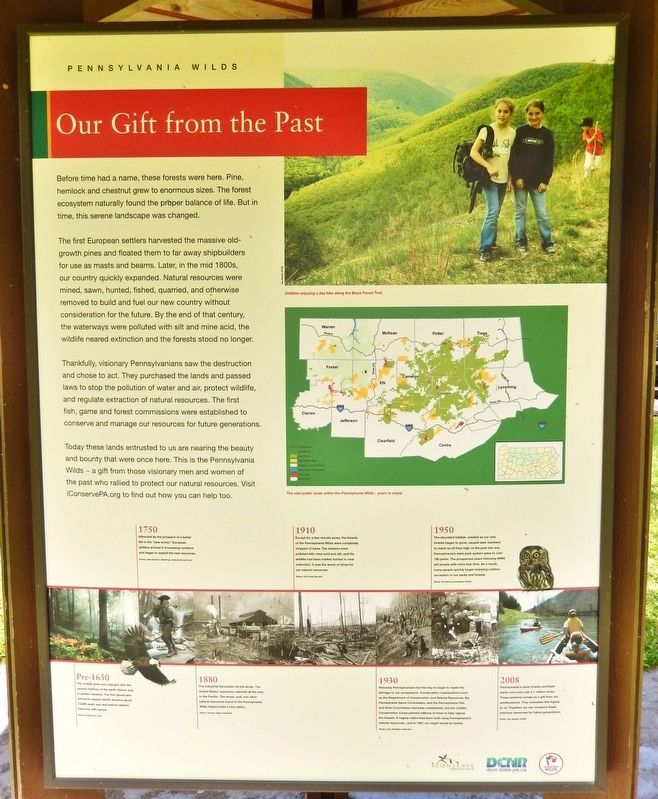
Before time had a name, these forests were here. Pine, hemlock and chestnut grew to enormous sizes. The forest ecosystem naturally found the proper balance of life. But in time, this serene landscape was changed.
The first European settlers harvested the massive old-growth pines and floated them to far away shipbuilders for use as masts and beams. Later, in the mid 1800s, our country quickly expanded. Natural resources were mined, sawn, hunted, fished, quarried, and otherwise removed to build and fuel our new country without consideration for the future. By the end of that century, the waterways were polluted with silt and mine acid, the wildlife neared extinction and the forests stood no longer.
Thankfully, visionary Pennsylvanians saw the destruction and chose to act. They purchased the lands and passed laws to stop the pollution of water and air, protect wildlife, and regulate extraction of natural resources. The first fish, game and forest commissions were established to conserve and manage our resources for future generations.
Today these lands entrusted to us are nearing the beauty and bounty that were once here.
this page online
Pre-1650
The forests grew and changed with the natural rhythms of the earth. Nature was in perfect balance. The first Americans arrived in eastern North America about 12,000 years ago and lived in relative harmony with nature.
1750
Attracted by the prospect of a better life in the “new world,” European settlers arrived in increasing numbers and began to exploit the vast resources.
1880
The Industrial Revolution hit full stride. The United States’ expansion reached all the way to the Pacific. The wood, coal, and other natural resources found in the Pennsylvania Wilds helped built a new nation.
1910
Except for a few remote acres, the forests of the Pennsylvania Wilds were completely stripped of trees. The streams were polluted with mine acid and silt, and the wildlife had been market hunted to near extinction. It was the worst of times for our natural resources.
1930
Visionary Pennsylvanians led the way to begin to repair the damage to our ecosystems. Conservation
Photographed by Cosmos Mariner, May 17, 2022
2. Our Gift from the Past Marker
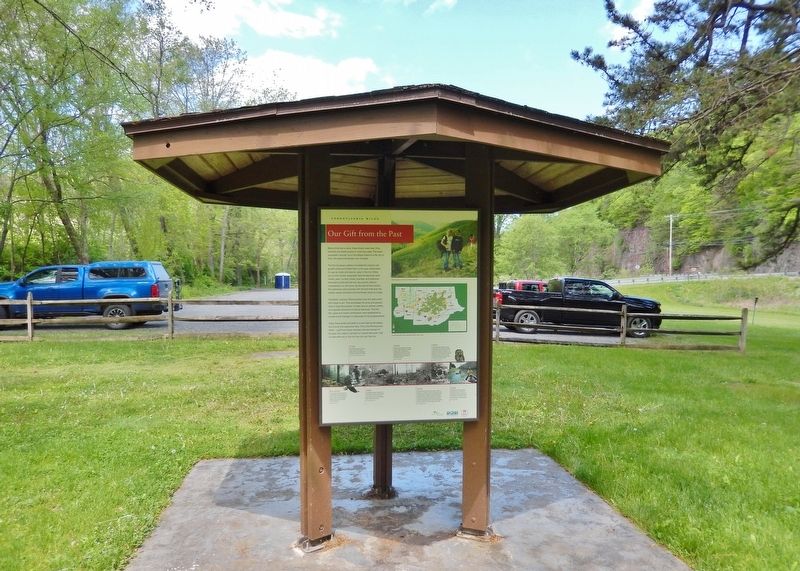
The Pine Creek Rail Trail Whitetail Trailhead parking lot is in the background.
1950
The abundant habitat, created as our new forests began to grow, caused deer numbers to reach an all time high. In the post war era, Pennsylvania’s state park system grew to over 100 parks. The prosperous years following WWII left people with more free time. As a result, many people quickly began enjoying outdoor recreation in our parks and forests.
2008
Pennsylvania’s state forests and state parks now hold over 2.1 million acres. These systems remain as a gift from our predecessors. They entrusted this legacy to us. Together, we can conserve these precious resources for future generations.
[photo captions]
• Children enjoying a day hike along the Black Forest Trail.
• The vast public lands within the Pennsylvania Wilds — yours to enjoy!
Erected by Conserve Pennsylvania, Pennsylvania Department of Conservation and Natural Resources, and Pennsylvania Wilds.
Topics and series. This historical marker is listed in these topic lists: Environment • Industry & Commerce • Parks & Recreational Areas • Settlements & Settlers. In addition, it is included in the Civilian Conservation Corps (CCC) series list.
Location. 41° 13.269′ N, 77° 19.166′ W. Marker is near Jersey Shore, Pennsylvania, in Lycoming County. It is in Watson Township. It can be reached from Pennsylvania Route 44 0.1 miles north of Furnace Run Road, on the left when traveling north. The marker is in the interpretive kiosk on the southeast side of the Pine Creek Rail Trail Whitetail Trailhead parking lot. Touch for map. Marker is in this post office area: Jersey Shore PA 17740, United States of America. Touch for directions.

Regionally, this marker is in the Pennsylvania Wilds and in the Susquehanna Valley. It is also in the American Northeast, in the Mid-Atlantic, in Appalachia, and specifically in Northern Appalachia. Globally, it is in North America, the Western Hemisphere, the Western World, and the Anglosphere. Historically, it finds itself in what was once the Haudenosaunee (Iroquois) Confederacy and also one of the original Thirteen Colonies.
Other nearby markers. At least 8 other markers are within 3 miles of this marker, measured as the crow flies: Pine Creek's Path Through History (here, next to this marker); Glacier to Gorge (here, next to this marker); Tiadaghton Elm (approx. 2.1 miles away); Fair Play in the Wild West (approx. 2.4 miles away); Pine Creek Valley — A Story of Transformations (approx. 2.4 miles away); Discover the Lumber Heritage Region (approx. 2.4 miles away); In the Beginning (approx. 2.4 miles away); Altered States (approx. 2.4 miles away). Touch for a list and map of all markers in Jersey Shore.
Also see . . . About the Pennsylvania Wilds.
Excerpt: The Pennsylvania Wilds covers approximately 25% of the state’s land acreage in north central Pennsylvania, yet just 4% of the population calls it home. Once the former lumber capital of the world, the region is home to more than 2 million acres of public land, 50 state game lands, 29 state parks, 8 state forests, 2 National Wild & Scenic Rivers, abundant wildlife, hundreds of miles of land and water trails, some of the darkest skies in the country, and the largest elk herd in the northeast.(Submitted on July 2, 2026, by Cosmos Mariner of Cape Canaveral, Florida.)
Credits. This page was last revised on July 2, 2026. It was originally submitted on July 1, 2026, by Cosmos Mariner of Cape Canaveral, Florida. This page has been viewed 13 times since then. Photos: 1, 2. submitted on July 2, 2026, by Cosmos Mariner of Cape Canaveral, Florida.
