Huisduinen in Den Helder, North Holland, Netherlands — Northwestern Europe
Vuurtoren de Lange Jaap
⎯⎯⎯
Lange Jaap Lighthouse
Photographed by Andrew Ruppenstein, June 2, 2026
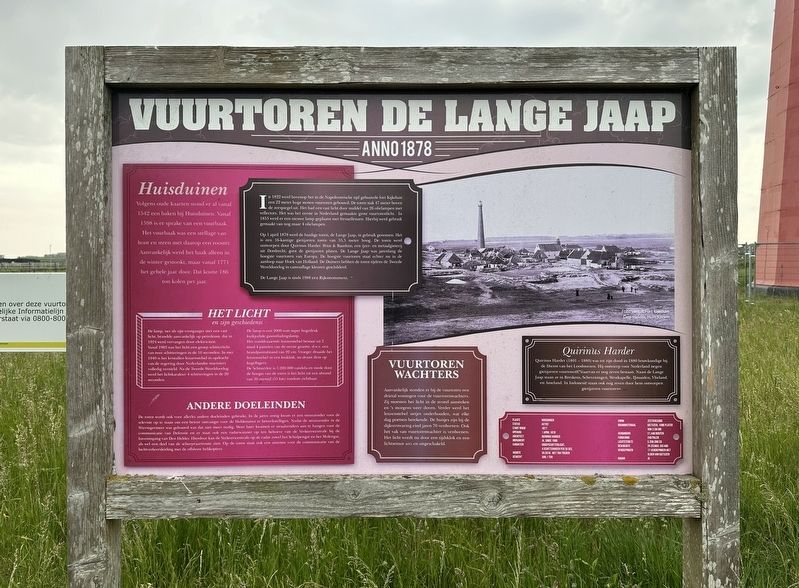
1. Vuurtoren de Lange Jaap / Lange Jaap Lighthouse Marker

Anno 1878
Huisduinen
Volgens oude kaarten stond er al vanaf 1542 een baken bij Huisduinen. Vanaf 1598 is er sprake van een vuurbaak. Het vuurbaak was een stellage van hout en steen met daarop een rooster. Aanvankelijk werd het baak alleen in de winter gestookt, maar vanaf 177 het gehele jaar door. Dat kostte 186 ton kolen per jaar.
Het Licht
en zijn geschiedenis
De lamp, net als zijn voorganger met een vast licht, brandde aanvankelijk op petroleum, dat in 1924 werd vervangen door elektriciteit.
Vanaf 1903 was het licht een groep schitterlicht van twee schitteringen in de 10 seconden. In mei 1940 is het kristallen lenzenstelsel in opdracht van de regering door Nederlandse mariniers volledig vernield. Na de Tweede Wereldoorlog werd het lichtkarakter 4 schitteringen in de 20 seconden.
De lamp is een 2000 watt super hogedruk kwikjodide gasontladingslamp. Het ronddraaiende lenzenstelsel bestaat uit 2 maal 4 panelen van de eerste grootte, d.w.z. een brandpuntafstand van 92 cm. Vroeger draaide het lenzenstelsel in een kwikbak, nu draait deze op kogellagers.
De lichtsterkte is 5.200.000 candela en mede door de hoogte van de toren is het licht tot een afstand van 30 zeemijl (55 km) rondom zichtbaar.
Andere Doelinden
De toren wordt ook voor allerlei
this page online
==========
In 1822 werd bovenop het in de Napoleontische tijd gebouwde fort Kijkduin een 22 meter hoge stenen vuurtoren gebouwd. De toren stak 47 meter boven de zeespiegel uit. Het had een vast licht door middel van 26 olielampen met reflectors. Het was het eerste in Nederland gemaakte grote vuurtorenlicht. In 1853 werd er een nieuwe lamp geplaatst met fresnellenzen. Hierbij werd gebruik gemaakt van nog maar 4 olielampen.
Op 1 april 1878 werd de huidige toren, de Lange Jaap, in gebruik genomen. Het is een 16-kantige gietijzeren toren van 55,5 meter hoog. De toren werd ontworpen door Quirinus Harder. Penn & Bauduin, een ijzer- en metaalgieterij uit
Photographed by Andrew Ruppenstein, June 2, 2026
2. Vuurtoren de Lange Jaap / Lange Jaap Lighthouse Marker
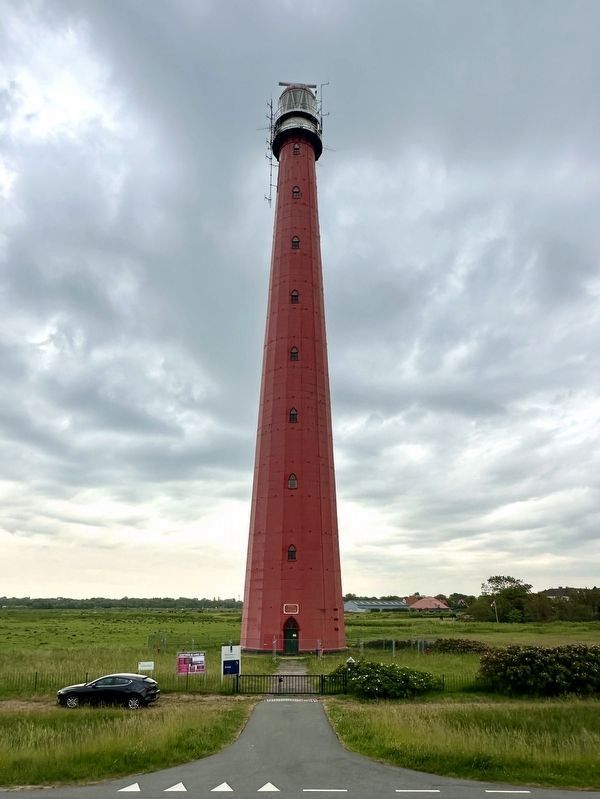
The marker is visible here just to the left of the path that leads to the lighthouse.
De Lange Jaap is sinds 1988 een Rijksmonument.
Vuurtoren Wachters
Aanvankelijk stonden er bij de vuurtoren een drietal woningen voor de vuurtorenwachters. Zij moesten het licht in de avond aansteken en 's morgens weer doven. Verder werd het lenzenstelsel netjes onderhouden, wat elke dag poetsen betekende. De huisjes zijn bij de dijkverzwaring eind jaren 70 verdwenen. Ook het vak van vuurtorenwachter is verdwenen. Het licht wordt nu door een tijdsklok en een lichtsensor aan en uitgeschakeld.
Quirinus Harder
Quirinus Harder (1801-1880) was tot zijn dood in 1880 bouwkundige bij de Dienst van het Loodswezen. Hij ontwierp voor Nederland negen gietijzeren vuurtorens, waarvan er nog zeven bestaan. Naast de Lange Jaap staan ze in Breskens, Scheveningen, Westkapelle, IJmuiden, Vlieland, en Ameland. In Indonesië staan ook nog zeven door hem ontworpen gietijzeren vuurtorens.
==========
Plaats Huisduinen · Status Actief · Start bouw 1877 · Opening 1 april 1878 · Architect Quirinus Harder · Monument ja, sinds 1988 · Karakter
Photographed by Andrew Ruppenstein, June 2, 2026
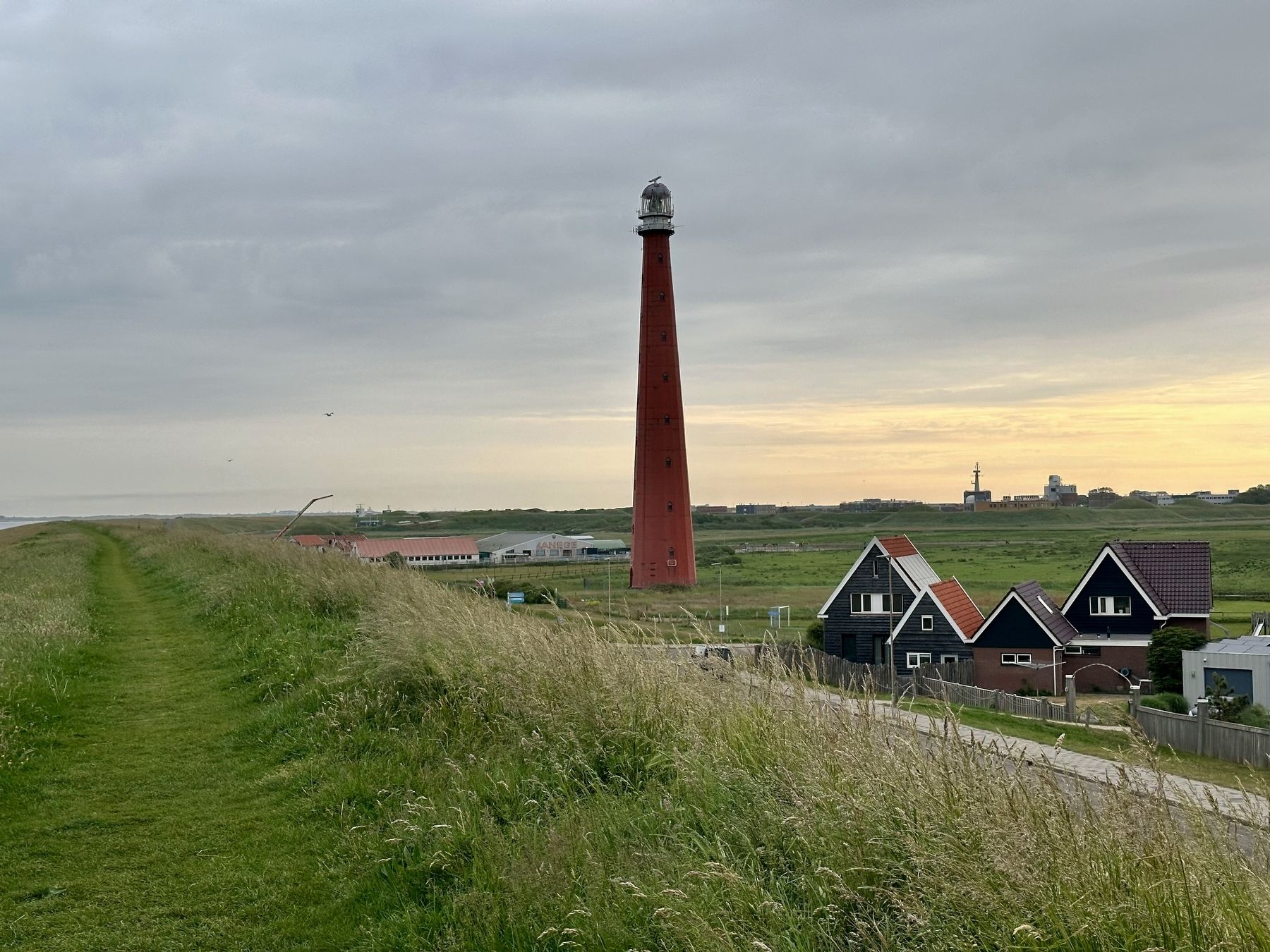
3. Vuurtoren de Lange Jaap / Lange Jaap Lighthouse
(English translation:)
Lange Jaap Lighthouse
Anno 1878
Huisduinen
According to old maps, a beacon stood at Huisduinen as early as 1542. Records mention a fire beacon there from 1598 onwards. This beacon consisted of a wooden and stone structure topped with a grate. Initially, the beacon was lit only during the winter, but from 1777 onwards, it was operated year-round. This required 186 tonnes of coal annually.
The Light
and its history
The light—like its predecessor, which emitted a steady beam—initially ran on kerosene; this was replaced by electricity in 1924.
From 1903 onwards, the light displayed a group-flashing characteristic: two flashes every 10 seconds. In May 1940, the crystal lens system was completely destroyed by Dutch marines on government orders. After the Second World War, the light characteristic was changed to four flashes every 20 seconds.
The light source is a 2,000-watt super-high-pressure mercury-iodide gas-discharge lamp. The rotating lens assembly consists of two sets of four first-order panels—meaning a focal length of 92 cm. While the lens assembly formerly rotated in a mercury bath, it now turns on ball bearings.
The luminous intensity is 5,200,000 candela, and—partly due to the height of the tower—the light is visible from a distance of 30 nautical miles (55 km) in all directions.
Other Purposes
The tower is also used for a variety of other purposes. In the 1960s, a television relay transmitter was installed to improve reception for the residents of Den Helder; this became unnecessary once a relay transmitter was built in the Wieringermeer. Later, microwave transmitters for military communications were added, and a radar scanner was installed to serve the traffic control center at the entrance to the port of Den Helder. This allows the traffic control center to monitor the Schulpengat and Molengat channels, as well as a section of the shipping route, via radar. The tower also houses an antenna used for air traffic control communications with offshore helicopters.
==========
In 1822, a 22-meter-high stone lighthouse was built atop Fort Kijkduin, a fortification originally constructed during the Napoleonic era. The tower rose 47 meters above sea level. It featured a fixed light produced by 26 oil lamps with reflectors—the first large lighthouse light manufactured in the Netherlands. In 1853, a new lamp assembly featuring Fresnel lenses was installed, requiring only four oil lamps.
The current tower, known as 'Lange Jaap', was put into service on April 1, 1878. It is a 16-sided cast-iron tower standing 55.5 meters tall. The tower was designed by Quirinus Harder, and the cast-iron plates were cast by Penn & Bauduin, an iron and metal foundry based in Dordrecht. For many years, Lange Jaap was the tallest lighthouse in Europe; however, the tallest lighthouse is now located on the approach to Hoek van Holland. During the Second World War, the Germans painted the tower in camouflage colors.
Lange Jaap has been a listed national monument since 1988.
Lighthouse Keepers
Initially, there were three houses for the lighthouse keepers near the lighthouse. They were responsible for lighting the lamp in the evening and extinguishing it in the morning. They also maintained the lens system, a task that required daily polishing. The cottages were demolished during the dike reinforcement project in the late 1970s. The profession of lighthouse keeper has also disappeared; the light is now switched on and off automatically by a timer and a light sensor.
Quirinus Harder
Quirinus Harder (1801–1880) was an architect for the Pilotage Service until his death in 1880. He designed nine cast-iron lighthouses for the Netherlands, seven of which are still standing. In addition to the "Lange Jaap," these are located in Breskens, Scheveningen, Westkapelle, IJmuiden, Vlieland, and Ameland. Seven cast-iron lighthouses designed by him also still stand in Indonesia.
Location Huisduinen · Status Active · Construction started 1877 · Opened 1 April 1878 · Architect Quirinus Harder · Monument status Yes (since 1988) · Characteristic Group flashing light, 4 flashes every 20 sec. · Height 55.50 m (284 steps) · Weight 506.1 tonnes Shape Sixteen-sided · Construction material Cast iron, 1,088 plates (3 cm thick) · Fastenings 21,446 bolts · Foundation 249 piles · Luminous intensity 5,200,000 cd · Range 30 nautical miles (55 km) · Floors 17 levels with cast-iron flooring · Radar Yes
Topics and series. This historical marker is listed in these topic lists: Architecture • Man-Made Features • Waterways & Vessels. In addition, it is included in the Lighthouses series list. A significant historical year for this entry is 1542.
Location. 52° 57.339′ N, 4° 43.566′ E. Marker is in Huisduinen, Noord-Holland (North Holland), in Den Helder. It is on Zeeweg, on the right when traveling north. Touch for map. Marker is at or near this postal address: Zeeweg 5, Huisduinen, Noord-Holland 1789 AC, Netherlands. Touch for directions.

Regionally, it is in Europe, the European Union, Atlantic Europe, the Benelux Low Countries, the Schengen Area, Western Europe, and the Western World. Historically, it finds itself in what was once the Holy Roman Empire.
Other nearby markers. At least 8 other markers are within walking distance of this marker: Monument ‘De Walvis’ / Huisduinen Whaling Memorial (approx. 0.3 kilometers away); Slag bij Kijkduin (21 augustus 1673) / Battle of Texel (August 21, 1673) (approx. 0.3 kilometers away); Nooit meer zoals het was / Never the same again! / Es wird nie wieder wie es war (approx. 0.4 kilometers away); De Atlantikwall / Der Atlantikwall / The Atlantikwall (approx. 0.4 kilometers away); Fort Kijkduin (approx. 0.4 kilometers away); Monument Joodse Begraafplaats / Jewish Cemetery Memorial (approx. 0.9 kilometers away); Algemene begraafplaats Den Helder / Den Helder General Cemetery (approx. 0.9 kilometers away); Waddenzee-graftekens / Waddenzee Gravestones (approx. 0.9 kilometers away). Touch for a list and map of all markers in Huisduinen.
Also see . . . Lange Jaap. Overview:
Lange Jaap ("Tall Jake"), also known as Kijkduin Light or Den Helder Light, is an active lighthouse near Fort Kijkduin in Huisduinen, Netherlands. At a height of 63.5 metres (208.2 ft) it is one of the tallest "traditional lighthouses" in the world. For almost a century, from 1878 to 1974, it was the tallest lighthouse in the Netherlands, until the construction of the Maasvlakte Light. According to The Lighthouse Directory it is the tallest non-skeletal cast-iron lighthouse in the world.(Submitted on July 3, 2026.)
Credits. This page was last revised on July 3, 2026. It was originally submitted on July 2, 2026, by Andrew Ruppenstein of Lamorinda, California. This page has been viewed 31 times since then. Photos: 1, 2, 3. submitted on July 2, 2026, by Andrew Ruppenstein of Lamorinda, California.
