Downtown in Saint Paul in Ramsey County, Minnesota — The American Midwest (Upper Plains)
Larry Cohen Held the Highest Office in All Three Branches of Government in Saint Paul
Photographed by McGhiever, June 18, 2026
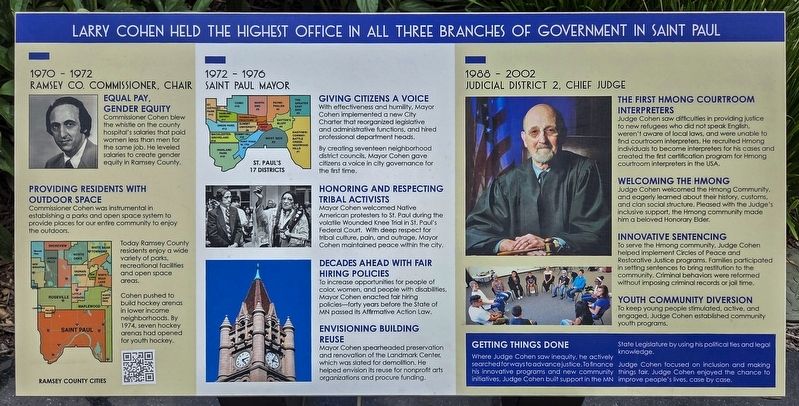
1. Larry Cohen Held the Highest Office in All Three Branches of Government in Saint Paul Marker
1970 - 1972
Ramsey Co. Commissioner, Chair
Equal Pay, Gender Equity
Commissioner Cohen blew the whistle on the county hospital's salaries that paid women less than men for the same job. He leveled salaries to create gender equity in Ramsey County.
Providing Residents with Outdoor Space
Commissioner Cohen was instrumental in establishing a parks and open space system to provide places for our entire community to enjoy the outdoors.
Today Ramsey County residents enjoy a wide variety of parks, recreational facilities and open space areas.
Cohen pushed to build hockey arenas in lower income neighborhoods. By 1974, seven hockey arenas had opened for youth hockey.
1972 - 1976
Saint Paul Mayor
Giving Citizens a Voice
With effectiveness and humility, Mayor Cohen implemented a new City Charter that reorganized legislative and administrative functions, and hired professional department heads.
By creating seventeen neighborhood district councils, Mayor Cohen gave citizens a voice in city governance for the first time.
Honoring and Respecting Tribal Activists
Mayor Cohen welcomed Native American protesters
this page online
Decades Ahead with Fair Hiring Policies
To increase opportunities for people of color, women, and people with disabilities, Mayor Cohen enacted fair hiring policies—forty years before the State of MN passed its Affirmative Action Law.
Envisioning Building Reuse
Mayor Cohen spearheaded preservation and renovation of the Landmark Center, which was slated for demolition. He helped envision its reuse for nonprofit arts organizations and procure funding.
1988 - 2002
Judicial District 2, Chief Judge
The First Hmong Courtroom Interpreters
Judge Cohen saw difficulties in providing justice to new refugees who did not speak English, weren't aware of local laws, and were unable to find courtroom interpreters. He recruited Hmong individuals to become interpreters for his cases and created the first certification program for Hmong courtroom interpreters in the USA.
Welcoming the Hmong
Judge Cohen welcomed the Hmong Community, and eagerly learned about
Photographed by McGhiever, June 18, 2026
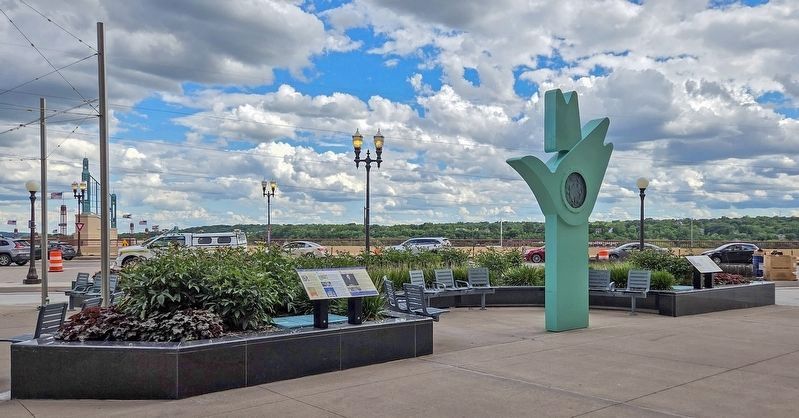
2. Larry Cohen Marker (left) on the plaza at the northwest corner of Kellogg and Wabasha
Innovative Sentencing
To serve the Hmong community, Judge Cohen helped implement Circles of Peace and Restorative Justice programs. Families participated in setting sentences to bring restitution to the community. Criminal behaviors were reformed without imposing criminal records or jail time.
Youth Community Diversion
To keep young people stimulated, active, and engaged, Judge Cohen established community youth programs.
Getting Things Done
Where Judge Cohen saw inequity, he actively searched for ways to advance justice. To finance his innovative programs and new community initiatives, Judge Cohen built support in the MN State Legislature by using his political ties and legal knowledge.
Judge Cohen focused on inclusion and making things fair. Judge Cohen enjoyed the chance to improve people's lives, case by case.
Erected by Ramsey County.
Topics. This historical marker is listed in these topic lists: Asian Americans • Civil Rights • Government & Politics • Law Enforcement. A significant historical year for this entry is 1970.
Location. 44° 56.644′ N, 93° 5.607′ W. Marker is in Saint Paul, Minnesota, in Ramsey County. It is in Downtown. It is at the intersection of Kellogg Boulevard and Wabasha Street N., on the right when traveling west on Kellogg Boulevard. The marker is on the plaza in front of Saint Paul City Hall and Ramsey County Courthouse. Touch for map. Marker is at or near this postal address: 15 W Kellogg Boulevard, Saint Paul MN 55102, United States of America. Touch for directions.

Regionally, this marker is in the Twin Cities Metropolitan Area. It is also in the American Midwest, in the Corn Belt, and in the Great River Road Region. Globally, it is in North America, the Western Hemisphere, the Western World, and the Anglosphere. Historically, it finds itself in what was once Rupert’s Land, the territory of the Mississippian Culture, and the Louisiana Purchase.
Other nearby markers. At least 8 other markers are within walking distance of this marker: Larry Cohen's Path to Social Justice (a few steps from this marker); Market Street Methodist Episcopal Church (about 800 feet away, measured in a direct line); Hans O. Nyman Energy Center (approx. 0.2 miles away); The James J. Hill Reference Library (approx. 0.2 miles away); Legacy of Leadership (approx. 0.2 miles away); History of Saint Paul (approx. 0.2 miles away); George Latimer Central Library (approx. 0.2 miles away); Rice Park (approx. 0.2 miles away). Touch for a list and map of all markers in Saint Paul.
Also see . . . Cohen Recognition Project (QR code on marker). (Submitted on July 2, 2026, by McGhiever of Minneapolis, Minnesota.)
Credits. This page was last revised on July 29, 2026. It was originally submitted on July 2, 2026, by McGhiever of Minneapolis, Minnesota. This page has been viewed 12 times since then. Photos: 1, 2. submitted on July 2, 2026, by McGhiever of Minneapolis, Minnesota.
