Critz in Patrick County, Virginia — The American South (Mid-Atlantic)
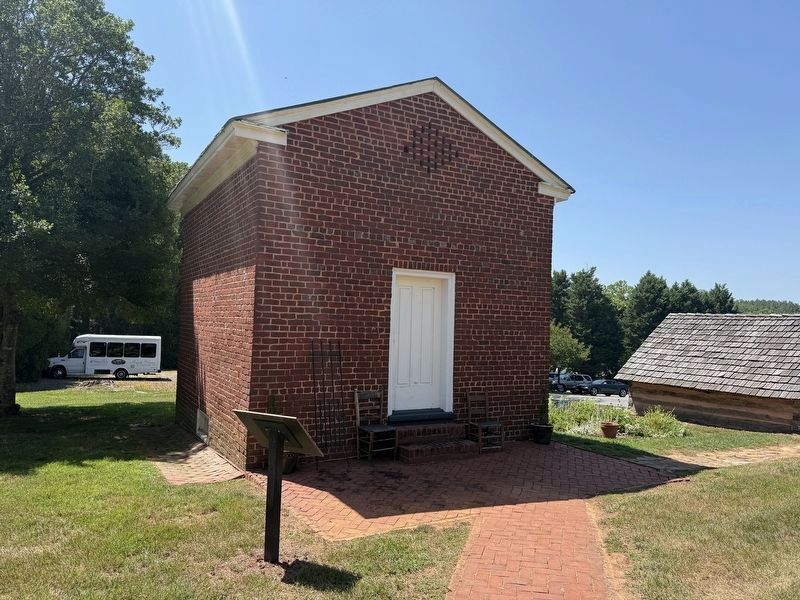
Plantation Kitchen
Reynolds Homestead

Cooking in a plantation kitchen was daunting and required constant attention and care. The basic equipment needed for hearth cooking included a swinging crane, pot hangers such as S-hooks, trammels, or ratchets, a minimum of two Dutch ovens, trivets, an iron pot, long-handled tools such as spoons, ladles, a meat fork and a spatula, and a poker, shovel or tongs for handling the fire. Successful fireplace cooking is dependent on the quality of the fire in the hearth. To provide optimal heat, fires were lit two to three hours before cooking began.
Cooking spaces on the hearth are similar to the burners of a stove. The back corner of the hearth could be used to bake a pie using a Dutch oven, while a ham could be simmering in the kettle on a crane. There could also be a brace of ducks roasting in a reflector oven, while other side items are simmering, sautéing, frying or being fricasseed in footed kettles, posnets (cast iron skillets with stubby legs), and spiders (cast iron skillets with long legs) over the coals in the front part of the hearth.
Kitchen gardens provided crops of corn, beans and squash, and culinary
this page online
A portrait of Kitty Reynolds hangs in the kitchen. Kitty was responsible for the care of Hardin and Nancy Reynolds' children, and is credited with saving Hardin from a raging bull. However, she should also be remembered as a "mother" of civil rights. Two of Kitty's children, Burwell and Lee, were involved in a scuffle resulting in the death of a white man, Aaron Shewell. In April 1878, the two brothers were tried separately by all-white juries and Burwell was found guilty of first degree murder, while Lee received an 18-year sentence for second-degree murder. The attorneys for the brothers, Andrew M. Lybrook and William Martin, had requested the jury be one third black. They petitioned U.S. District Judge Alexander Rives to move the cases to federal court on the grounds the state court denied the defendants' rights by excluding citizens of African race on the juries

Ex parte Virginia was the first case which upheld the federal government's right to enforce Civil Rights legislation on the states. As a result, the brothers' cases were reviewed. In a second trial, Burwell Reynolds received a sentence of five years for manslaughter for the killing of Aaron Skelton, and Patrick County released Lee Reynolds without prosecuting him. Judge Rives called two grand juries (including black men) that eventually indicted judges from across Western Virginia for violating the Civil Rights Act of 1875 by excluding blacks from juries.
[Caption:]
The indentions in the hearth of the Reynolds plantation kitchen are the result of years of knives being sharpened on the bricks.
Erected by Virginia
Topics. This historical marker is listed in these topic lists: African Americans • Civil Rights • Indigenous Peoples and Communities • Settlements & Settlers. A significant historical month for this entry is April 1878.
Location. 36° 38.609′ N, 80° 8.93′ W. Marker is in Critz, Virginia, in Patrick County. It is on Homestead Lane half a mile north of Abram Penn Highway (Virginia Route 626), on the right when traveling north. Touch for map. Marker is at or near this postal address: 474 Webbs Ml Ln, Critz VA 24082, United States of America. Touch for directions.

Regionally, this marker is in Southern Virginia and in the Blue Ridge Highlands. It is also in the American South, specifically in the Upper South, in Appalachia, and specifically in Southern Appalachia. Globally, it is in North America, the Western Hemisphere, the Western World, and the Anglosphere. Historically, it finds itself in what was once the territory of the Mississippian Culture, one of the original Thirteen Colonies, one of the Confederate States of America, and the Antebellum South.
Other nearby markers. At least 8 other markers are within 5 miles of this marker, measured as the crow flies: Creamery & Ice House (here, next to this marker); Rock Spring Plantation (a few steps from this marker); Historic Home (a few steps from this marker); The Reynolds Homestead (within shouting distance of this marker); Family Cemetery (within shouting distance of this marker); Tobacco Barn (about 400 feet away, measured in a direct line); a different marker also named Reynolds Homestead (approx. 3.1 miles away); Col. Abram Penn (approx. 4.2 miles away). Touch for a list and map of all markers in Critz.
Another marker is no longer nearby. Colonel Abram Penn (was approx. 4.2 miles away but has been replaced with another marker now near it).
Credits. This page was last revised on July 16, 2026. It was originally submitted on July 6, 2026, by Devry Becker Jones of Washington, District of Columbia. This page has been viewed 11 times since then. Photos: 1, 2, 3. submitted on July 6, 2026, by Devry Becker Jones of Washington, District of Columbia.
