Manassas, Virginia — The American South (Mid-Atlantic)
Jackson's Raid
1862
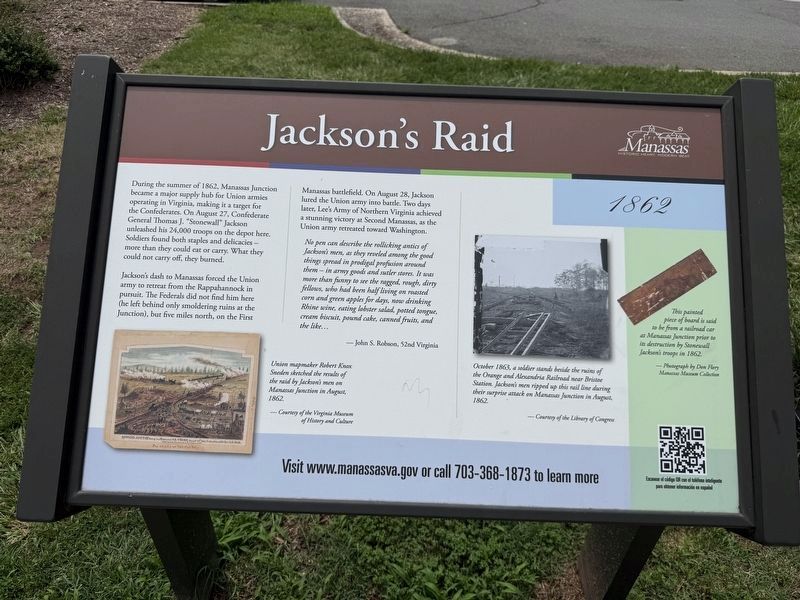
During the summer of 1862, Manassas Junction became a major supply hub for Union armies operating in Virginia, making it a target for the Confederates. On August 27, Confederate General Thomas J. "Stonewall" Jackson unleashed his 24,000 troops on the depot here. Soldiers found both staples and delicacies — more than they could eat or carry. What they could not carry off, they burned.
Jackson's dash to Manassas forced the Union army to retreat from the Rappahannock in pursuit. The Federals did not find him here (he left behind only smoldering ruins at the Junction), but five miles north, on the First Manassas battlefield. On August 28, Jackson lured the Union army into battle. Two days later, Lee's Army of Northern Virginia achieeed a stunning victoyr at Second manassas, as the Union army retreated toward Washington.
No pen can describe the rollicking antics of Jackson's men, as they reveled among the good things spread in prodigal profusion around them — in army goods and sutler stores. It was more than funny to see the ragged, rough, dirty fellows, who had been half living on roasted corn and green apples for days, now drinking Rhine whine, eating lobster salad, potted tongue, cream biscuit, pound cake, canned fruits, and the like…
—John S. Robson, 52nd Virginia
Click or scan to see
this page online
[Captions:]
Union mapmaker Robert Knox Sneden sketched the results of the raid by Jackson's men on Manassas Junction in August, 1862.
— Courtesy of the Virginia Museum of History and Culture
October 1863, a soldier stands beside the ruins of the Orange and Alexandria Railroad near Bristoe Station. Jackson's men ripped up this rail line during their surprise attack on Manassas Junction in August, 1862.
— Courtesy of the Library of Congress
This painted piece of board is said to be from a railroad car at Manassas Junction prior to its destruction by Stonewall Jackson's troops in 1862.
— Photograph by Don Flory, Manassas Museum Collection
Erected by City of Manassas, Virginia.
Topics and series. This historical marker is listed in these topic lists: Railroads & Streetcars • War, US Civil. In addition, it is included in the Orange and Alexandria Railroad, and the Virginia, City of Manassas series lists. A significant historical date for this entry is August 27, 1862.
Location. 38° 44.987′ N, 77° 28.339′ W. Marker is in Manassas, Virginia. It is on Battle Street north of Prince William Street, on the

Regionally, this marker is in the Washington Metropolitan Area and in Northern Virginia. It is also in the American South, specifically in the Upper South, and in the Mid-Atlantic. Globally, it is in North America, the Western Hemisphere, the Western World, and the Anglosphere. Historically, it finds itself in what was once the territory of the Mississippian Culture, one of the original Thirteen Colonies, one of the Confederate States of America, and the Antebellum South.
Other nearby markers. At least 8 other markers are within walking distance of this marker: Occupation or Liberation (within shouting distance of this marker); Wartime Manassas (within shouting distance of this marker); a different marker also named Wartime Manassas (within shouting distance of this marker); Liberty Street / First African-American School (within shouting distance of this marker); a different marker also named Wartime Manassas (about 300 feet away); A Railroad Town (about 300 feet away); Burning of Manassas (about 300 feet away); a different marker also named Wartime Manassas (about 300 feet away). Touch for a list and map of all markers in Manassas.
Other markers no longer nearby. Site of Manassas Junction (was within shouting distance of this marker but has been permanently removed); a different marker also named Wartime Manassas (was within shouting distance of this marker but has been confirmed missing); a different marker also named Jackson's Raid (was about 300 feet away, measured in a direct line but has been replaced with another marker now near it); Manassas 1905 - The Great Fire (was about 300 feet away but has been permanently removed).
Credits. This page was last revised on July 11, 2026. It was originally submitted on July 11, 2026, by Devry Becker Jones of Washington, District of Columbia. This page has been viewed 23 times since then. Photos: 1, 2. submitted on July 11, 2026, by Devry Becker Jones of Washington, District of Columbia.
