
Manassas, Virginia — The American South (Mid-Atlantic)
A New Brown School
1928
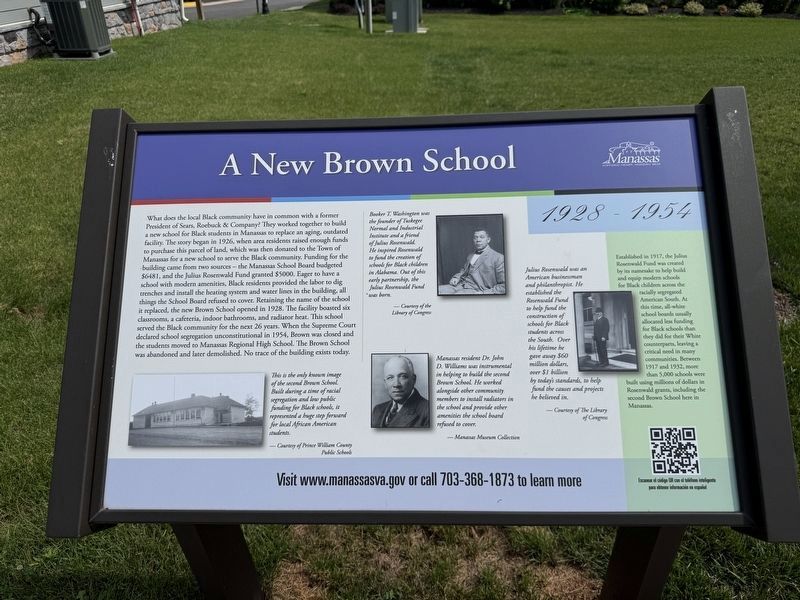
What does the local Black community have in common with a former President of Sears, Roebuck & Company? They worked together to build a new school for Black students in Manassas to replace an aging, outdated facility. The story began in 1926, when area residents raised enough funds to purchase this parcel of land, which was then donated to the Town of Manassas for a new school to serve the Black community. Funding for the building came from two sources — the Manassas School Board budgeted $6481, and the Julius Rosenwald Fund granted $5000. Eager to have a school with modern amenities, Black residents provided the labor to dig trenches and install the heating system and water lines in the building, all things the School Board refused to cover. Retaining the name of the school it replaced, the new Brown School opened in 1928. The facility boasted six classrooms, a cafeteria, indoor bathrooms, and radiator heat. This school served the Black community for the next 26 years. When the Supreme Court declared school segregation unconstitutional in 1954, Brown was closed and the students moved to Manassas Regional High School.
this page online
[Sidebar:]
Established in 1917, the Julius Rosenwald Fund was created by its namesake to help build and equip modern schools for Black children across the racially segregated American South. At this time, all-white school boards usually allocated less Black schools than they did for their White counterparts, leaving a critical need in many communities. Between 1917 and 1932, more than 5,000 schools were built using millions of dollars in Rosenwald grants, including the second Brown School here in Manassas.
[Captions:]
This is the only known image of the second Brown School. Built during a time of racial segregation and low public funding for Black schools, it represented a huge step forward for local African American students.
— Courtesy of Prince William County Public Schools
Booker T. Washington was the founder of Tuskegee Normal and Industrial Institute and a friend of Julius Rosenwald. He inspired Rosenwald to fund the creation of schools for Black children in Alabama. Out of his early partnership, the Julius Rosenwald Fund was born.
— Courtesy of the Library of Congress
Manassas resident Dr. John D. Williams was instrumental in helping to build the second Brown School. He worked along side other community members to install radiators in the school and provide other amenities the school board refused to cover.
— Manassas Museum Collection
Julius Rosenwald was an American businessman and philanthropist. He established the Rosenwald Fund to help fund the construction of schools for Black students across the South. Over his lifetime he gave away $60 million dollars, over $1 billion by today's standards, to help fund the causes and projects he believed in.
— Courtesy of The Library of Congress
Erected by City
Topics and series. This historical marker is listed in these topic lists: African Americans • Civil Rights • Education. In addition, it is included in the Rosenwald Schools, and the Virginia, City of Manassas series lists. A significant historical year for this entry is 1926.
Location. 38° 44.898′ N, 77° 28.944′ W. Marker is in Manassas, Virginia. It is on Prince William Street east of Jefferson Street, on the right when traveling east. Touch for map. Marker is at or near this postal address: 9479 Prince William St, Manassas VA 20110, United States of America. Touch for directions.

Regionally, this marker is in the Washington Metropolitan Area and in Northern Virginia. It is also in the American South, specifically in the Upper South, and in the Mid-Atlantic. Globally, it is in North America, the Western Hemisphere, the Western World, and the Anglosphere. Historically, it finds itself in what was once the territory of the Mississippian Culture, one of the original Thirteen Colonies, one of the Confederate States of America, and the Antebellum South.
Other nearby markers. At least 8 other markers are within walking distance of this marker: Confederate Cemetery (about 800 feet away, measured in a direct line); Manassas Confederate Cemetery (approx. 0.2 miles away); Jane Serepta Dean (approx. 0.3 miles away); Jennie Dean (approx. 0.3 miles away); Charter Cottage (approx. 0.3 miles away); Ruffner Public School Number 1 (approx. 0.3 miles away); a different marker also named Charter Cottage (approx. 0.3 miles away); Hackley Hall (approx. 0.3 miles away). Touch for a list and map of all markers in Manassas.
Another marker is no longer nearby. Wartime Manassas (was approx. 0.3 miles away but has been permanently removed).
Credits. This page was last revised on July 12, 2026. It was originally submitted on July 12, 2026, by Devry Becker Jones of Washington, District of Columbia. This page has been viewed 13 times since then. Photos: 1, 2. submitted on July 12, 2026, by Devry Becker Jones of Washington, District of Columbia.
