Carlton in Melbourne, Victoria, Australia — Oceania
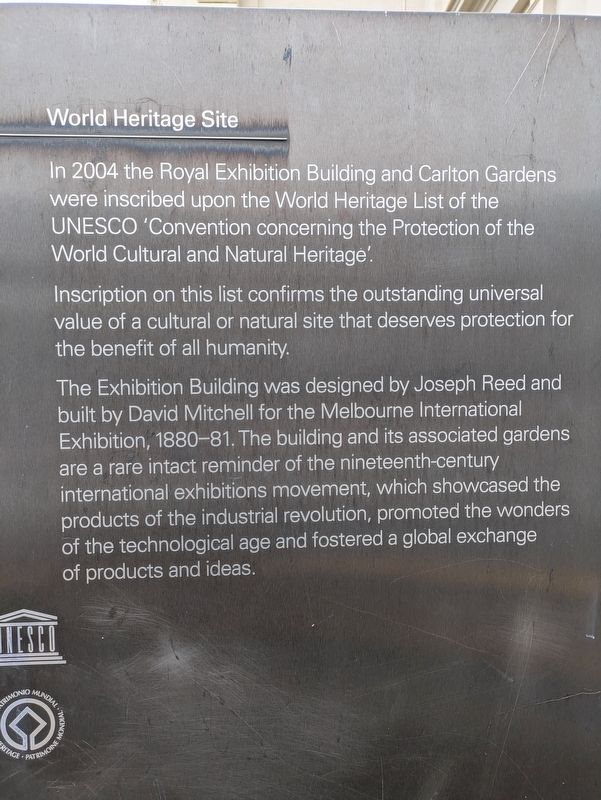
World Heritage Site
Photographed by Dean Barton-Ancliffe, June 16, 2026
1. World Heritage Site Marker
Inscription on this list confirms the outstanding universal value of a cultural or natural site that deserves protection for the benefit of all humanity.
The Exhibition Building was designed by Joseph Reed and built by David Mitchell for the Melbourne International Exhibition, 1880-81. The building and its associated gardens are a rare intact reminder of the nineteenth-century international exhibitions movement, which showcased the products of the industrial revolution, promoted the wonders of the technological age and fostered a global exchange of products and ideas.
Erected by UNESCO World Heritage.
Topics and series. This historical marker is listed in these topic lists: Architecture • Colonial Era • Industry & Commerce • Parks & Recreational Areas. In addition, it is included in the UNESCO World Heritage Sites series list. A significant historical year for this entry is 1880.
Location. 37° 48.253′ S, 144° 58.306′ E.
this page online

Regionally, it is in Oceania, in Australasia, in the Pacific Ocean, in South Pacific, on the Pacific Rim, in the Western World, and in the Anglosphere. Historically, it finds itself in what was once a British colony.
Other nearby markers. At least 8 other markers are within walking distance of this marker: Royal Exhibition Building Handover Centenary (about 90 meters away, measured in a direct line); Royal Exhibition Building Opening Centenary (about 90 meters away); Exhibition Building Great Hall (about 90 meters away); Exhibition Building receives Royal Title (about 90 meters away); Exhibition Building Foundation Stone Centenary (about 90 meters away); Royal Exhibition Building and Carlton Gardens (South of Building) (about 90 meters away); Pillar of Stone (about 120 meters away); Colonial Mutual Life Building (about 120 meters away). Touch for a list and map of all markers in Carlton.
Also see . . . Royal Exhibition Building and Carlton Gardens.
Photographed by Dean Barton-Ancliffe, June 16, 2026
2. World Heritage Site Marker
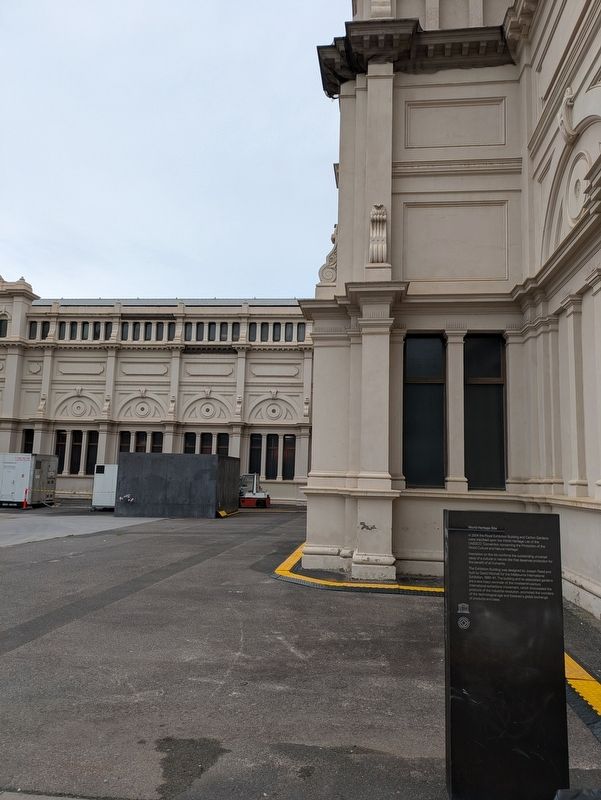
The Royal Exhibition Building and its surrounding Carlton Gardens were designed for the great international exhibitions of 1880 and 1888 in Melbourne. The building and grounds were designed by Joseph Reed. The building is constructed of brick and timber, steel and slate. It combines elements from the Byzantine, Romanesque, Lombardic and Italian Renaissance styles. The property is typical of the international exhibition movement which saw over 50 exhibitions staged between 1851 and 1915 in venues including Paris, New York, Vienna, Calcutta, Kingston (Jamaica) and Santiago (Chile). All shared a common theme and aims: to chart material and moral progress through displays of industry from all nations.(Submitted on July 12, 2026, by Dean Barton-Ancliffe of Rowville, Victoria.)
Credits. This page was last revised on July 15, 2026. It was originally submitted on July 12, 2026, by Dean Barton-Ancliffe of Rowville, Victoria. This page has been viewed 10 times since then. Photos: 1, 2. submitted on July 12, 2026, by Dean Barton-Ancliffe of Rowville, Victoria. • Andrew Ruppenstein was the editor who published this page.
