Central Business District in Melbourne, Victoria, Australia — Oceania
8 Hours Movement
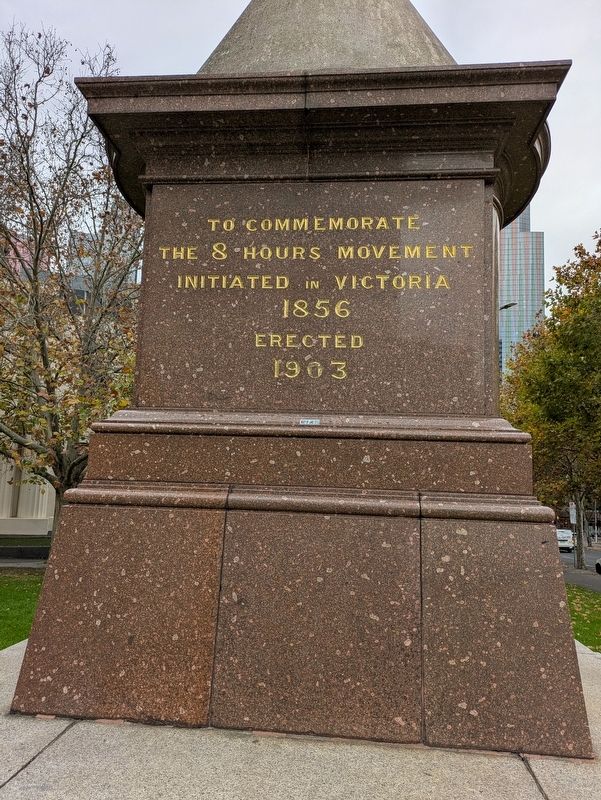
Photographed by Dean Barton-Ancliffe, June 16, 2026
1. 8 Hours Movement Marker
the 8 Hours movement
initiated in Victoria
1856
Erected
1903
Erected 1903.
Topics. This historical marker is listed in these topic lists: Colonial Era • Industry & Commerce • Labor Unions. A significant historical year for this entry is 1856.
Location. 37° 48.431′ S, 144° 57.94′ E. Marker is in Melbourne, Victoria. It is in the Central Business District. It is at the intersection of Victoria Street (Victoria Route 32) and Russell Street, on the left when traveling west on Victoria Street. Touch for map. Marker is at or near this postal address: 8 Hour Reserve Victoria Street, Melbourne VIC 3000, Australia. Touch for directions.

Regionally, it is in Oceania, in Australasia, in the Pacific Ocean, in South Pacific, on the Pacific Rim, in the Western World, and in the Anglosphere. Historically, it finds itself in what was once a British colony.
Other nearby markers. At least 8 other markers are within walking distance of this marker: Horticultural Hall (within shouting distance of this marker); Old Melbourne Gaol Trust Marker (within shouting distance of this marker); Bluestone Gaol Wall
this page online
Also see . . . Eight-hour day. National Museum Australia
On 21 April 1856 stonemasons in Melbourne downed tools and walked off the job in protest over their employers’ refusal to accept their demands for reduced working hours.(Submitted on July 12, 2026, by Dean Barton-Ancliffe of Rowville, Victoria.)
This brought the employers to the negotiating table and led to an agreement whereby stonemasons worked no more than an eight-hour day.
It was the first of a long, hard-fought series of victories that led to Australia having one of the most progressive labour environments in the world by the early 20th century.
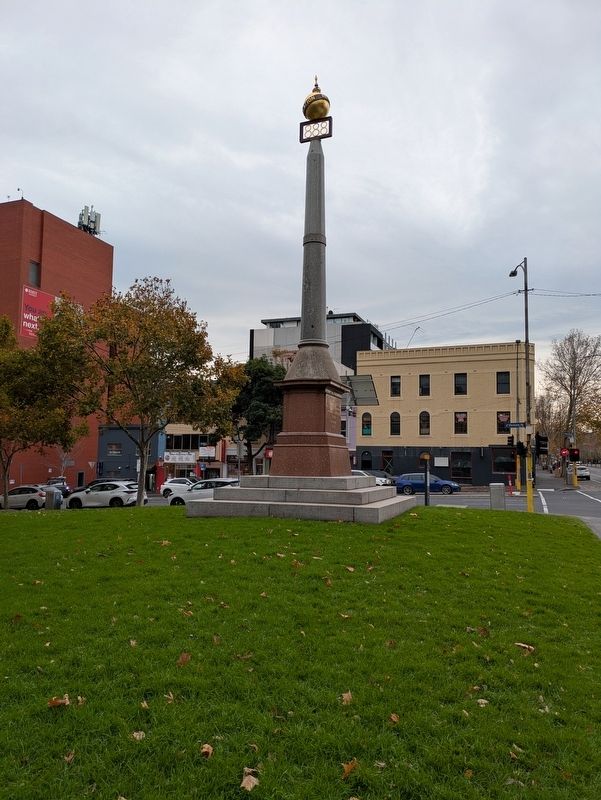
Photographed by Dean Barton-Ancliffe, June 16, 2026
2. 8 Hours Movement Marker
Credits. This page was last revised on July 15, 2026. It was originally submitted on July 12, 2026, by Dean Barton-Ancliffe of Rowville, Victoria. This page has been viewed 14 times since then. Photos: 1, 2. submitted on July 12, 2026, by Dean Barton-Ancliffe of Rowville, Victoria. • Andrew Ruppenstein was the editor who published this page.
